

In the 1980s and 1990s, radio observations at the Nobeyama Radio Observatory
were made, including 5- and 10-GHz continuum observations (Sofue Yoshiaki
1980, 1983) and CO line and polarization observations (Tatematsu Ken’ichi
1985, 1987).
X-ray observations were carried out with GINGA and ASCA by Koyama Katsuji,
Makino Nobuyoshi, and their group for typical SNRs. They found that, while the
types of original supernovae were different, the observed X-ray spectra were wholly
thermal in nature. Their spectra exhibited a multitemperature system due to shockheated gas. An example of ASCA observations made by Fujimoto Ryuichi, Tanaka
Yasuo, and others at the Institute of Space and Aeronautical Sciences (ISAS) is
illustrated in Fig. 7.35 for SNR W 49B (Fujimoto et al. 1995). Panel (a) illustrates the
contour map of W 49B in the range 0.5–1.0 KeV, where the center-filled structure is
apparent. Panel (b) shows the X-ray spectrum. Owing to the superior energy
resolution of ASCA, the number of emission lines were resolved to the highly
ionized ions of Mg, Si, S, Ar, Ca, and Fe. The coexistence of different ionization
degrees suggests the multitemperature state of the SNR. It was also noticed that radio
emissions are nonthermal in nature, indicating the existence of a sufficient magnetic
field inside SNRs regardless of their type.
7.7.4 Star-Forming Regions
A typical SFR is the Orion region where OB stars, HII regions, and dark clouds form
a complex structure of ongoing star formation.
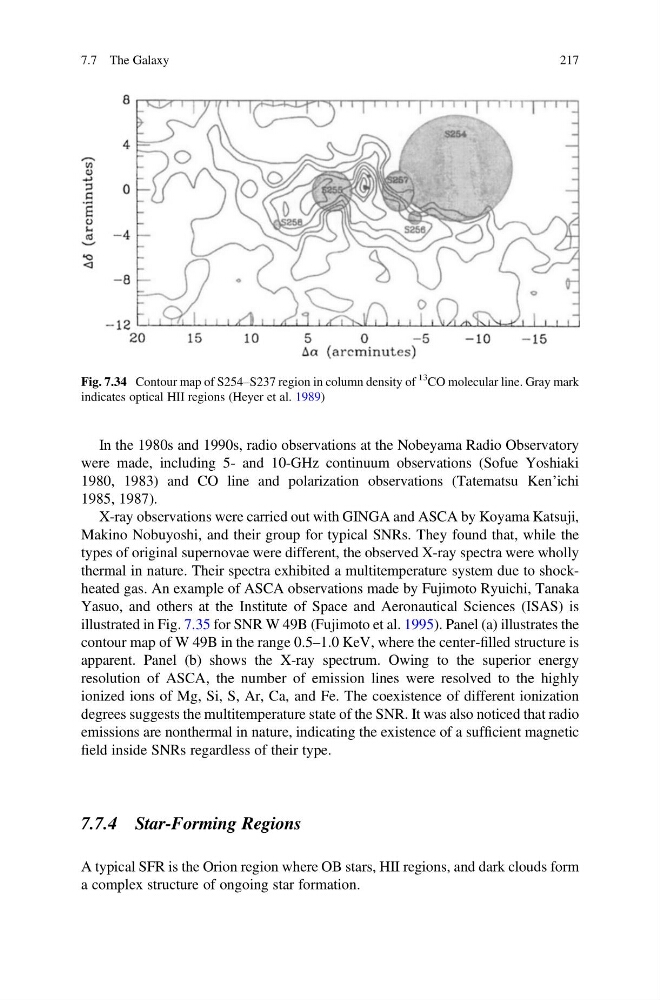
Fig. 7.34 Contour map of S254–S237 region in column density of
13
CO molecular line. Gray mark
indicates optical HII regions (Heyer et al. 1989)
7.7 The Galaxy
217
were made, including 5- and 10-GHz continuum observations (Sofue Yoshiaki
1980, 1983) and CO line and polarization observations (Tatematsu Ken’ichi
1985, 1987).
X-ray observations were carried out with GINGA and ASCA by Koyama Katsuji,
Makino Nobuyoshi, and their group for typical SNRs. They found that, while the
types of original supernovae were different, the observed X-ray spectra were wholly
thermal in nature. Their spectra exhibited a multitemperature system due to shockheated gas. An example of ASCA observations made by Fujimoto Ryuichi, Tanaka
Yasuo, and others at the Institute of Space and Aeronautical Sciences (ISAS) is
illustrated in Fig. 7.35 for SNR W 49B (Fujimoto et al. 1995). Panel (a) illustrates the
contour map of W 49B in the range 0.5–1.0 KeV, where the center-filled structure is
apparent. Panel (b) shows the X-ray spectrum. Owing to the superior energy
resolution of ASCA, the number of emission lines were resolved to the highly
ionized ions of Mg, Si, S, Ar, Ca, and Fe. The coexistence of different ionization
degrees suggests the multitemperature state of the SNR. It was also noticed that radio
emissions are nonthermal in nature, indicating the existence of a sufficient magnetic
field inside SNRs regardless of their type.
7.7.4 Star-Forming Regions
A typical SFR is the Orion region where OB stars, HII regions, and dark clouds form
a complex structure of ongoing star formation.
Fig. 7.34 Contour map of S254–S237 region in column density of
13
CO molecular line. Gray mark
indicates optical HII regions (Heyer et al. 1989)
7.7 The Galaxy
217