

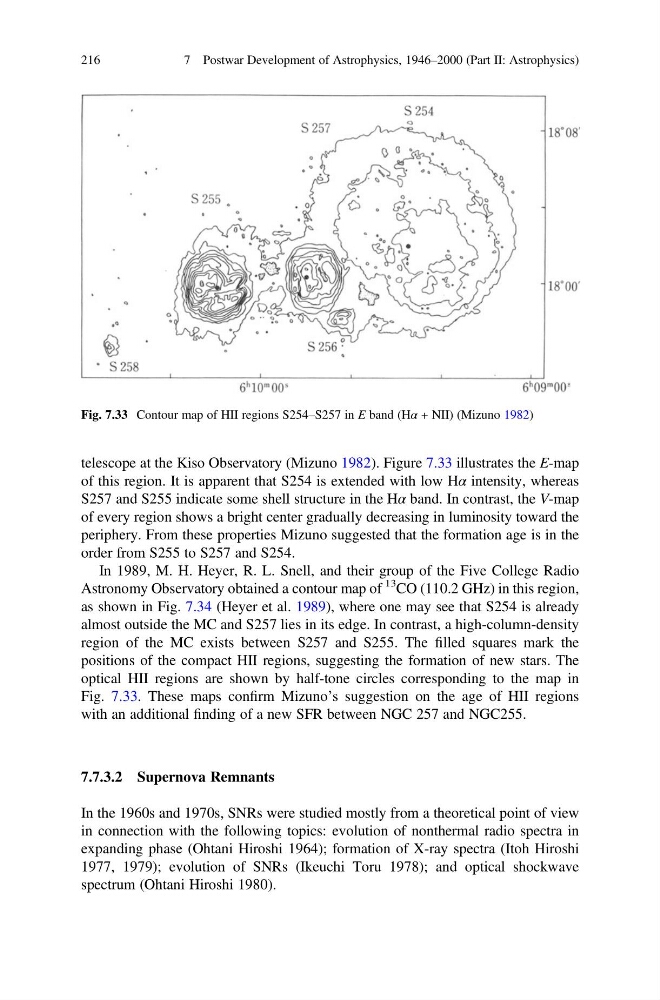
telescope at the Kiso Observatory (Mizuno 1982). Figure 7.33 illustrates the E-map
of this region. It is apparent that S254 is extended with low Hα intensity, whereas
S257 and S255 indicate some shell structure in the Hα band. In contrast, the V-map
of every region shows a bright center gradually decreasing in luminosity toward the
periphery. From these properties Mizuno suggested that the formation age is in the
order from S255 to S257 and S254.
In 1989, M. H. Heyer, R. L. Snell, and their group of the Five College Radio
Astronomy Observatory obtained a contour map of
13 CO (110.2 GHz) in this region,
as shown in Fig. 7.34 (Heyer et al. 1989), where one may see that S254 is already
almost outside the MC and S257 lies in its edge. In contrast, a high-column-density
region of the MC exists between S257 and S255. The filled squares mark the
positions of the compact HII regions, suggesting the formation of new stars. The
optical HII regions are shown by half-tone circles corresponding to the map in
Fig. 7.33. These maps confirm Mizuno’s suggestion on the age of HII regions
with an additional finding of a new SFR between NGC 257 and NGC255.
7.7.3.2 Supernova Remnants
In the 1960s and 1970s, SNRs were studied mostly from a theoretical point of view
in connection with the following topics: evolution of nonthermal radio spectra in
expanding phase (Ohtani Hiroshi 1964); formation of X-ray spectra (Itoh Hiroshi
1977, 1979); evolution of SNRs (Ikeuchi Toru 1978); and optical shockwave
spectrum (Ohtani Hiroshi 1980).
Fig. 7.33 Contour map of HII regions S254–S257 in E band (Hα + NII) (Mizuno 1982)
216
7 Postwar Development of Astrophysics, 1946–2000 (Part II: Astrophysics)
of this region. It is apparent that S254 is extended with low Hα intensity, whereas
S257 and S255 indicate some shell structure in the Hα band. In contrast, the V-map
of every region shows a bright center gradually decreasing in luminosity toward the
periphery. From these properties Mizuno suggested that the formation age is in the
order from S255 to S257 and S254.
In 1989, M. H. Heyer, R. L. Snell, and their group of the Five College Radio
Astronomy Observatory obtained a contour map of
13 CO (110.2 GHz) in this region,
as shown in Fig. 7.34 (Heyer et al. 1989), where one may see that S254 is already
almost outside the MC and S257 lies in its edge. In contrast, a high-column-density
region of the MC exists between S257 and S255. The filled squares mark the
positions of the compact HII regions, suggesting the formation of new stars. The
optical HII regions are shown by half-tone circles corresponding to the map in
Fig. 7.33. These maps confirm Mizuno’s suggestion on the age of HII regions
with an additional finding of a new SFR between NGC 257 and NGC255.
7.7.3.2 Supernova Remnants
In the 1960s and 1970s, SNRs were studied mostly from a theoretical point of view
in connection with the following topics: evolution of nonthermal radio spectra in
expanding phase (Ohtani Hiroshi 1964); formation of X-ray spectra (Itoh Hiroshi
1977, 1979); evolution of SNRs (Ikeuchi Toru 1978); and optical shockwave
spectrum (Ohtani Hiroshi 1980).
Fig. 7.33 Contour map of HII regions S254–S257 in E band (Hα + NII) (Mizuno 1982)
216
7 Postwar Development of Astrophysics, 1946–2000 (Part II: Astrophysics)