

7.7.3.1 HII Regions
The first radio observations of galactic HII regions were made with 30-m parabola
antennae at Kashima in 1967 in a collaborative project that included Green Bank and
Nanҫay Radio Observatory in several radio bands in the frequency region
1410–14,500 MHz. Kawajiri Nobuhiro of Radio Research Laboratories, Kashima,
and Akabane Kenji of the TAO made observations at 4170 MHz for selected HII
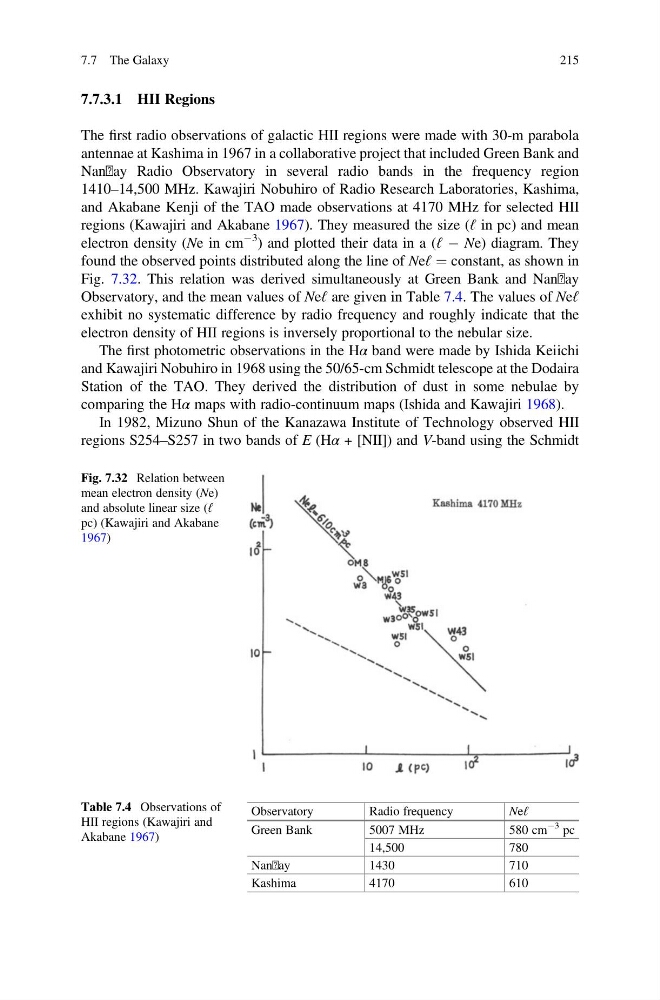
regions (Kawajiri and Akabane 1967). They measured the size (ℓ in pc) and mean
electron density (Ne in cm
À3 ) and plotted their data in a (ℓ À Ne) diagram. They
found the observed points distributed along the line of Neℓ ¼ constant, as shown in
Fig. 7.32. This relation was derived simultaneously at Green Bank and Nanҫay
Observatory, and the mean values of Neℓ are given in Table 7.4. The values of Neℓ
exhibit no systematic difference by radio frequency and roughly indicate that the
electron density of HII regions is inversely proportional to the nebular size.
The first photometric observations in the Hα band were made by Ishida Keiichi
and Kawajiri Nobuhiro in 1968 using the 50/65-cm Schmidt telescope at the Dodaira
Station of the TAO. They derived the distribution of dust in some nebulae by
comparing the Hα maps with radio-continuum maps (Ishida and Kawajiri 1968).
In 1982, Mizuno Shun of the Kanazawa Institute of Technology observed HII
regions S254–S257 in two bands of E (Hα + [NII]) and V-band using the Schmidt
Fig. 7.32 Relation between
mean electron density (Ne)
and absolute linear size (ℓ
pc) (Kawajiri and Akabane
1967)
Table 7.4 Observations of
HII regions (Kawajiri and
Akabane 1967)
Observatory
Radio frequency
Neℓ
Green Bank
5007 MHz
580 cm
À3 pc
14,500
780
Nanҫay
1430
710
Kashima
4170
610
7.7 The Galaxy
215
The first radio observations of galactic HII regions were made with 30-m parabola
antennae at Kashima in 1967 in a collaborative project that included Green Bank and
Nanҫay Radio Observatory in several radio bands in the frequency region
1410–14,500 MHz. Kawajiri Nobuhiro of Radio Research Laboratories, Kashima,
and Akabane Kenji of the TAO made observations at 4170 MHz for selected HII
regions (Kawajiri and Akabane 1967). They measured the size (ℓ in pc) and mean
electron density (Ne in cm
À3 ) and plotted their data in a (ℓ À Ne) diagram. They
found the observed points distributed along the line of Neℓ ¼ constant, as shown in
Fig. 7.32. This relation was derived simultaneously at Green Bank and Nanҫay
Observatory, and the mean values of Neℓ are given in Table 7.4. The values of Neℓ
exhibit no systematic difference by radio frequency and roughly indicate that the
electron density of HII regions is inversely proportional to the nebular size.
The first photometric observations in the Hα band were made by Ishida Keiichi
and Kawajiri Nobuhiro in 1968 using the 50/65-cm Schmidt telescope at the Dodaira
Station of the TAO. They derived the distribution of dust in some nebulae by
comparing the Hα maps with radio-continuum maps (Ishida and Kawajiri 1968).
In 1982, Mizuno Shun of the Kanazawa Institute of Technology observed HII
regions S254–S257 in two bands of E (Hα + [NII]) and V-band using the Schmidt
Fig. 7.32 Relation between
mean electron density (Ne)
and absolute linear size (ℓ
pc) (Kawajiri and Akabane
1967)
Table 7.4 Observations of
HII regions (Kawajiri and
Akabane 1967)
Observatory
Radio frequency
Neℓ
Green Bank
5007 MHz
580 cm
À3 pc
14,500
780
Nanҫay
1430
710
Kashima
4170
610
7.7 The Galaxy
215