

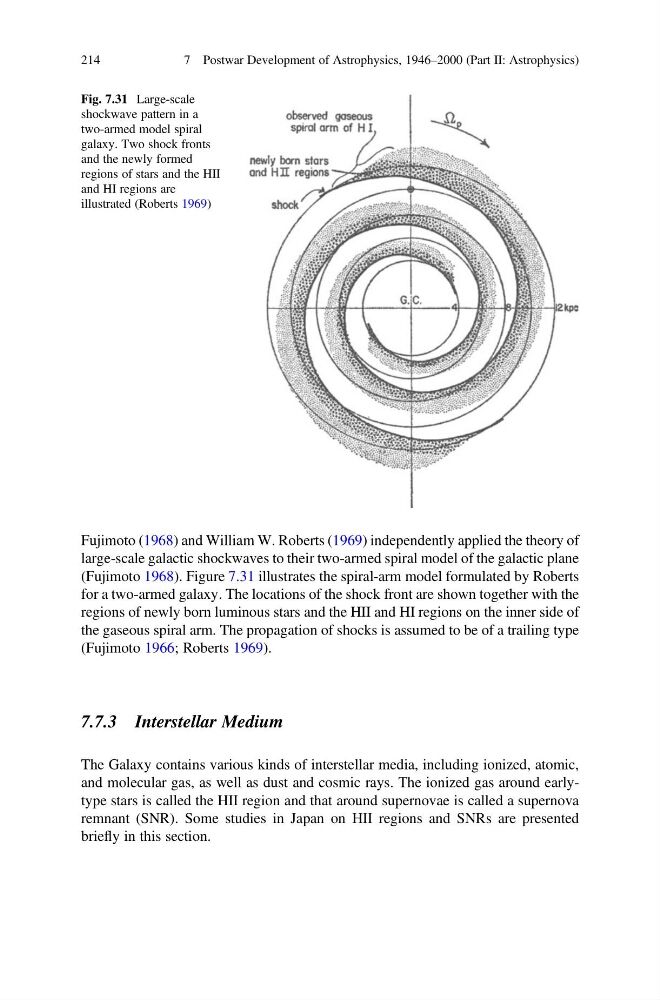
Fujimoto (1968) and William W. Roberts (1969) independently applied the theory of
large-scale galactic shockwaves to their two-armed spiral model of the galactic plane
(Fujimoto 1968). Figure 7.31 illustrates the spiral-arm model formulated by Roberts
for a two-armed galaxy. The locations of the shock front are shown together with the
regions of newly born luminous stars and the HII and HI regions on the inner side of
the gaseous spiral arm. The propagation of shocks is assumed to be of a trailing type
(Fujimoto 1966; Roberts 1969).
7.7.3 Interstellar Medium
The Galaxy contains various kinds of interstellar media, including ionized, atomic,
and molecular gas, as well as dust and cosmic rays. The ionized gas around earlytype stars is called the HII region and that around supernovae is called a supernova
remnant (SNR). Some studies in Japan on HII regions and SNRs are presented
briefly in this section.
Fig. 7.31 Large-scale
shockwave pattern in a
two-armed model spiral
galaxy. Two shock fronts
and the newly formed
regions of stars and the HII
and HI regions are
illustrated (Roberts 1969)
214
7 Postwar Development of Astrophysics, 1946–2000 (Part II: Astrophysics)
large-scale galactic shockwaves to their two-armed spiral model of the galactic plane
(Fujimoto 1968). Figure 7.31 illustrates the spiral-arm model formulated by Roberts
for a two-armed galaxy. The locations of the shock front are shown together with the
regions of newly born luminous stars and the HII and HI regions on the inner side of
the gaseous spiral arm. The propagation of shocks is assumed to be of a trailing type
(Fujimoto 1966; Roberts 1969).
7.7.3 Interstellar Medium
The Galaxy contains various kinds of interstellar media, including ionized, atomic,
and molecular gas, as well as dust and cosmic rays. The ionized gas around earlytype stars is called the HII region and that around supernovae is called a supernova
remnant (SNR). Some studies in Japan on HII regions and SNRs are presented
briefly in this section.
Fig. 7.31 Large-scale
shockwave pattern in a
two-armed model spiral
galaxy. Two shock fronts
and the newly formed
regions of stars and the HII
and HI regions are
illustrated (Roberts 1969)
214
7 Postwar Development of Astrophysics, 1946–2000 (Part II: Astrophysics)