

On this excess emission, Okuda suggested that near-IR radiation around the
galactic center was predominantly emitted from late-type stars, which include a
major part of the mass of the Galaxy and, hence, governs its dynamics. According to
this view, the contour map of Fig. 7.30 exhibits an edge-on view of the Galaxy,
which resembles the dynamical structure of edge-on galaxies (Okuda 1981).
7.7.2 Spiral Arm and Magnetic Field
The formation of spiral arms in our Galaxy was studied by a group at Tohoku
University from a magneto-hydrodynamic viewpoint in 1965. As stated in Chap. 5
(Sect. 5.3.4), their hydrodynamic models had met with difficulty in the short lives of
spiral arms.
To avoid such a difficulty, C. C. Lin and F. H. Shu (1964, 1966) considered the
stability problem of the galactic disk, and they showed that the arm structure could
be regarded as a density wave in the galactic plane. According to them, the structure
of arms depends upon the velocity dispersion of stars. When sufficient velocity
dispersion exists among stars, a stable arm can be produced.
In star-predominant density waves, how can star-forming regions (SFRs) be
formed along the arm? In 1966, Fujimoto Mitsuaki suggested the presence of
large-scale galactic shockwaves along the stellar density waves. Thereafter,
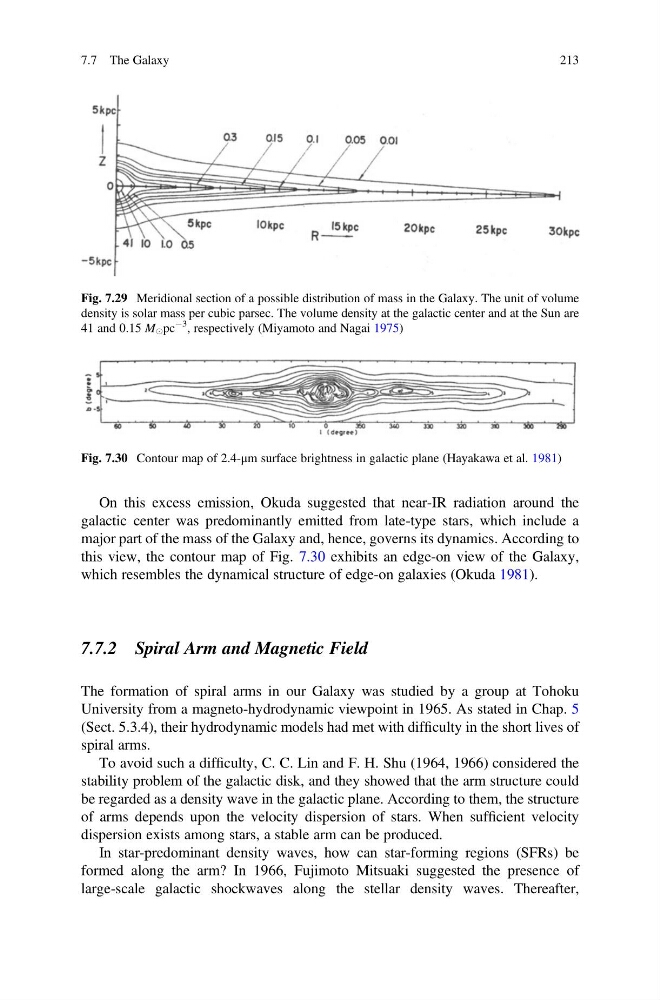
Fig. 7.29 Meridional section of a possible distribution of mass in the Galaxy. The unit of volume
density is solar mass per cubic parsec. The volume density at the galactic center and at the Sun are
41 and 0.15 M ☉ pc
À3
, respectively (Miyamoto and Nagai 1975)
Fig. 7.30 Contour map of 2.4-μm surface brightness in galactic plane (Hayakawa et al. 1981)
7.7 The Galaxy
213
galactic center was predominantly emitted from late-type stars, which include a
major part of the mass of the Galaxy and, hence, governs its dynamics. According to
this view, the contour map of Fig. 7.30 exhibits an edge-on view of the Galaxy,
which resembles the dynamical structure of edge-on galaxies (Okuda 1981).
7.7.2 Spiral Arm and Magnetic Field
The formation of spiral arms in our Galaxy was studied by a group at Tohoku
University from a magneto-hydrodynamic viewpoint in 1965. As stated in Chap. 5
(Sect. 5.3.4), their hydrodynamic models had met with difficulty in the short lives of
spiral arms.
To avoid such a difficulty, C. C. Lin and F. H. Shu (1964, 1966) considered the
stability problem of the galactic disk, and they showed that the arm structure could
be regarded as a density wave in the galactic plane. According to them, the structure
of arms depends upon the velocity dispersion of stars. When sufficient velocity
dispersion exists among stars, a stable arm can be produced.
In star-predominant density waves, how can star-forming regions (SFRs) be
formed along the arm? In 1966, Fujimoto Mitsuaki suggested the presence of
large-scale galactic shockwaves along the stellar density waves. Thereafter,
Fig. 7.29 Meridional section of a possible distribution of mass in the Galaxy. The unit of volume
density is solar mass per cubic parsec. The volume density at the galactic center and at the Sun are
41 and 0.15 M ☉ pc
À3
, respectively (Miyamoto and Nagai 1975)
Fig. 7.30 Contour map of 2.4-μm surface brightness in galactic plane (Hayakawa et al. 1981)
7.7 The Galaxy
213