

KL. They supposed that this disk may be responsible for the bipolar nature of the
flow (Hasegawa et al. 1984).
Radio continuum observations of the Ori KL region at λ 3 mm were made using
aperture synthesis with the Nobeyama millimeter array by Murata Yasuhiro,
Kawabe Ryohei, and their group (1992). With the beam width of around 2
00
 3
00
for a field of 70
00
 70
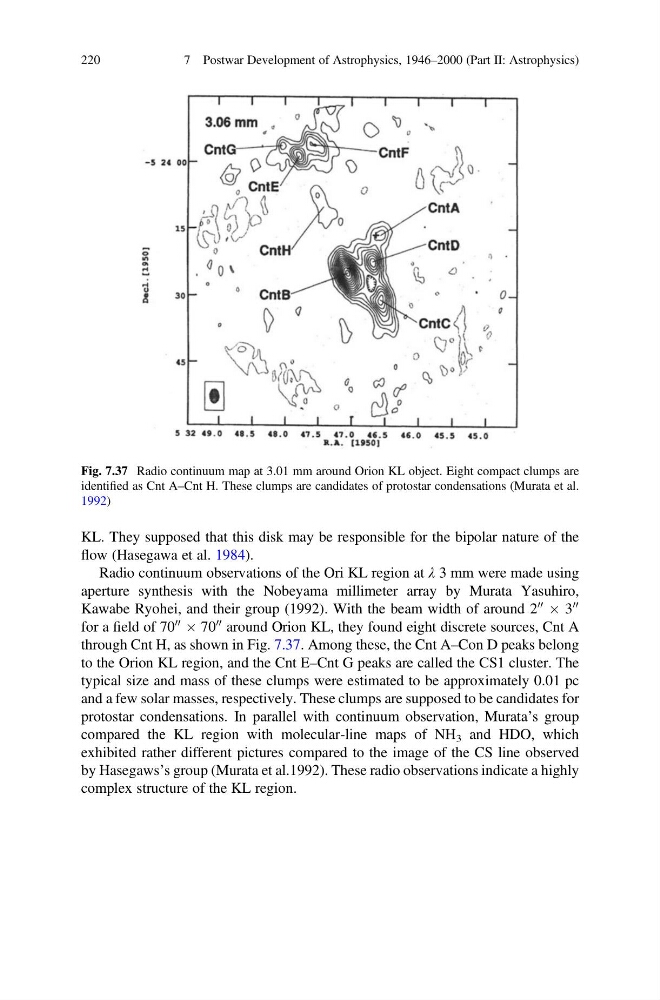
00 around Orion KL, they found eight discrete sources, Cnt A
through Cnt H, as shown in Fig. 7.37. Among these, the Cnt A–Con D peaks belong
to the Orion KL region, and the Cnt E–Cnt G peaks are called the CS1 cluster. The
typical size and mass of these clumps were estimated to be approximately 0.01 pc
and a few solar masses, respectively. These clumps are supposed to be candidates for
protostar condensations. In parallel with continuum observation, Murata’s group
compared the KL region with molecular-line maps of NH 3 and HDO, which
exhibited rather different pictures compared to the image of the CS line observed
by Hasegaws’s group (Murata et al.1992). These radio observations indicate a highly
complex structure of the KL region.
Fig. 7.37 Radio continuum map at 3.01 mm around Orion KL object. Eight compact clumps are
identified as Cnt A–Cnt H. These clumps are candidates of protostar condensations (Murata et al.
1992)
220
7 Postwar Development of Astrophysics, 1946–2000 (Part II: Astrophysics)
flow (Hasegawa et al. 1984).
Radio continuum observations of the Ori KL region at λ 3 mm were made using
aperture synthesis with the Nobeyama millimeter array by Murata Yasuhiro,
Kawabe Ryohei, and their group (1992). With the beam width of around 2
00
 3
00
for a field of 70
00
 70
00 around Orion KL, they found eight discrete sources, Cnt A
through Cnt H, as shown in Fig. 7.37. Among these, the Cnt A–Con D peaks belong
to the Orion KL region, and the Cnt E–Cnt G peaks are called the CS1 cluster. The
typical size and mass of these clumps were estimated to be approximately 0.01 pc
and a few solar masses, respectively. These clumps are supposed to be candidates for
protostar condensations. In parallel with continuum observation, Murata’s group
compared the KL region with molecular-line maps of NH 3 and HDO, which
exhibited rather different pictures compared to the image of the CS line observed
by Hasegaws’s group (Murata et al.1992). These radio observations indicate a highly
complex structure of the KL region.
Fig. 7.37 Radio continuum map at 3.01 mm around Orion KL object. Eight compact clumps are
identified as Cnt A–Cnt H. These clumps are candidates of protostar condensations (Murata et al.
1992)
220
7 Postwar Development of Astrophysics, 1946–2000 (Part II: Astrophysics)