

Astronomical Observatory (Chap. 8) in 1997–2012). He died in 2018 in Tokyo at
age 89 (Osaki 2008a, b; Takahashi 2015; Shibata et al. 2018; Kinoshita 2018)
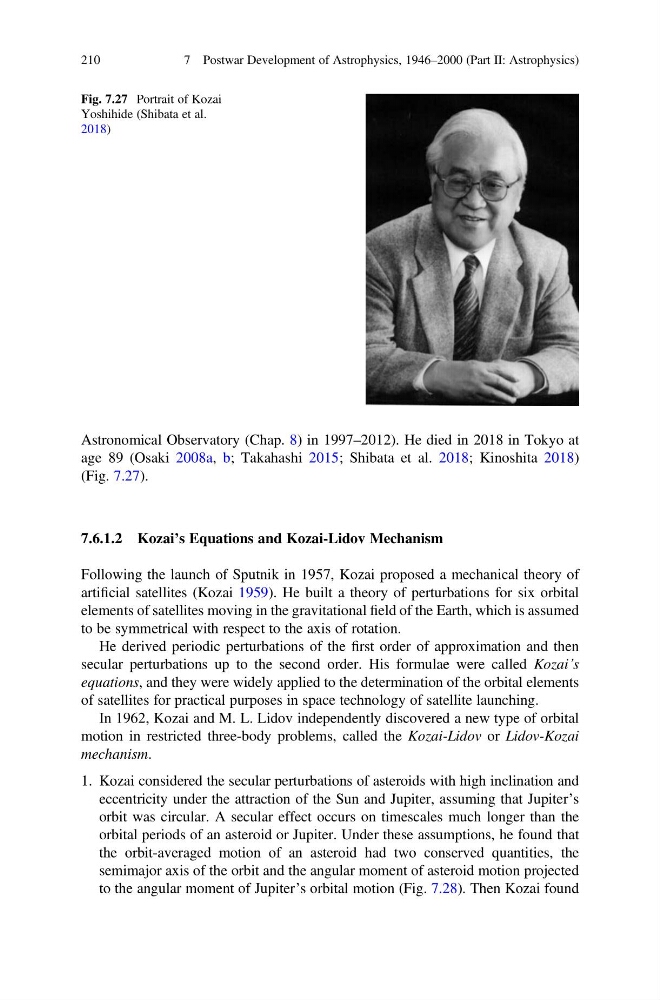
(Fig. 7.27).
7.6.1.2 Kozai’s Equations and Kozai-Lidov Mechanism
Following the launch of Sputnik in 1957, Kozai proposed a mechanical theory of
artificial satellites (Kozai 1959). He built a theory of perturbations for six orbital
elements of satellites moving in the gravitational field of the Earth, which is assumed
to be symmetrical with respect to the axis of rotation.
He derived periodic perturbations of the first order of approximation and then
secular perturbations up to the second order. His formulae were called Kozai’s
equations, and they were widely applied to the determination of the orbital elements
of satellites for practical purposes in space technology of satellite launching.
In 1962, Kozai and M. L. Lidov independently discovered a new type of orbital
motion in restricted three-body problems, called the Kozai-Lidov or Lidov-Kozai
mechanism.
1. Kozai considered the secular perturbations of asteroids with high inclination and
eccentricity under the attraction of the Sun and Jupiter, assuming that Jupiter’s
orbit was circular. A secular effect occurs on timescales much longer than the
orbital periods of an asteroid or Jupiter. Under these assumptions, he found that
the orbit-averaged motion of an asteroid had two conserved quantities, the
semimajor axis of the orbit and the angular moment of asteroid motion projected
to the angular moment of Jupiter’s orbital motion (Fig. 7.28). Then Kozai found
Fig. 7.27 Portrait of Kozai
Yoshihide (Shibata et al.
2018)
210
7 Postwar Development of Astrophysics, 1946–2000 (Part II: Astrophysics)
age 89 (Osaki 2008a, b; Takahashi 2015; Shibata et al. 2018; Kinoshita 2018)
(Fig. 7.27).
7.6.1.2 Kozai’s Equations and Kozai-Lidov Mechanism
Following the launch of Sputnik in 1957, Kozai proposed a mechanical theory of
artificial satellites (Kozai 1959). He built a theory of perturbations for six orbital
elements of satellites moving in the gravitational field of the Earth, which is assumed
to be symmetrical with respect to the axis of rotation.
He derived periodic perturbations of the first order of approximation and then
secular perturbations up to the second order. His formulae were called Kozai’s
equations, and they were widely applied to the determination of the orbital elements
of satellites for practical purposes in space technology of satellite launching.
In 1962, Kozai and M. L. Lidov independently discovered a new type of orbital
motion in restricted three-body problems, called the Kozai-Lidov or Lidov-Kozai
mechanism.
1. Kozai considered the secular perturbations of asteroids with high inclination and
eccentricity under the attraction of the Sun and Jupiter, assuming that Jupiter’s
orbit was circular. A secular effect occurs on timescales much longer than the
orbital periods of an asteroid or Jupiter. Under these assumptions, he found that
the orbit-averaged motion of an asteroid had two conserved quantities, the
semimajor axis of the orbit and the angular moment of asteroid motion projected
to the angular moment of Jupiter’s orbital motion (Fig. 7.28). Then Kozai found
Fig. 7.27 Portrait of Kozai
Yoshihide (Shibata et al.
2018)
210
7 Postwar Development of Astrophysics, 1946–2000 (Part II: Astrophysics)