

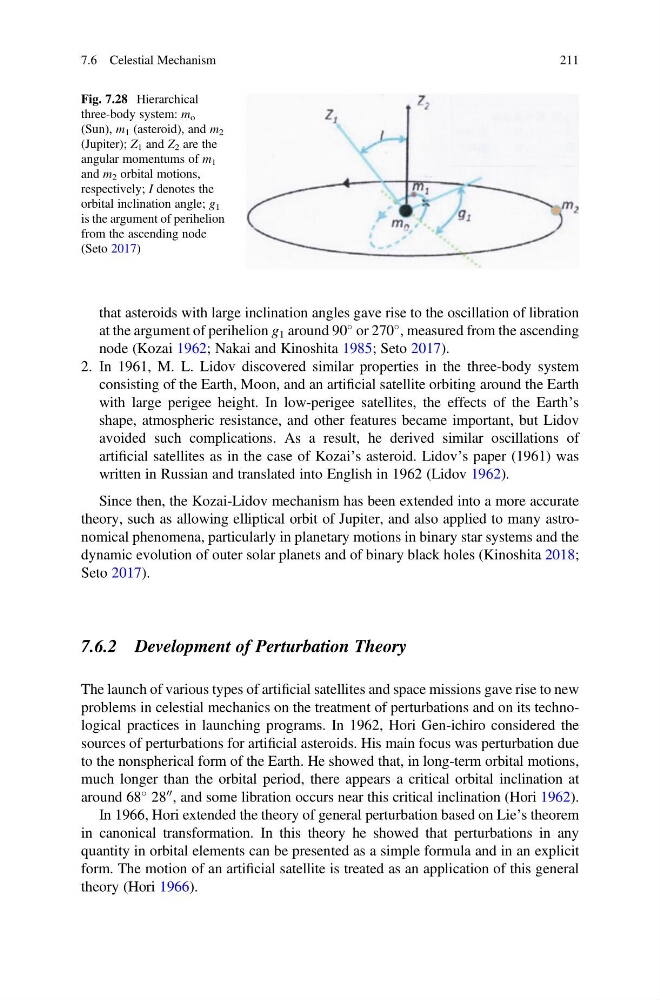
that asteroids with large inclination angles gave rise to the oscillation of libration
at the argument of perihelion g 1 around 90
or 270
, measured from the ascending
node (Kozai 1962; Nakai and Kinoshita 1985; Seto 2017).
2. In 1961, M. L. Lidov discovered similar properties in the three-body system
consisting of the Earth, Moon, and an artificial satellite orbiting around the Earth
with large perigee height. In low-perigee satellites, the effects of the Earth’s
shape, atmospheric resistance, and other features became important, but Lidov
avoided such complications. As a result, he derived similar oscillations of
artificial satellites as in the case of Kozai’s asteroid. Lidov’s paper (1961) was
written in Russian and translated into English in 1962 (Lidov 1962).
Since then, the Kozai-Lidov mechanism has been extended into a more accurate
theory, such as allowing elliptical orbit of Jupiter, and also applied to many astronomical phenomena, particularly in planetary motions in binary star systems and the
dynamic evolution of outer solar planets and of binary black holes (Kinoshita 2018;
Seto 2017).
7.6.2 Development of Perturbation Theory
The launch of various types of artificial satellites and space missions gave rise to new
problems in celestial mechanics on the treatment of perturbations and on its technological practices in launching programs. In 1962, Hori Gen-ichiro considered the
sources of perturbations for artificial asteroids. His main focus was perturbation due
to the nonspherical form of the Earth. He showed that, in long-term orbital motions,
much longer than the orbital period, there appears a critical orbital inclination at
around 68
28
00 , and some libration occurs near this critical inclination (Hori 1962).
In 1966, Hori extended the theory of general perturbation based on Lie’s theorem
in canonical transformation. In this theory he showed that perturbations in any
quantity in orbital elements can be presented as a simple formula and in an explicit
form. The motion of an artificial satellite is treated as an application of this general
theory (Hori 1966).
Fig. 7.28 Hierarchical
three-body system: m o
(Sun), m 1 (asteroid), and m 2
(Jupiter); Z 1 and Z 2 are the
angular momentums of m 1
and m 2 orbital motions,
respectively; I denotes the
orbital inclination angle; g 1
is the argument of perihelion
from the ascending node
(Seto 2017)
7.6 Celestial Mechanism
211
at the argument of perihelion g 1 around 90
or 270
, measured from the ascending
node (Kozai 1962; Nakai and Kinoshita 1985; Seto 2017).
2. In 1961, M. L. Lidov discovered similar properties in the three-body system
consisting of the Earth, Moon, and an artificial satellite orbiting around the Earth
with large perigee height. In low-perigee satellites, the effects of the Earth’s
shape, atmospheric resistance, and other features became important, but Lidov
avoided such complications. As a result, he derived similar oscillations of
artificial satellites as in the case of Kozai’s asteroid. Lidov’s paper (1961) was
written in Russian and translated into English in 1962 (Lidov 1962).
Since then, the Kozai-Lidov mechanism has been extended into a more accurate
theory, such as allowing elliptical orbit of Jupiter, and also applied to many astronomical phenomena, particularly in planetary motions in binary star systems and the
dynamic evolution of outer solar planets and of binary black holes (Kinoshita 2018;
Seto 2017).
7.6.2 Development of Perturbation Theory
The launch of various types of artificial satellites and space missions gave rise to new
problems in celestial mechanics on the treatment of perturbations and on its technological practices in launching programs. In 1962, Hori Gen-ichiro considered the
sources of perturbations for artificial asteroids. His main focus was perturbation due
to the nonspherical form of the Earth. He showed that, in long-term orbital motions,
much longer than the orbital period, there appears a critical orbital inclination at
around 68
28
00 , and some libration occurs near this critical inclination (Hori 1962).
In 1966, Hori extended the theory of general perturbation based on Lie’s theorem
in canonical transformation. In this theory he showed that perturbations in any
quantity in orbital elements can be presented as a simple formula and in an explicit
form. The motion of an artificial satellite is treated as an application of this general
theory (Hori 1966).
Fig. 7.28 Hierarchical
three-body system: m o
(Sun), m 1 (asteroid), and m 2
(Jupiter); Z 1 and Z 2 are the
angular momentums of m 1
and m 2 orbital motions,
respectively; I denotes the
orbital inclination angle; g 1
is the argument of perihelion
from the ascending node
(Seto 2017)
7.6 Celestial Mechanism
211