

Gravity-darkening is a kind of center-limb darkening on a stellar surface that
appears in rotationally or tidally distorted stars in radiative equilibrium. In such stars,
surface flux at any point of the surface varies proportionally to the local gravity
g (von Zeipel’s law) as follows:
F / g:
ð7:1Þ
According to this law, surface gravity in the equatorial region of a rapidly rotating
star is small, so the surface brightness is low compared to the polar region.
In highly distorted stars in close binary systems, gravity darkening deviates from
von Zeipel’s law in the form
F / g
α
:
ð7:2Þ
where α is the exponent of gravity darkening.
The study of gravity darkening was advanced by E. Budding and Z. Kopal (1970)
for the Algol-type binary. They cited, however, the work of Takeda Shin’ichiro
(Chap. 4) as the original study in this field. Takeda wrote in his paper that “The effect
of this deformation on the light curve is estimated by taking into account both the
variation in the surface brightness and darkening to the limb (Takeda 1934).
Kitamura’s works could be the modern legacy of Takeda’s suggestion. Kitamura
made theoretical as well as observational studies in the 1980s and thereafter for
every type of detached, semidetached (Algol-type), and contact binary system. Of
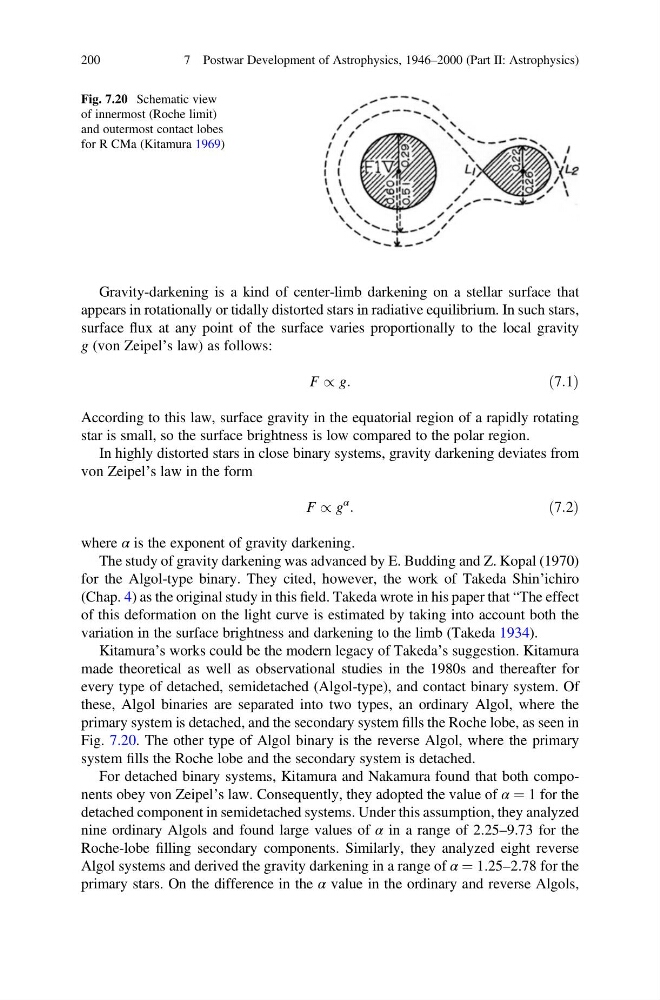
these, Algol binaries are separated into two types, an ordinary Algol, where the
primary system is detached, and the secondary system fills the Roche lobe, as seen in
Fig. 7.20. The other type of Algol binary is the reverse Algol, where the primary
system fills the Roche lobe and the secondary system is detached.
For detached binary systems, Kitamura and Nakamura found that both components obey von Zeipel’s law. Consequently, they adopted the value of α ¼ 1 for the
detached component in semidetached systems. Under this assumption, they analyzed
nine ordinary Algols and found large values of α in a range of 2.25–9.73 for the
Roche-lobe filling secondary components. Similarly, they analyzed eight reverse
Algol systems and derived the gravity darkening in a range of α ¼ 1.25–2.78 for the
primary stars. On the difference in the α value in the ordinary and reverse Algols,
Fig. 7.20 Schematic view
of innermost (Roche limit)
and outermost contact lobes
for R CMa (Kitamura 1969)
200
7 Postwar Development of Astrophysics, 1946–2000 (Part II: Astrophysics)
appears in rotationally or tidally distorted stars in radiative equilibrium. In such stars,
surface flux at any point of the surface varies proportionally to the local gravity
g (von Zeipel’s law) as follows:
F / g:
ð7:1Þ
According to this law, surface gravity in the equatorial region of a rapidly rotating
star is small, so the surface brightness is low compared to the polar region.
In highly distorted stars in close binary systems, gravity darkening deviates from
von Zeipel’s law in the form
F / g
α
:
ð7:2Þ
where α is the exponent of gravity darkening.
The study of gravity darkening was advanced by E. Budding and Z. Kopal (1970)
for the Algol-type binary. They cited, however, the work of Takeda Shin’ichiro
(Chap. 4) as the original study in this field. Takeda wrote in his paper that “The effect
of this deformation on the light curve is estimated by taking into account both the
variation in the surface brightness and darkening to the limb (Takeda 1934).
Kitamura’s works could be the modern legacy of Takeda’s suggestion. Kitamura
made theoretical as well as observational studies in the 1980s and thereafter for
every type of detached, semidetached (Algol-type), and contact binary system. Of
these, Algol binaries are separated into two types, an ordinary Algol, where the
primary system is detached, and the secondary system fills the Roche lobe, as seen in
Fig. 7.20. The other type of Algol binary is the reverse Algol, where the primary
system fills the Roche lobe and the secondary system is detached.
For detached binary systems, Kitamura and Nakamura found that both components obey von Zeipel’s law. Consequently, they adopted the value of α ¼ 1 for the
detached component in semidetached systems. Under this assumption, they analyzed
nine ordinary Algols and found large values of α in a range of 2.25–9.73 for the
Roche-lobe filling secondary components. Similarly, they analyzed eight reverse
Algol systems and derived the gravity darkening in a range of α ¼ 1.25–2.78 for the
primary stars. On the difference in the α value in the ordinary and reverse Algols,
Fig. 7.20 Schematic view
of innermost (Roche limit)
and outermost contact lobes
for R CMa (Kitamura 1969)
200
7 Postwar Development of Astrophysics, 1946–2000 (Part II: Astrophysics)