

Kitamura suggested that it was a result of the difference in mass-loss rate from the
Roche-lobe filling component to the detached star in the sense that the mass-loss rate
is higher in ordinary Algols, causing higher gravity darkening in the filling
component (Kitamura and Nakamura 1987, 1988).
7.5.3 Emission-Line Stars
Emission-line stars are stars that show conspicuous emission lines in the optical
spectra, and they are widely distributed in HR diagrams (Kogure and Leung 2007).
In this section we consider Be stars and symbiotic stars as examples of wellstudied emission-line stars.
7.5.3.1 Be Stars
Be stars are rapidly rotating B-type stars that exhibit emission lines in hydrogen, and
sometimes in helium and metallic lines. Emission lines are formed in the nebular
disks or rings around a star’s equator, as suggested by Otto Struve in 1931.
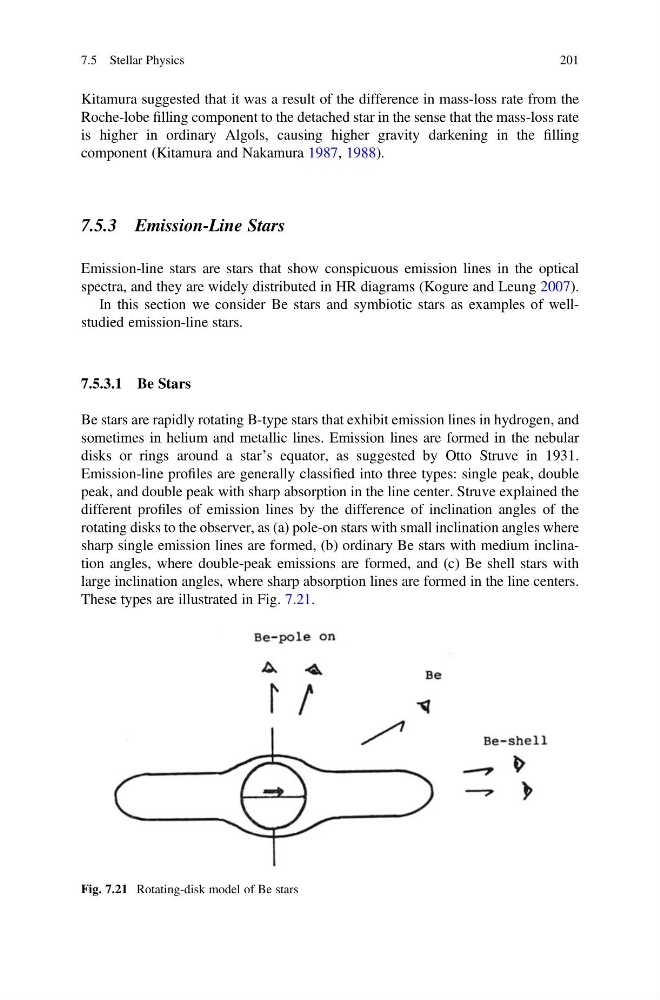
Emission-line profiles are generally classified into three types: single peak, double
peak, and double peak with sharp absorption in the line center. Struve explained the
different profiles of emission lines by the difference of inclination angles of the
rotating disks to the observer, as (a) pole-on stars with small inclination angles where
sharp single emission lines are formed, (b) ordinary Be stars with medium inclination angles, where double-peak emissions are formed, and (c) Be shell stars with
large inclination angles, where sharp absorption lines are formed in the line centers.
These types are illustrated in Fig. 7.21.
Fig. 7.21 Rotating-disk model of Be stars
7.5 Stellar Physics
201
Roche-lobe filling component to the detached star in the sense that the mass-loss rate
is higher in ordinary Algols, causing higher gravity darkening in the filling
component (Kitamura and Nakamura 1987, 1988).
7.5.3 Emission-Line Stars
Emission-line stars are stars that show conspicuous emission lines in the optical
spectra, and they are widely distributed in HR diagrams (Kogure and Leung 2007).
In this section we consider Be stars and symbiotic stars as examples of wellstudied emission-line stars.
7.5.3.1 Be Stars
Be stars are rapidly rotating B-type stars that exhibit emission lines in hydrogen, and
sometimes in helium and metallic lines. Emission lines are formed in the nebular
disks or rings around a star’s equator, as suggested by Otto Struve in 1931.
Emission-line profiles are generally classified into three types: single peak, double
peak, and double peak with sharp absorption in the line center. Struve explained the
different profiles of emission lines by the difference of inclination angles of the
rotating disks to the observer, as (a) pole-on stars with small inclination angles where
sharp single emission lines are formed, (b) ordinary Be stars with medium inclination angles, where double-peak emissions are formed, and (c) Be shell stars with
large inclination angles, where sharp absorption lines are formed in the line centers.
These types are illustrated in Fig. 7.21.
Fig. 7.21 Rotating-disk model of Be stars
7.5 Stellar Physics
201