

associate professor and then to professor of astronomy in 1972. After retirement in
1986, he continued the study of close binaries and in addition promoted international
cooperation through the provision of astronomical facilities to developing countries
by 2004. Based on the Official Development Assistance (ODA) project of the
Ministry of Foreign Affairs of Japan, Kitamura provided a 45-cm reflector or an
intermediate-size planetarium to each of 25 developing countries in Asia, South
America, Africa, and other areas (Kitamura 2003). Kitamura died in 2012 at age
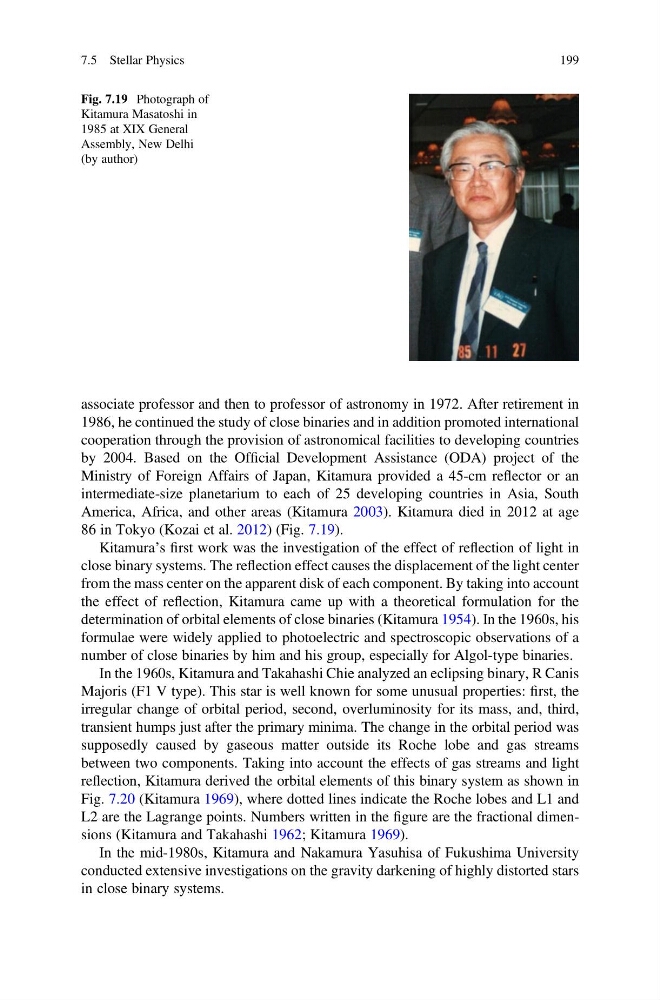
86 in Tokyo (Kozai et al. 2012) (Fig. 7.19).
Kitamura’s first work was the investigation of the effect of reflection of light in
close binary systems. The reflection effect causes the displacement of the light center
from the mass center on the apparent disk of each component. By taking into account
the effect of reflection, Kitamura came up with a theoretical formulation for the
determination of orbital elements of close binaries (Kitamura 1954). In the 1960s, his
formulae were widely applied to photoelectric and spectroscopic observations of a
number of close binaries by him and his group, especially for Algol-type binaries.
In the 1960s, Kitamura and Takahashi Chie analyzed an eclipsing binary, R Canis
Majoris (F1 V type). This star is well known for some unusual properties: first, the
irregular change of orbital period, second, overluminosity for its mass, and, third,
transient humps just after the primary minima. The change in the orbital period was
supposedly caused by gaseous matter outside its Roche lobe and gas streams
between two components. Taking into account the effects of gas streams and light
reflection, Kitamura derived the orbital elements of this binary system as shown in
Fig. 7.20 (Kitamura 1969), where dotted lines indicate the Roche lobes and L1 and
L2 are the Lagrange points. Numbers written in the figure are the fractional dimensions (Kitamura and Takahashi 1962; Kitamura 1969).
In the mid-1980s, Kitamura and Nakamura Yasuhisa of Fukushima University
conducted extensive investigations on the gravity darkening of highly distorted stars
in close binary systems.
Fig. 7.19 Photograph of
Kitamura Masatoshi in
1985 at XIX General
Assembly, New Delhi
(by author)
7.5 Stellar Physics
199
1986, he continued the study of close binaries and in addition promoted international
cooperation through the provision of astronomical facilities to developing countries
by 2004. Based on the Official Development Assistance (ODA) project of the
Ministry of Foreign Affairs of Japan, Kitamura provided a 45-cm reflector or an
intermediate-size planetarium to each of 25 developing countries in Asia, South
America, Africa, and other areas (Kitamura 2003). Kitamura died in 2012 at age
86 in Tokyo (Kozai et al. 2012) (Fig. 7.19).
Kitamura’s first work was the investigation of the effect of reflection of light in
close binary systems. The reflection effect causes the displacement of the light center
from the mass center on the apparent disk of each component. By taking into account
the effect of reflection, Kitamura came up with a theoretical formulation for the
determination of orbital elements of close binaries (Kitamura 1954). In the 1960s, his
formulae were widely applied to photoelectric and spectroscopic observations of a
number of close binaries by him and his group, especially for Algol-type binaries.
In the 1960s, Kitamura and Takahashi Chie analyzed an eclipsing binary, R Canis
Majoris (F1 V type). This star is well known for some unusual properties: first, the
irregular change of orbital period, second, overluminosity for its mass, and, third,
transient humps just after the primary minima. The change in the orbital period was
supposedly caused by gaseous matter outside its Roche lobe and gas streams
between two components. Taking into account the effects of gas streams and light
reflection, Kitamura derived the orbital elements of this binary system as shown in
Fig. 7.20 (Kitamura 1969), where dotted lines indicate the Roche lobes and L1 and
L2 are the Lagrange points. Numbers written in the figure are the fractional dimensions (Kitamura and Takahashi 1962; Kitamura 1969).
In the mid-1980s, Kitamura and Nakamura Yasuhisa of Fukushima University
conducted extensive investigations on the gravity darkening of highly distorted stars
in close binary systems.
Fig. 7.19 Photograph of
Kitamura Masatoshi in
1985 at XIX General
Assembly, New Delhi
(by author)
7.5 Stellar Physics
199