

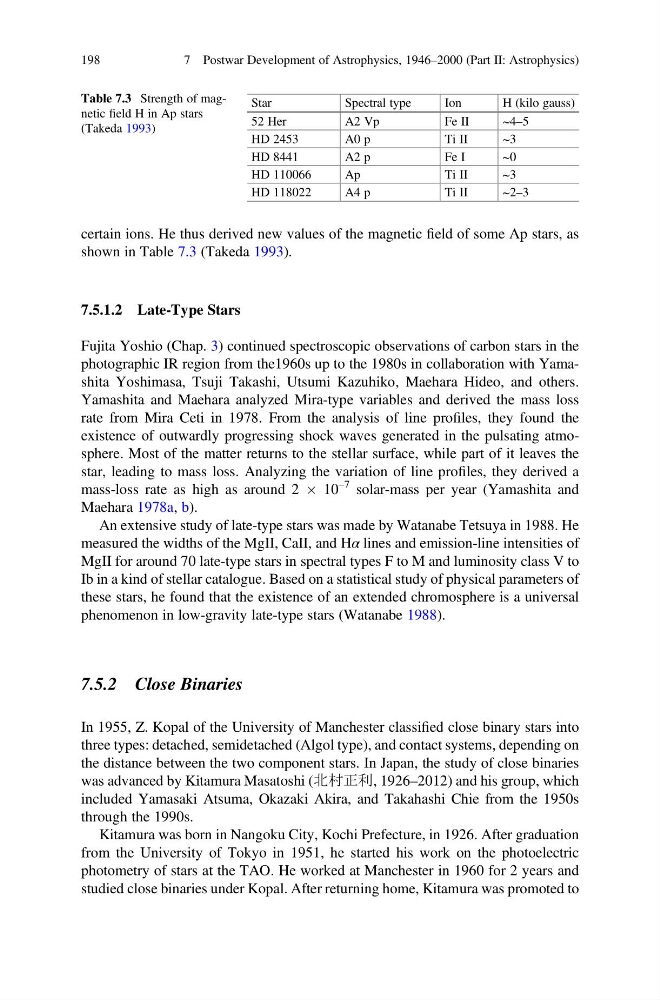
certain ions. He thus derived new values of the magnetic field of some Ap stars, as
shown in Table 7.3 (Takeda 1993).
7.5.1.2 Late-Type Stars
Fujita Yoshio (Chap. 3) continued spectroscopic observations of carbon stars in the
photographic IR region from the1960s up to the 1980s in collaboration with Yamashita Yoshimasa, Tsuji Takashi, Utsumi Kazuhiko, Maehara Hideo, and others.
Yamashita and Maehara analyzed Mira-type variables and derived the mass loss
rate from Mira Ceti in 1978. From the analysis of line profiles, they found the
existence of outwardly progressing shock waves generated in the pulsating atmosphere. Most of the matter returns to the stellar surface, while part of it leaves the
star, leading to mass loss. Analyzing the variation of line profiles, they derived a
mass-loss rate as high as around 2 Â 10
–7 solar-mass per year (Yamashita and
Maehara 1978a, b).
An extensive study of late-type stars was made by Watanabe Tetsuya in 1988. He
measured the widths of the MgII, CaII, and Hα lines and emission-line intensities of
MgII for around 70 late-type stars in spectral types F to M and luminosity class V to
Ib in a kind of stellar catalogue. Based on a statistical study of physical parameters of
these stars, he found that the existence of an extended chromosphere is a universal
phenomenon in low-gravity late-type stars (Watanabe 1988).
7.5.2 Close Binaries
In 1955, Z. Kopal of the University of Manchester classified close binary stars into
three types: detached, semidetached (Algol type), and contact systems, depending on
the distance between the two component stars. In Japan, the study of close binaries
was advanced by Kitamura Masatoshi (北村正利, 1926–2012) and his group, which
included Yamasaki Atsuma, Okazaki Akira, and Takahashi Chie from the 1950s
through the 1990s.
Kitamura was born in Nangoku City, Kochi Prefecture, in 1926. After graduation
from the University of Tokyo in 1951, he started his work on the photoelectric
photometry of stars at the TAO. He worked at Manchester in 1960 for 2 years and
studied close binaries under Kopal. After returning home, Kitamura was promoted to
Table 7.3 Strength of magnetic field H in Ap stars
(Takeda 1993)
Star
Spectral type
Ion
H (kilo gauss)
52 Her
A2 Vp
Fe II
~4–5
HD 2453
A0 p
Ti II
~3
HD 8441
A2 p
Fe I
~0
HD 110066
Ap
Ti II
~3
HD 118022
A4 p
Ti II
~2–3
198
7 Postwar Development of Astrophysics, 1946–2000 (Part II: Astrophysics)
shown in Table 7.3 (Takeda 1993).
7.5.1.2 Late-Type Stars
Fujita Yoshio (Chap. 3) continued spectroscopic observations of carbon stars in the
photographic IR region from the1960s up to the 1980s in collaboration with Yamashita Yoshimasa, Tsuji Takashi, Utsumi Kazuhiko, Maehara Hideo, and others.
Yamashita and Maehara analyzed Mira-type variables and derived the mass loss
rate from Mira Ceti in 1978. From the analysis of line profiles, they found the
existence of outwardly progressing shock waves generated in the pulsating atmosphere. Most of the matter returns to the stellar surface, while part of it leaves the
star, leading to mass loss. Analyzing the variation of line profiles, they derived a
mass-loss rate as high as around 2 Â 10
–7 solar-mass per year (Yamashita and
Maehara 1978a, b).
An extensive study of late-type stars was made by Watanabe Tetsuya in 1988. He
measured the widths of the MgII, CaII, and Hα lines and emission-line intensities of
MgII for around 70 late-type stars in spectral types F to M and luminosity class V to
Ib in a kind of stellar catalogue. Based on a statistical study of physical parameters of
these stars, he found that the existence of an extended chromosphere is a universal
phenomenon in low-gravity late-type stars (Watanabe 1988).
7.5.2 Close Binaries
In 1955, Z. Kopal of the University of Manchester classified close binary stars into
three types: detached, semidetached (Algol type), and contact systems, depending on
the distance between the two component stars. In Japan, the study of close binaries
was advanced by Kitamura Masatoshi (北村正利, 1926–2012) and his group, which
included Yamasaki Atsuma, Okazaki Akira, and Takahashi Chie from the 1950s
through the 1990s.
Kitamura was born in Nangoku City, Kochi Prefecture, in 1926. After graduation
from the University of Tokyo in 1951, he started his work on the photoelectric
photometry of stars at the TAO. He worked at Manchester in 1960 for 2 years and
studied close binaries under Kopal. After returning home, Kitamura was promoted to
Table 7.3 Strength of magnetic field H in Ap stars
(Takeda 1993)
Star
Spectral type
Ion
H (kilo gauss)
52 Her
A2 Vp
Fe II
~4–5
HD 2453
A0 p
Ti II
~3
HD 8441
A2 p
Fe I
~0
HD 110066
Ap
Ti II
~3
HD 118022
A4 p
Ti II
~2–3
198
7 Postwar Development of Astrophysics, 1946–2000 (Part II: Astrophysics)