

7.5.1.1 Early-Type Stars
In the 1960s, Nariai Kyoji and Nishimura Shiro took up Osawa’s work on A and Ap
stars (Chap. 3) based on photometric and spectroscopic observations at the Okayama
Astrophysical Observatory (OAO). Nariai observed a hydrogen-deficient star, HD
30353, and determined the physical parameters of the atmosphere using modelatmosphere calculations and infrared (IR) observations (Nariai 1967). Nishimura
carried out photometric and spectroscopic observations of a metallic-line star,
28 Andromedae, and found that this star was a pulsating variable star with some
beat phenomena in the light curve (Nishimura 1969). In the 1970s, Sadakane Kozo
and his group, Okyudo Masami, Kato Ken’ichi, and Nishimura Masayoshi started
extensive spectroscopic studies of A and Ap stars. Sadakane examined the profile
variation of the Ca II K line of the Ap star 73 Draconis and showed that variation of
the K-line profile could be explained in terms of a calcium spot (or continent) that
appears and disappears as the star rotates. He thus estimated the size of the spot and
the concentration of Ca ions in the spot (Sadakane 1974).
In the 1990s, studies of Ap stars were extended by a fine analysis of spectral lines
based on the models of nonlocal thermodynamic equilibrium by the group of
Sadakane Kozo, Takeda, Yoichi et al. (1993) and Hidai Masahide and Takeda
Yoichi (1996) for the upper main-sequence stars and for some early-type supergiants. Takeda Yoichi investigated the stellar magnetic fields in Ap stars based on a
fine analysis of a model atmosphere and the analysis of Zeeman-split profiles in
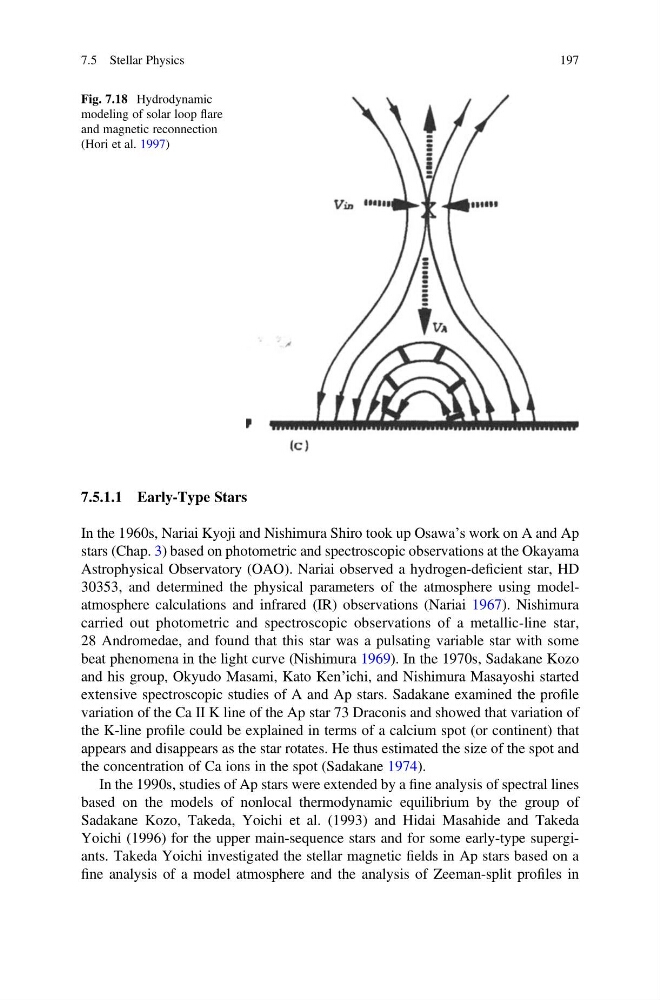
Fig. 7.18 Hydrodynamic
modeling of solar loop flare
and magnetic reconnection
(Hori et al. 1997)
7.5 Stellar Physics
197
In the 1960s, Nariai Kyoji and Nishimura Shiro took up Osawa’s work on A and Ap
stars (Chap. 3) based on photometric and spectroscopic observations at the Okayama
Astrophysical Observatory (OAO). Nariai observed a hydrogen-deficient star, HD
30353, and determined the physical parameters of the atmosphere using modelatmosphere calculations and infrared (IR) observations (Nariai 1967). Nishimura
carried out photometric and spectroscopic observations of a metallic-line star,
28 Andromedae, and found that this star was a pulsating variable star with some
beat phenomena in the light curve (Nishimura 1969). In the 1970s, Sadakane Kozo
and his group, Okyudo Masami, Kato Ken’ichi, and Nishimura Masayoshi started
extensive spectroscopic studies of A and Ap stars. Sadakane examined the profile
variation of the Ca II K line of the Ap star 73 Draconis and showed that variation of
the K-line profile could be explained in terms of a calcium spot (or continent) that
appears and disappears as the star rotates. He thus estimated the size of the spot and
the concentration of Ca ions in the spot (Sadakane 1974).
In the 1990s, studies of Ap stars were extended by a fine analysis of spectral lines
based on the models of nonlocal thermodynamic equilibrium by the group of
Sadakane Kozo, Takeda, Yoichi et al. (1993) and Hidai Masahide and Takeda
Yoichi (1996) for the upper main-sequence stars and for some early-type supergiants. Takeda Yoichi investigated the stellar magnetic fields in Ap stars based on a
fine analysis of a model atmosphere and the analysis of Zeeman-split profiles in
Fig. 7.18 Hydrodynamic
modeling of solar loop flare
and magnetic reconnection
(Hori et al. 1997)
7.5 Stellar Physics
197