

Astronomy and started theoretical studies of chromosphere and prominence activities. In 1953, he began observational study of the Sun. His first work was the
construction of a small coelostat (aperture 14 cm) at the Solar Laboratory of the
Kwasan Observatory. For this construction, he designed the optical system and made
some parts of the instrument by hand, reflecting the poor state of the early postwar
period. The coelostat was reconstructed first with a 30-cm and finally to a 70-cm
aperture at the new Solar Laboratory. He was promoted associate professor in 1961
and professor of astrophysics in 1971. Kawaguchi’s research interests were active
phenomena of the Sun such as sunspots, chromosphere, and active prominences.
With these works, he was invited twice by the French government in 1966 for
2 years and in 1975 for 1 year and carried out observations at the Pic du Midi
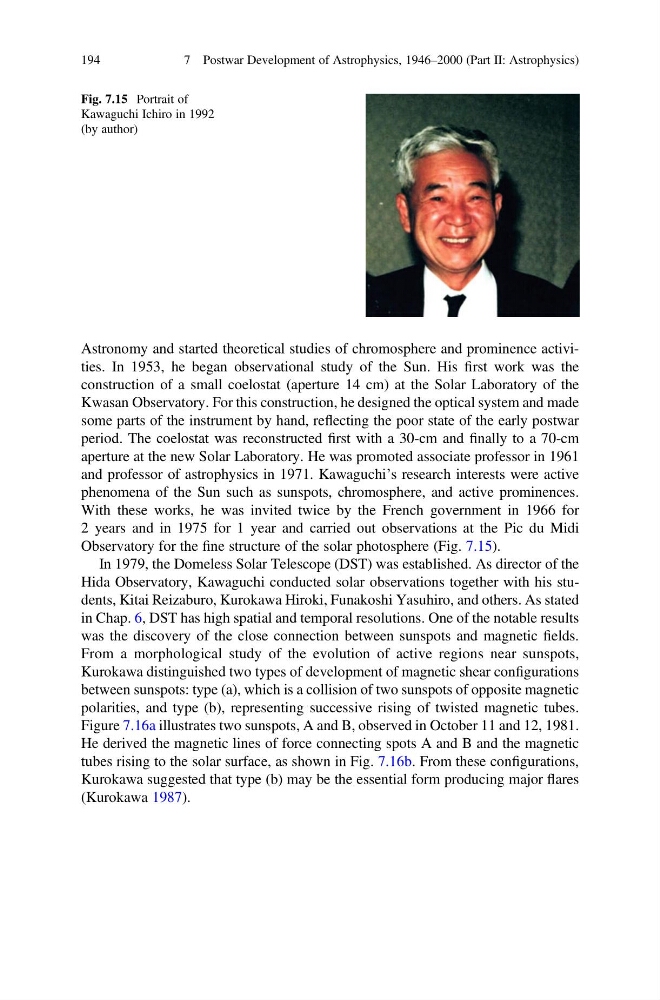
Observatory for the fine structure of the solar photosphere (Fig. 7.15).
In 1979, the Domeless Solar Telescope (DST) was established. As director of the
Hida Observatory, Kawaguchi conducted solar observations together with his students, Kitai Reizaburo, Kurokawa Hiroki, Funakoshi Yasuhiro, and others. As stated
in Chap. 6, DST has high spatial and temporal resolutions. One of the notable results
was the discovery of the close connection between sunspots and magnetic fields.
From a morphological study of the evolution of active regions near sunspots,
Kurokawa distinguished two types of development of magnetic shear configurations
between sunspots: type (a), which is a collision of two sunspots of opposite magnetic
polarities, and type (b), representing successive rising of twisted magnetic tubes.
Figure 7.16a illustrates two sunspots, A and B, observed in October 11 and 12, 1981.
He derived the magnetic lines of force connecting spots A and B and the magnetic
tubes rising to the solar surface, as shown in Fig. 7.16b. From these configurations,
Kurokawa suggested that type (b) may be the essential form producing major flares
(Kurokawa 1987).
Fig. 7.15 Portrait of
Kawaguchi Ichiro in 1992
(by author)
194
7 Postwar Development of Astrophysics, 1946–2000 (Part II: Astrophysics)
construction of a small coelostat (aperture 14 cm) at the Solar Laboratory of the
Kwasan Observatory. For this construction, he designed the optical system and made
some parts of the instrument by hand, reflecting the poor state of the early postwar
period. The coelostat was reconstructed first with a 30-cm and finally to a 70-cm
aperture at the new Solar Laboratory. He was promoted associate professor in 1961
and professor of astrophysics in 1971. Kawaguchi’s research interests were active
phenomena of the Sun such as sunspots, chromosphere, and active prominences.
With these works, he was invited twice by the French government in 1966 for
2 years and in 1975 for 1 year and carried out observations at the Pic du Midi
Observatory for the fine structure of the solar photosphere (Fig. 7.15).
In 1979, the Domeless Solar Telescope (DST) was established. As director of the
Hida Observatory, Kawaguchi conducted solar observations together with his students, Kitai Reizaburo, Kurokawa Hiroki, Funakoshi Yasuhiro, and others. As stated
in Chap. 6, DST has high spatial and temporal resolutions. One of the notable results
was the discovery of the close connection between sunspots and magnetic fields.
From a morphological study of the evolution of active regions near sunspots,
Kurokawa distinguished two types of development of magnetic shear configurations
between sunspots: type (a), which is a collision of two sunspots of opposite magnetic
polarities, and type (b), representing successive rising of twisted magnetic tubes.
Figure 7.16a illustrates two sunspots, A and B, observed in October 11 and 12, 1981.
He derived the magnetic lines of force connecting spots A and B and the magnetic
tubes rising to the solar surface, as shown in Fig. 7.16b. From these configurations,
Kurokawa suggested that type (b) may be the essential form producing major flares
(Kurokawa 1987).
Fig. 7.15 Portrait of
Kawaguchi Ichiro in 1992
(by author)
194
7 Postwar Development of Astrophysics, 1946–2000 (Part II: Astrophysics)