

being around 30,000 K. Redman and Suemoto analyzed the flash spectra taken at the
Khartoum total solar eclipse in 1952 and concluded that the kinetic temperature of
the chromosphere should not exceed 10,000 K (Redman and Suemoto 1954). This
was confirmation of the low-temperature model of Miyamoto proposed in 1950
(Chap. 4).
After returning to Mitaka, he continued making spectroscopic observations of
flares by constructing a new spectrograph attached to the Tower Telescope. Through
the analysis of Balmer lines he found that flares consisted of a filamentary structure
as thin as around 10 km in diameter for each filament (Suemoto and Hiei 1959).
In 1961, Suemoto was promoted to professor at the TAO. He joined the Department of Astronomy at the University of Tokyo in 1965 and returned to the TAO in
1977 as its director. He also devoted some attention to the development of space
observations and served as a professor of the Aeronautical Institute of the University
of Tokyo. He contributed to the launch of the solar X-ray satellite HINOTORI in
1981 as general manager of the project.
In 1991, he died at age 71. Suemoto’s works have been taken up by Hiei Eijiro,
Uchida Yutaka, and others (Hiei and Uchida 1993).
7.4.2 Solar Physics in Kyoto
In the same period as Suemoto, Miyamoto (Chap. 4) and his student Kawaguchi
Ichirro (川口市郎, 1924–2019) (Shibata et al. 2019) worked on the theoretical study
of solar physics.
Kawaguchi was born in Osaka and entered Matsumoto High School (old),
Nagano Prefecture, which was located near high mountains. He loved mountain
climbing his entire life. At Kyoto University, Kawaguchi studied astrophysics under
Miyamoto. After graduation in 1947 he worked in the same Department of
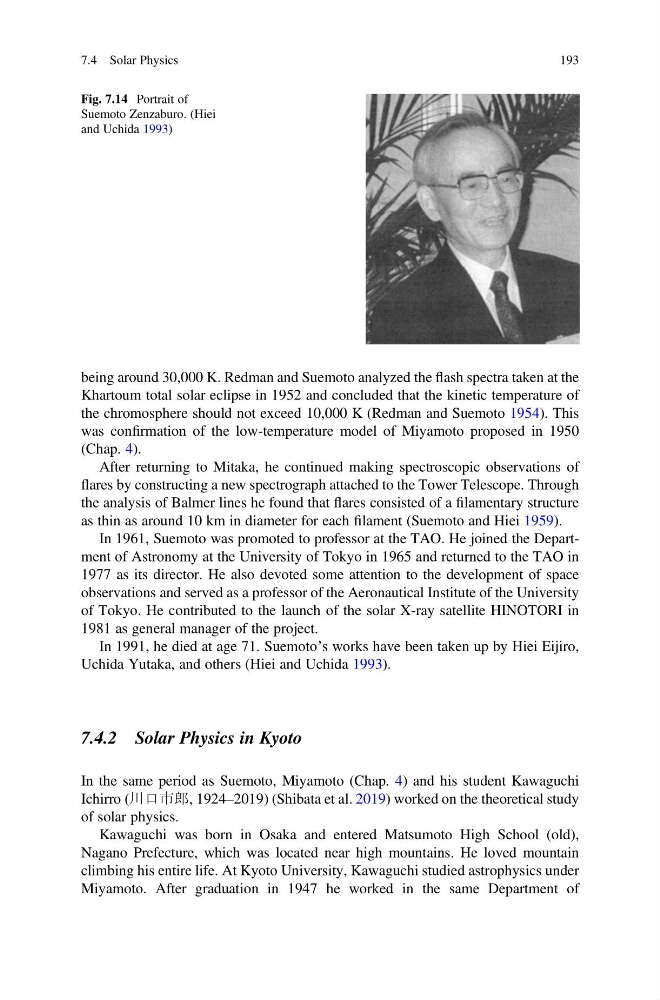
Fig. 7.14 Portrait of
Suemoto Zenzaburo. (Hiei
and Uchida 1993)
7.4 Solar Physics
193
Khartoum total solar eclipse in 1952 and concluded that the kinetic temperature of
the chromosphere should not exceed 10,000 K (Redman and Suemoto 1954). This
was confirmation of the low-temperature model of Miyamoto proposed in 1950
(Chap. 4).
After returning to Mitaka, he continued making spectroscopic observations of
flares by constructing a new spectrograph attached to the Tower Telescope. Through
the analysis of Balmer lines he found that flares consisted of a filamentary structure
as thin as around 10 km in diameter for each filament (Suemoto and Hiei 1959).
In 1961, Suemoto was promoted to professor at the TAO. He joined the Department of Astronomy at the University of Tokyo in 1965 and returned to the TAO in
1977 as its director. He also devoted some attention to the development of space
observations and served as a professor of the Aeronautical Institute of the University
of Tokyo. He contributed to the launch of the solar X-ray satellite HINOTORI in
1981 as general manager of the project.
In 1991, he died at age 71. Suemoto’s works have been taken up by Hiei Eijiro,
Uchida Yutaka, and others (Hiei and Uchida 1993).
7.4.2 Solar Physics in Kyoto
In the same period as Suemoto, Miyamoto (Chap. 4) and his student Kawaguchi
Ichirro (川口市郎, 1924–2019) (Shibata et al. 2019) worked on the theoretical study
of solar physics.
Kawaguchi was born in Osaka and entered Matsumoto High School (old),
Nagano Prefecture, which was located near high mountains. He loved mountain
climbing his entire life. At Kyoto University, Kawaguchi studied astrophysics under
Miyamoto. After graduation in 1947 he worked in the same Department of
Fig. 7.14 Portrait of
Suemoto Zenzaburo. (Hiei
and Uchida 1993)
7.4 Solar Physics
193