

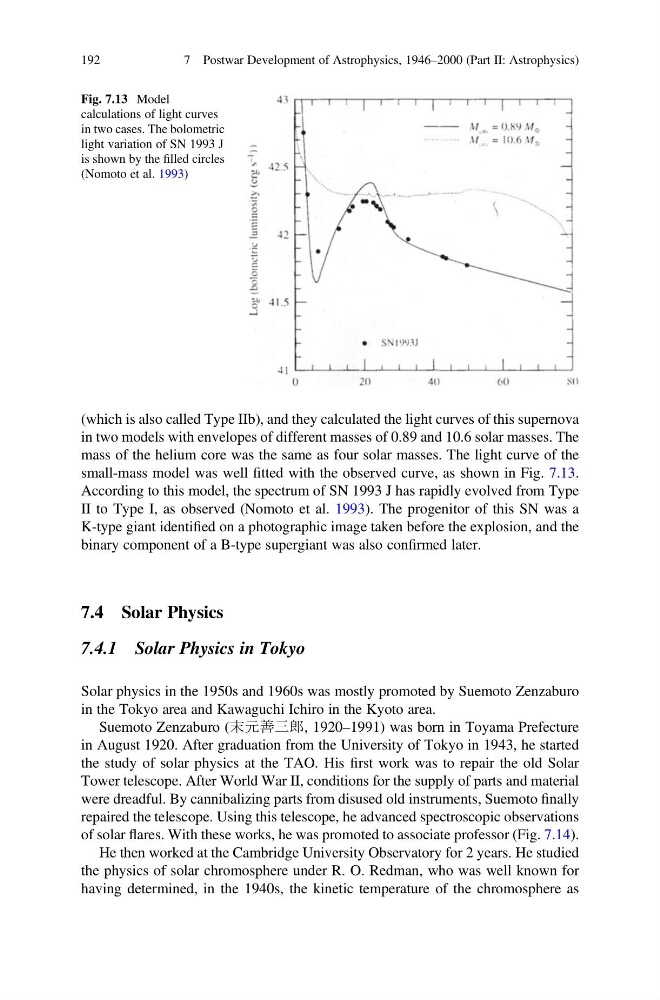
(which is also called Type IIb), and they calculated the light curves of this supernova
in two models with envelopes of different masses of 0.89 and 10.6 solar masses. The
mass of the helium core was the same as four solar masses. The light curve of the
small-mass model was well fitted with the observed curve, as shown in Fig. 7.13.
According to this model, the spectrum of SN 1993 J has rapidly evolved from Type
II to Type I, as observed (Nomoto et al. 1993). The progenitor of this SN was a
K-type giant identified on a photographic image taken before the explosion, and the
binary component of a B-type supergiant was also confirmed later.
7.4 Solar Physics
7.4.1 Solar Physics in Tokyo
Solar physics in the 1950s and 1960s was mostly promoted by Suemoto Zenzaburo
in the Tokyo area and Kawaguchi Ichiro in the Kyoto area.
Suemoto Zenzaburo (末元善三郎, 1920–1991) was born in Toyama Prefecture
in August 1920. After graduation from the University of Tokyo in 1943, he started
the study of solar physics at the TAO. His first work was to repair the old Solar
Tower telescope. After World War II, conditions for the supply of parts and material
were dreadful. By cannibalizing parts from disused old instruments, Suemoto finally
repaired the telescope. Using this telescope, he advanced spectroscopic observations
of solar flares. With these works, he was promoted to associate professor (Fig. 7.14).
He then worked at the Cambridge University Observatory for 2 years. He studied
the physics of solar chromosphere under R. O. Redman, who was well known for
having determined, in the 1940s, the kinetic temperature of the chromosphere as
Fig. 7.13 Model
calculations of light curves
in two cases. The bolometric
light variation of SN 1993 J
is shown by the filled circles
(Nomoto et al. 1993)
192
7 Postwar Development of Astrophysics, 1946–2000 (Part II: Astrophysics)
in two models with envelopes of different masses of 0.89 and 10.6 solar masses. The
mass of the helium core was the same as four solar masses. The light curve of the
small-mass model was well fitted with the observed curve, as shown in Fig. 7.13.
According to this model, the spectrum of SN 1993 J has rapidly evolved from Type
II to Type I, as observed (Nomoto et al. 1993). The progenitor of this SN was a
K-type giant identified on a photographic image taken before the explosion, and the
binary component of a B-type supergiant was also confirmed later.
7.4 Solar Physics
7.4.1 Solar Physics in Tokyo
Solar physics in the 1950s and 1960s was mostly promoted by Suemoto Zenzaburo
in the Tokyo area and Kawaguchi Ichiro in the Kyoto area.
Suemoto Zenzaburo (末元善三郎, 1920–1991) was born in Toyama Prefecture
in August 1920. After graduation from the University of Tokyo in 1943, he started
the study of solar physics at the TAO. His first work was to repair the old Solar
Tower telescope. After World War II, conditions for the supply of parts and material
were dreadful. By cannibalizing parts from disused old instruments, Suemoto finally
repaired the telescope. Using this telescope, he advanced spectroscopic observations
of solar flares. With these works, he was promoted to associate professor (Fig. 7.14).
He then worked at the Cambridge University Observatory for 2 years. He studied
the physics of solar chromosphere under R. O. Redman, who was well known for
having determined, in the 1940s, the kinetic temperature of the chromosphere as
Fig. 7.13 Model
calculations of light curves
in two cases. The bolometric
light variation of SN 1993 J
is shown by the filled circles
(Nomoto et al. 1993)
192
7 Postwar Development of Astrophysics, 1946–2000 (Part II: Astrophysics)