

their group found in 1987 that the early light curve can be accounted for by the
diffusive release of energy deposited by shock waves propagating from the star’s
center. SN 1987A yielded the first observations of the X-rays and gamma-rays
emitted from supernovae (Shigeyama et al. 1987, 1988).
Approximately 2 to 3 hours before the optical observations of SN 1987A, a burst
of neutrinos was observed as shown in Fig. 6.31. A neutrino burst indicates the time
of core collapse, which leads to an outward shock wave. Visible light was emitted
only after the shock wave reached the stellar surface.
When a massive star at the end of its life collapses into a neutron star or a black
hole, it radiates almost all its binding energy in the form of neutrinos, most of which
have energies in the range 10–30 MeV. These neutrinos are emitted over a timescale
of several tens of seconds. The neutrino luminosity of a gravitational core collapse is
typically 100 times higher than the optical luminosity. These behaviors of supernova
neutrinos were confirmed at first by the neutrino observations of SN 1987A (Hirata
et al. 1987).
Another supernova, SN 1993 J, appeared in the galaxy M81 and was also studied
by Nomoto’s group.
SN 1993 J was the second brightest supernova, next to SN 1987A, at the time.
This supernova was characterized by the appearance of the secondary light maximum after the primary maximum. Nomoto Ken’ichi, Suzuki Tomoharu, and their
group analyzed the time variation of the SN as a combination of Type II and Type Ib
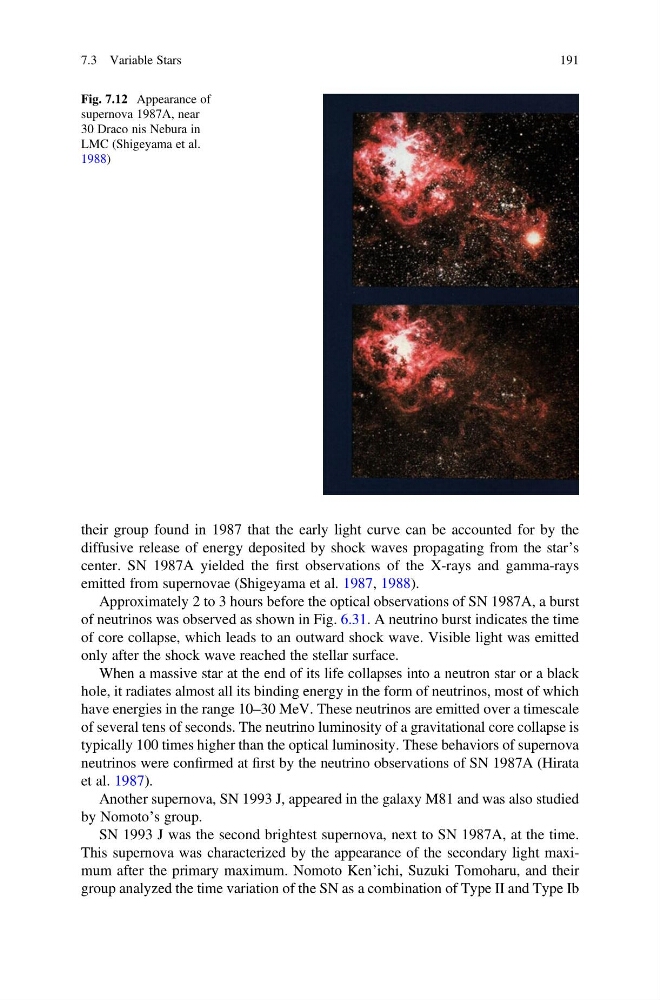
Fig. 7.12 Appearance of
supernova 1987A, near
30 Draco nis Nebura in
LMC (Shigeyama et al.
1988)
7.3 Variable Stars
191
diffusive release of energy deposited by shock waves propagating from the star’s
center. SN 1987A yielded the first observations of the X-rays and gamma-rays
emitted from supernovae (Shigeyama et al. 1987, 1988).
Approximately 2 to 3 hours before the optical observations of SN 1987A, a burst
of neutrinos was observed as shown in Fig. 6.31. A neutrino burst indicates the time
of core collapse, which leads to an outward shock wave. Visible light was emitted
only after the shock wave reached the stellar surface.
When a massive star at the end of its life collapses into a neutron star or a black
hole, it radiates almost all its binding energy in the form of neutrinos, most of which
have energies in the range 10–30 MeV. These neutrinos are emitted over a timescale
of several tens of seconds. The neutrino luminosity of a gravitational core collapse is
typically 100 times higher than the optical luminosity. These behaviors of supernova
neutrinos were confirmed at first by the neutrino observations of SN 1987A (Hirata
et al. 1987).
Another supernova, SN 1993 J, appeared in the galaxy M81 and was also studied
by Nomoto’s group.
SN 1993 J was the second brightest supernova, next to SN 1987A, at the time.
This supernova was characterized by the appearance of the secondary light maximum after the primary maximum. Nomoto Ken’ichi, Suzuki Tomoharu, and their
group analyzed the time variation of the SN as a combination of Type II and Type Ib
Fig. 7.12 Appearance of
supernova 1987A, near
30 Draco nis Nebura in
LMC (Shigeyama et al.
1988)
7.3 Variable Stars
191