

about the equilibrium point between the Sun and the Earth (Lagrange-1 point). With
these projects, observations of the lower p-mode and g-mode oscillations were
greatly advanced (Sekii 1998a, b).
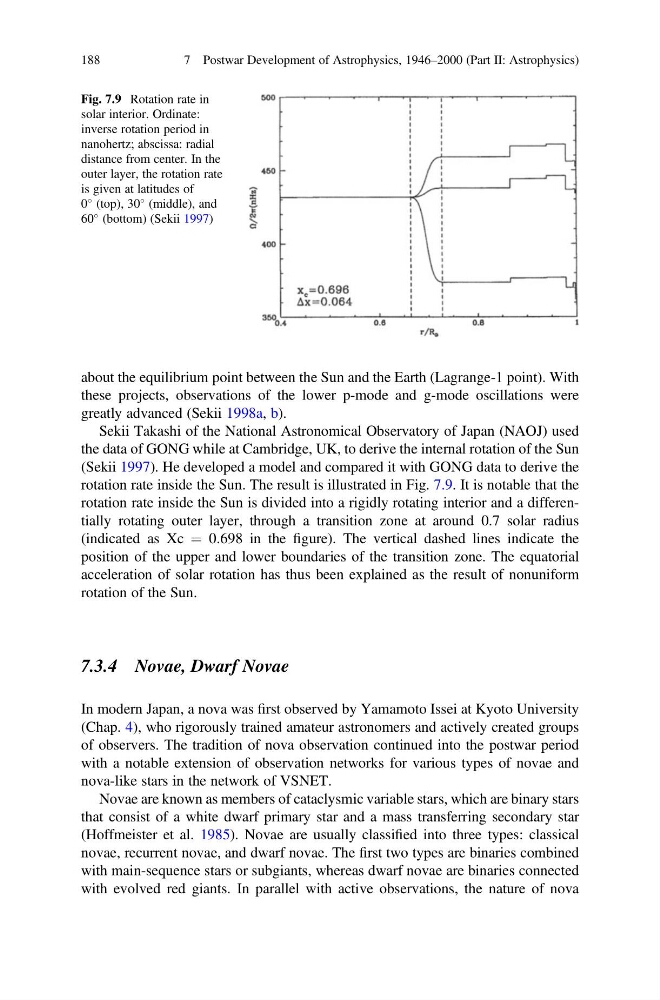
Sekii Takashi of the National Astronomical Observatory of Japan (NAOJ) used
the data of GONG while at Cambridge, UK, to derive the internal rotation of the Sun
(Sekii 1997). He developed a model and compared it with GONG data to derive the
rotation rate inside the Sun. The result is illustrated in Fig. 7.9. It is notable that the
rotation rate inside the Sun is divided into a rigidly rotating interior and a differentially rotating outer layer, through a transition zone at around 0.7 solar radius
(indicated as Xc ¼ 0.698 in the figure). The vertical dashed lines indicate the
position of the upper and lower boundaries of the transition zone. The equatorial
acceleration of solar rotation has thus been explained as the result of nonuniform
rotation of the Sun.
7.3.4 Novae, Dwarf Novae
In modern Japan, a nova was first observed by Yamamoto Issei at Kyoto University
(Chap. 4), who rigorously trained amateur astronomers and actively created groups
of observers. The tradition of nova observation continued into the postwar period
with a notable extension of observation networks for various types of novae and
nova-like stars in the network of VSNET.
Novae are known as members of cataclysmic variable stars, which are binary stars
that consist of a white dwarf primary star and a mass transferring secondary star
(Hoffmeister et al. 1985). Novae are usually classified into three types: classical
novae, recurrent novae, and dwarf novae. The first two types are binaries combined
with main-sequence stars or subgiants, whereas dwarf novae are binaries connected
with evolved red giants. In parallel with active observations, the nature of nova
Fig. 7.9 Rotation rate in
solar interior. Ordinate:
inverse rotation period in
nanohertz; abscissa: radial
distance from center. In the
outer layer, the rotation rate
is given at latitudes of
0
(top), 30
(middle), and
60
(bottom) (Sekii 1997)
188
7 Postwar Development of Astrophysics, 1946–2000 (Part II: Astrophysics)
these projects, observations of the lower p-mode and g-mode oscillations were
greatly advanced (Sekii 1998a, b).
Sekii Takashi of the National Astronomical Observatory of Japan (NAOJ) used
the data of GONG while at Cambridge, UK, to derive the internal rotation of the Sun
(Sekii 1997). He developed a model and compared it with GONG data to derive the
rotation rate inside the Sun. The result is illustrated in Fig. 7.9. It is notable that the
rotation rate inside the Sun is divided into a rigidly rotating interior and a differentially rotating outer layer, through a transition zone at around 0.7 solar radius
(indicated as Xc ¼ 0.698 in the figure). The vertical dashed lines indicate the
position of the upper and lower boundaries of the transition zone. The equatorial
acceleration of solar rotation has thus been explained as the result of nonuniform
rotation of the Sun.
7.3.4 Novae, Dwarf Novae
In modern Japan, a nova was first observed by Yamamoto Issei at Kyoto University
(Chap. 4), who rigorously trained amateur astronomers and actively created groups
of observers. The tradition of nova observation continued into the postwar period
with a notable extension of observation networks for various types of novae and
nova-like stars in the network of VSNET.
Novae are known as members of cataclysmic variable stars, which are binary stars
that consist of a white dwarf primary star and a mass transferring secondary star
(Hoffmeister et al. 1985). Novae are usually classified into three types: classical
novae, recurrent novae, and dwarf novae. The first two types are binaries combined
with main-sequence stars or subgiants, whereas dwarf novae are binaries connected
with evolved red giants. In parallel with active observations, the nature of nova
Fig. 7.9 Rotation rate in
solar interior. Ordinate:
inverse rotation period in
nanohertz; abscissa: radial
distance from center. In the
outer layer, the rotation rate
is given at latitudes of
0
(top), 30
(middle), and
60
(bottom) (Sekii 1997)
188
7 Postwar Development of Astrophysics, 1946–2000 (Part II: Astrophysics)