

phenomena has been widely studied in Japan. Particular attention is presented here
for the studies of dwarf novae by Osaki Yoji and Mineshige Shin (Fig. 7.10).
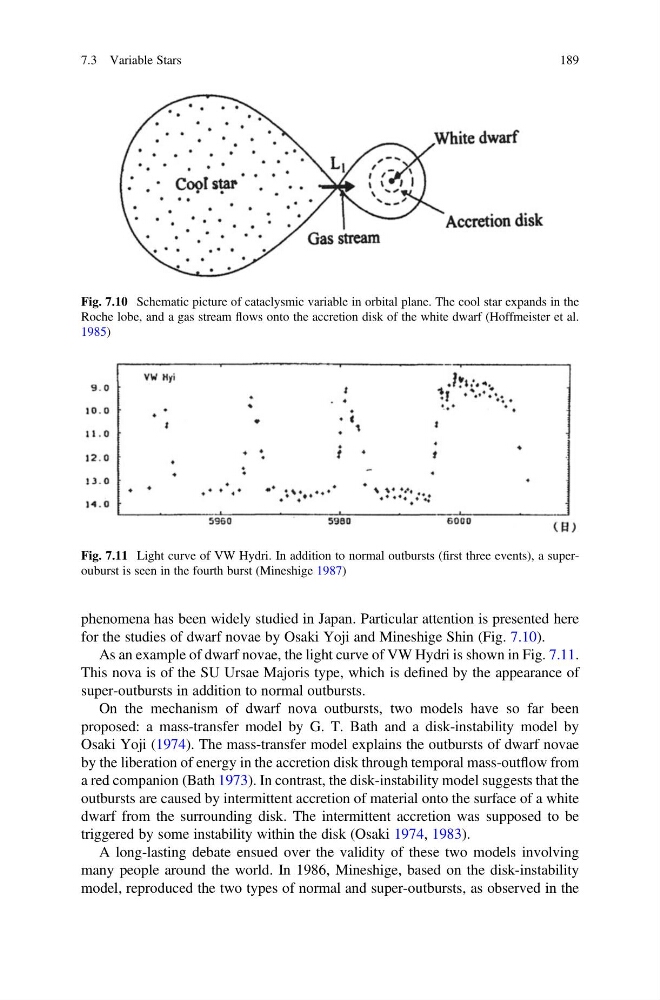
As an example of dwarf novae, the light curve of VW Hydri is shown in Fig. 7.11.
This nova is of the SU Ursae Majoris type, which is defined by the appearance of
super-outbursts in addition to normal outbursts.
On the mechanism of dwarf nova outbursts, two models have so far been
proposed: a mass-transfer model by G. T. Bath and a disk-instability model by
Osaki Yoji (1974). The mass-transfer model explains the outbursts of dwarf novae
by the liberation of energy in the accretion disk through temporal mass-outflow from
a red companion (Bath 1973). In contrast, the disk-instability model suggests that the
outbursts are caused by intermittent accretion of material onto the surface of a white
dwarf from the surrounding disk. The intermittent accretion was supposed to be
triggered by some instability within the disk (Osaki 1974, 1983).
A long-lasting debate ensued over the validity of these two models involving
many people around the world. In 1986, Mineshige, based on the disk-instability
model, reproduced the two types of normal and super-outbursts, as observed in the
Fig. 7.10 Schematic picture of cataclysmic variable in orbital plane. The cool star expands in the
Roche lobe, and a gas stream flows onto the accretion disk of the white dwarf (Hoffmeister et al.
1985)
Fig. 7.11 Light curve of VW Hydri. In addition to normal outbursts (first three events), a superouburst is seen in the fourth burst (Mineshige 1987)
7.3 Variable Stars
189
for the studies of dwarf novae by Osaki Yoji and Mineshige Shin (Fig. 7.10).
As an example of dwarf novae, the light curve of VW Hydri is shown in Fig. 7.11.
This nova is of the SU Ursae Majoris type, which is defined by the appearance of
super-outbursts in addition to normal outbursts.
On the mechanism of dwarf nova outbursts, two models have so far been
proposed: a mass-transfer model by G. T. Bath and a disk-instability model by
Osaki Yoji (1974). The mass-transfer model explains the outbursts of dwarf novae
by the liberation of energy in the accretion disk through temporal mass-outflow from
a red companion (Bath 1973). In contrast, the disk-instability model suggests that the
outbursts are caused by intermittent accretion of material onto the surface of a white
dwarf from the surrounding disk. The intermittent accretion was supposed to be
triggered by some instability within the disk (Osaki 1974, 1983).
A long-lasting debate ensued over the validity of these two models involving
many people around the world. In 1986, Mineshige, based on the disk-instability
model, reproduced the two types of normal and super-outbursts, as observed in the
Fig. 7.10 Schematic picture of cataclysmic variable in orbital plane. The cool star expands in the
Roche lobe, and a gas stream flows onto the accretion disk of the white dwarf (Hoffmeister et al.
1985)
Fig. 7.11 Light curve of VW Hydri. In addition to normal outbursts (first three events), a superouburst is seen in the fourth burst (Mineshige 1987)
7.3 Variable Stars
189