

were also confirmed. In the 1970s, the existence of g-mode oscillations was also
discovered, though not confirmed at the time.
Higher-mode oscillations, such as 5-min oscillations, are confined to the upper
layer of the Sun. Since temperature rises toward a deeper layer, and the sound
velocity also gets higher, then each mode of oscillation is reflected at some depth
and back to the surface with some information on the deep layer. Lower-mode
oscillations reach deeper layers of the solar interior. Different modes yield information on different inner layers. Thus, the nonradial oscillation of the Sun may allow
for the study of the physical structure of the solar interior. This new branch of science
was called helioseismology, and it was developed in connection with the deep
relationship with the theoretical physics of the internal solar structure starting in
the early 1980s (Shibahashi and Sekii 1993).
To observe nonradial oscillations in detail, long-term unbroken and stable observations are essential. For this purpose, two projects were launched in the late 1990s.
One was the Global Oscillation Network Group (GONG) project (1995), which was
a network of same-size telescopes distributed around the world to avoid discontinuities in observations of the Sun. The second was the SOHO satellite launched by the
European Space Agency (ESA) and the National Aeronautics and Space Administration (NASA) in 1995. SOHO was loaded with several instruments for observing
the Sun, including telescopes for gravity-mode oscillations. SOHO had an orbit
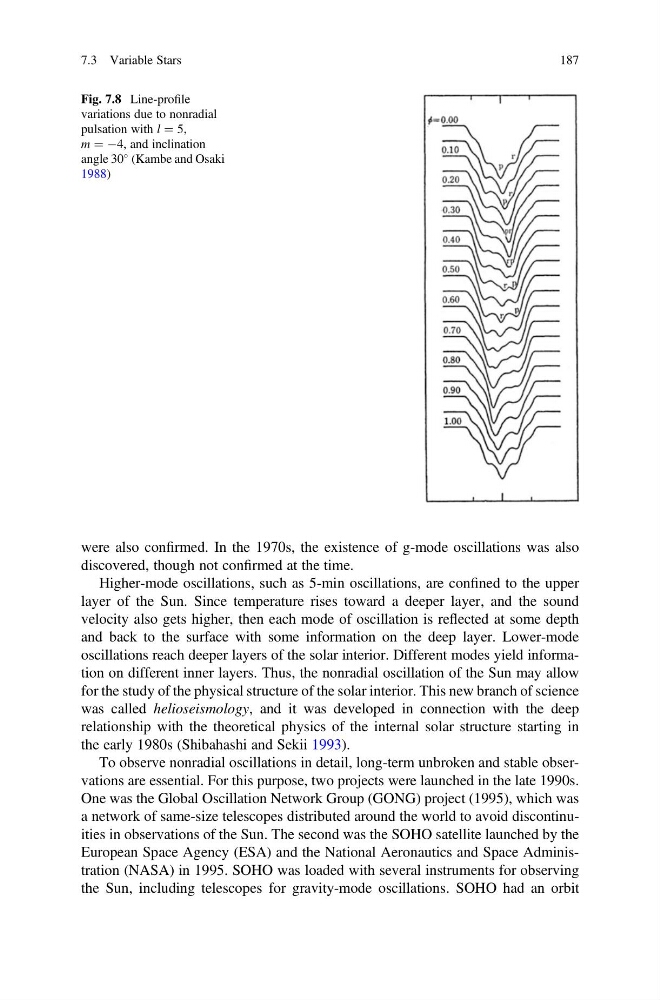
Fig. 7.8 Line-profile
variations due to nonradial
pulsation with l ¼ 5,
m ¼ À4, and inclination
angle 30
(Kambe and Osaki
1988)
7.3 Variable Stars
187
discovered, though not confirmed at the time.
Higher-mode oscillations, such as 5-min oscillations, are confined to the upper
layer of the Sun. Since temperature rises toward a deeper layer, and the sound
velocity also gets higher, then each mode of oscillation is reflected at some depth
and back to the surface with some information on the deep layer. Lower-mode
oscillations reach deeper layers of the solar interior. Different modes yield information on different inner layers. Thus, the nonradial oscillation of the Sun may allow
for the study of the physical structure of the solar interior. This new branch of science
was called helioseismology, and it was developed in connection with the deep
relationship with the theoretical physics of the internal solar structure starting in
the early 1980s (Shibahashi and Sekii 1993).
To observe nonradial oscillations in detail, long-term unbroken and stable observations are essential. For this purpose, two projects were launched in the late 1990s.
One was the Global Oscillation Network Group (GONG) project (1995), which was
a network of same-size telescopes distributed around the world to avoid discontinuities in observations of the Sun. The second was the SOHO satellite launched by the
European Space Agency (ESA) and the National Aeronautics and Space Administration (NASA) in 1995. SOHO was loaded with several instruments for observing
the Sun, including telescopes for gravity-mode oscillations. SOHO had an orbit
Fig. 7.8 Line-profile
variations due to nonradial
pulsation with l ¼ 5,
m ¼ À4, and inclination
angle 30
(Kambe and Osaki
1988)
7.3 Variable Stars
187