

width. In radial velocity, weak line doublings are seen in the interval of the phase
Φ ¼ 0.70–0.80. The arrow in the lower panel indicates the half-width for pure
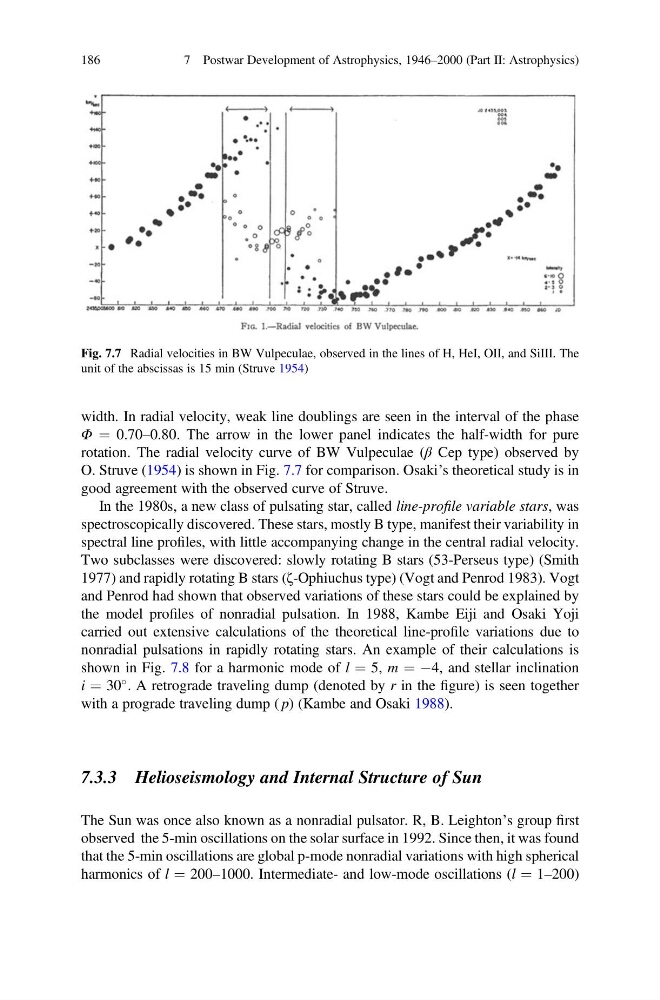
rotation. The radial velocity curve of BW Vulpeculae (β Cep type) observed by
O. Struve (1954) is shown in Fig. 7.7 for comparison. Osaki’s theoretical study is in
good agreement with the observed curve of Struve.
In the 1980s, a new class of pulsating star, called line-profile variable stars, was
spectroscopically discovered. These stars, mostly B type, manifest their variability in
spectral line profiles, with little accompanying change in the central radial velocity.
Two subclasses were discovered: slowly rotating B stars (53-Perseus type) (Smith
1977) and rapidly rotating B stars (ζ-Ophiuchus type) (Vogt and Penrod 1983). Vogt
and Penrod had shown that observed variations of these stars could be explained by
the model profiles of nonradial pulsation. In 1988, Kambe Eiji and Osaki Yoji
carried out extensive calculations of the theoretical line-profile variations due to
nonradial pulsations in rapidly rotating stars. An example of their calculations is
shown in Fig. 7.8 for a harmonic mode of l ¼ 5, m ¼ À4, and stellar inclination
i ¼ 30
. A retrograde traveling dump (denoted by r in the figure) is seen together
with a prograde traveling dump ( p) (Kambe and Osaki 1988).
7.3.3 Helioseismology and Internal Structure of Sun
The Sun was once also known as a nonradial pulsator. R, B. Leighton’s group first
observed the 5-min oscillations on the solar surface in 1992. Since then, it was found
that the 5-min oscillations are global p-mode nonradial variations with high spherical
harmonics of l ¼ 200–1000. Intermediate- and low-mode oscillations (l ¼ 1–200)
Fig. 7.7 Radial velocities in BW Vulpeculae, observed in the lines of H, HeI, OII, and SiIII. The
unit of the abscissas is 15 min (Struve 1954)
186
7 Postwar Development of Astrophysics, 1946–2000 (Part II: Astrophysics)
Φ ¼ 0.70–0.80. The arrow in the lower panel indicates the half-width for pure
rotation. The radial velocity curve of BW Vulpeculae (β Cep type) observed by
O. Struve (1954) is shown in Fig. 7.7 for comparison. Osaki’s theoretical study is in
good agreement with the observed curve of Struve.
In the 1980s, a new class of pulsating star, called line-profile variable stars, was
spectroscopically discovered. These stars, mostly B type, manifest their variability in
spectral line profiles, with little accompanying change in the central radial velocity.
Two subclasses were discovered: slowly rotating B stars (53-Perseus type) (Smith
1977) and rapidly rotating B stars (ζ-Ophiuchus type) (Vogt and Penrod 1983). Vogt
and Penrod had shown that observed variations of these stars could be explained by
the model profiles of nonradial pulsation. In 1988, Kambe Eiji and Osaki Yoji
carried out extensive calculations of the theoretical line-profile variations due to
nonradial pulsations in rapidly rotating stars. An example of their calculations is
shown in Fig. 7.8 for a harmonic mode of l ¼ 5, m ¼ À4, and stellar inclination
i ¼ 30
. A retrograde traveling dump (denoted by r in the figure) is seen together
with a prograde traveling dump ( p) (Kambe and Osaki 1988).
7.3.3 Helioseismology and Internal Structure of Sun
The Sun was once also known as a nonradial pulsator. R, B. Leighton’s group first
observed the 5-min oscillations on the solar surface in 1992. Since then, it was found
that the 5-min oscillations are global p-mode nonradial variations with high spherical
harmonics of l ¼ 200–1000. Intermediate- and low-mode oscillations (l ¼ 1–200)
Fig. 7.7 Radial velocities in BW Vulpeculae, observed in the lines of H, HeI, OII, and SiIII. The
unit of the abscissas is 15 min (Struve 1954)
186
7 Postwar Development of Astrophysics, 1946–2000 (Part II: Astrophysics)