

6.6.4 Kamiokande and Cosmic Neutrinos
Kamiokande was constructed in 1983 in the deep interior of the Kamioka mine,
1000-m below sea level. Kamiokande means the Kamioka Nucleon Decay Experiment, the Kamioka Neutrino Detection Experiment, or both. The original purpose of
this facility was to detect the proton decay anticipated in the grand unified theory of
elementary particle physics. The construction of Kamiokande was conducted by
Koshiba Masatoshi (小柴昌俊) of the University of Tokyo, and Kamiokande was
update to Kamiokande-II in the fall of 1985. Since the facility was able to detect
cosmic neutrinos, Kamiokande also played a role as a neutrino observatory.
When the supernova SN 1987A erupted, the neutrino burst was detected at three
sites: Kamiokande-II (Japan, 25 neutrinos), Irvine-Michigan-Brookhaven (IMB)
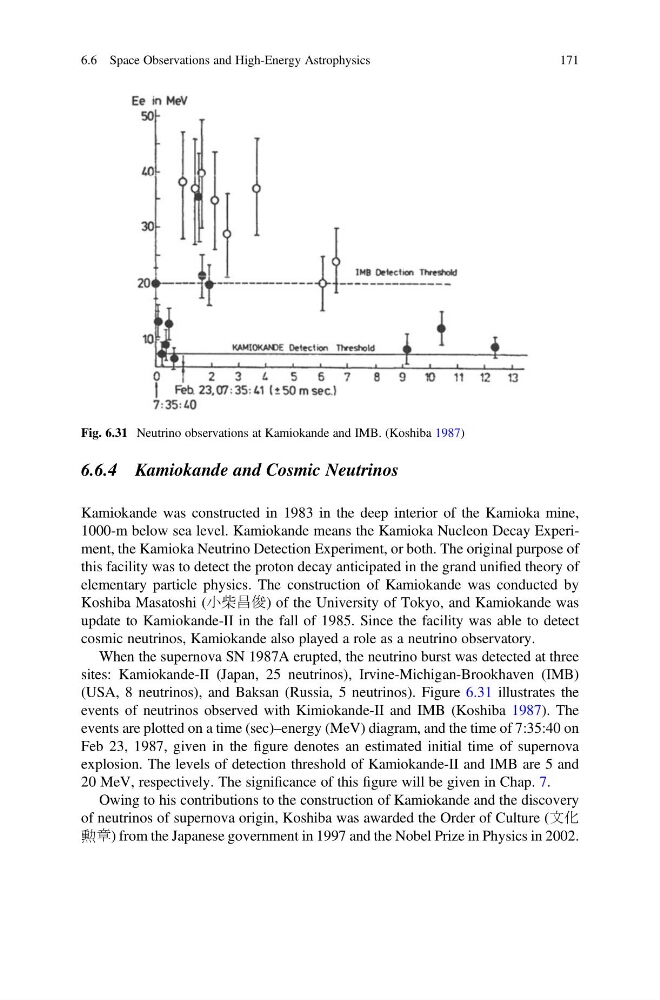
(USA, 8 neutrinos), and Baksan (Russia, 5 neutrinos). Figure 6.31 illustrates the
events of neutrinos observed with Kimiokande-II and IMB (Koshiba 1987). The
events are plotted on a time (sec)–energy (MeV) diagram, and the time of 7:35:40 on
Feb 23, 1987, given in the figure denotes an estimated initial time of supernova
explosion. The levels of detection threshold of Kamiokande-II and IMB are 5 and
20 MeV, respectively. The significance of this figure will be given in Chap. 7.
Owing to his contributions to the construction of Kamiokande and the discovery
of neutrinos of supernova origin, Koshiba was awarded the Order of Culture (文化
勲章) from the Japanese government in 1997 and the Nobel Prize in Physics in 2002.
Fig. 6.31 Neutrino observations at Kamiokande and IMB. (Koshiba 1987)
6.6 Space Observations and High-Energy Astrophysics
171
Kamiokande was constructed in 1983 in the deep interior of the Kamioka mine,
1000-m below sea level. Kamiokande means the Kamioka Nucleon Decay Experiment, the Kamioka Neutrino Detection Experiment, or both. The original purpose of
this facility was to detect the proton decay anticipated in the grand unified theory of
elementary particle physics. The construction of Kamiokande was conducted by
Koshiba Masatoshi (小柴昌俊) of the University of Tokyo, and Kamiokande was
update to Kamiokande-II in the fall of 1985. Since the facility was able to detect
cosmic neutrinos, Kamiokande also played a role as a neutrino observatory.
When the supernova SN 1987A erupted, the neutrino burst was detected at three
sites: Kamiokande-II (Japan, 25 neutrinos), Irvine-Michigan-Brookhaven (IMB)
(USA, 8 neutrinos), and Baksan (Russia, 5 neutrinos). Figure 6.31 illustrates the
events of neutrinos observed with Kimiokande-II and IMB (Koshiba 1987). The
events are plotted on a time (sec)–energy (MeV) diagram, and the time of 7:35:40 on
Feb 23, 1987, given in the figure denotes an estimated initial time of supernova
explosion. The levels of detection threshold of Kamiokande-II and IMB are 5 and
20 MeV, respectively. The significance of this figure will be given in Chap. 7.
Owing to his contributions to the construction of Kamiokande and the discovery
of neutrinos of supernova origin, Koshiba was awarded the Order of Culture (文化
勲章) from the Japanese government in 1997 and the Nobel Prize in Physics in 2002.
Fig. 6.31 Neutrino observations at Kamiokande and IMB. (Koshiba 1987)
6.6 Space Observations and High-Energy Astrophysics
171