

2. TENMA (1983–1988): With the X-ray spectral analyzer boarded, TENMA
obtained X-ray spectra of various X-ray stars with high energy resolution. The
first discovery was the distribution of hot plasma at temperatures of several tens of
millions of degrees along the galactic plane. The satellite also discovered and
analyzed iron absorption lines in the X-ray spectra in many low-mass X-ray
binaries (LMXRB), high-mass X-ray binaries (HMXRB), and active galactic
nuclei (AGN).
3. GINGA (1987–1991): Just after the launch, a supernova appeared in the LMC.
GINGA successfully observed X-ray emissions from the supernova. In addition,
GINGA conducted a wide survey of X-ray objects in the Galaxy, including blackhole candidates, high-temperature plasma inside dark nebulae, flare bursts in
binary systems, extragalactic X-rays in the nuclei of Seyfert galaxies, and so
on. GINGA also was installed with a gamma-ray burst detector (GBD) and
discovered more than 30 events of γ-ray bursts.
4. ASCA (1993–2001): With an X-ray CCD camera and an imaging spectrometer,
ASCA carried out precise X-ray observations of various celestial objects in the
Universe, including a supernova that appeared in 1993 in the M81 galaxy, X-ray
observations of γ-ray bursts, and a distant cluster of galaxies located at a distance
of 7000 million light-years.
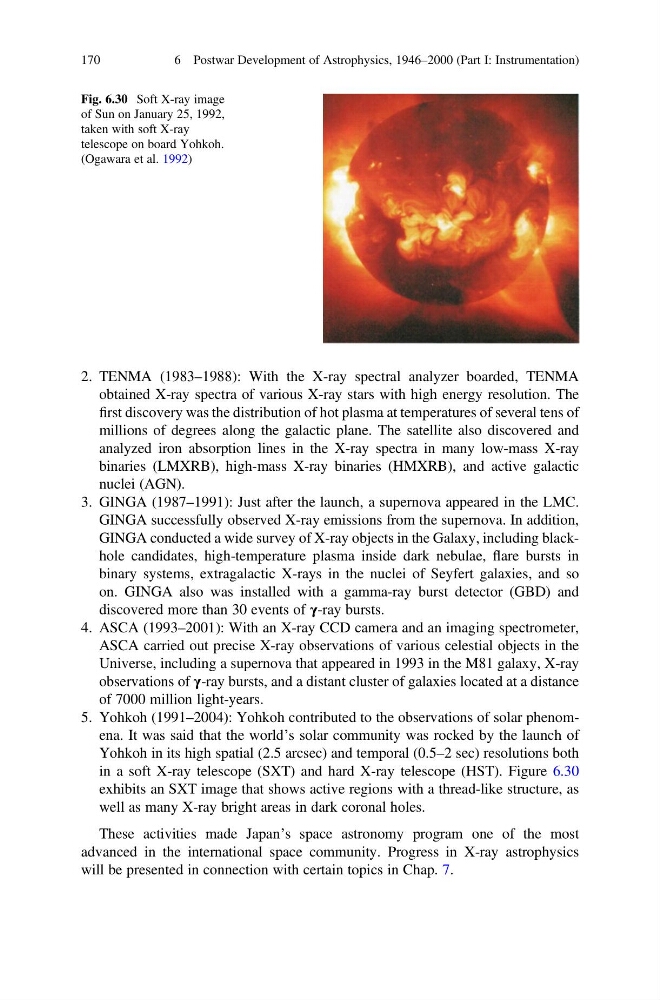
5. Yohkoh (1991–2004): Yohkoh contributed to the observations of solar phenomena. It was said that the world’s solar community was rocked by the launch of
Yohkoh in its high spatial (2.5 arcsec) and temporal (0.5–2 sec) resolutions both
in a soft X-ray telescope (SXT) and hard X-ray telescope (HST). Figure 6.30
exhibits an SXT image that shows active regions with a thread-like structure, as
well as many X-ray bright areas in dark coronal holes.
These activities made Japan’s space astronomy program one of the most
advanced in the international space community. Progress in X-ray astrophysics
will be presented in connection with certain topics in Chap. 7.
Fig. 6.30 Soft X-ray image
of Sun on January 25, 1992,
taken with soft X-ray
telescope on board Yohkoh.
(Ogawara et al. 1992)
170
6 Postwar Development of Astrophysics, 1946–2000 (Part I: Instrumentation)
obtained X-ray spectra of various X-ray stars with high energy resolution. The
first discovery was the distribution of hot plasma at temperatures of several tens of
millions of degrees along the galactic plane. The satellite also discovered and
analyzed iron absorption lines in the X-ray spectra in many low-mass X-ray
binaries (LMXRB), high-mass X-ray binaries (HMXRB), and active galactic
nuclei (AGN).
3. GINGA (1987–1991): Just after the launch, a supernova appeared in the LMC.
GINGA successfully observed X-ray emissions from the supernova. In addition,
GINGA conducted a wide survey of X-ray objects in the Galaxy, including blackhole candidates, high-temperature plasma inside dark nebulae, flare bursts in
binary systems, extragalactic X-rays in the nuclei of Seyfert galaxies, and so
on. GINGA also was installed with a gamma-ray burst detector (GBD) and
discovered more than 30 events of γ-ray bursts.
4. ASCA (1993–2001): With an X-ray CCD camera and an imaging spectrometer,
ASCA carried out precise X-ray observations of various celestial objects in the
Universe, including a supernova that appeared in 1993 in the M81 galaxy, X-ray
observations of γ-ray bursts, and a distant cluster of galaxies located at a distance
of 7000 million light-years.
5. Yohkoh (1991–2004): Yohkoh contributed to the observations of solar phenomena. It was said that the world’s solar community was rocked by the launch of
Yohkoh in its high spatial (2.5 arcsec) and temporal (0.5–2 sec) resolutions both
in a soft X-ray telescope (SXT) and hard X-ray telescope (HST). Figure 6.30
exhibits an SXT image that shows active regions with a thread-like structure, as
well as many X-ray bright areas in dark coronal holes.
These activities made Japan’s space astronomy program one of the most
advanced in the international space community. Progress in X-ray astrophysics
will be presented in connection with certain topics in Chap. 7.
Fig. 6.30 Soft X-ray image
of Sun on January 25, 1992,
taken with soft X-ray
telescope on board Yohkoh.
(Ogawara et al. 1992)
170
6 Postwar Development of Astrophysics, 1946–2000 (Part I: Instrumentation)