

in Japanese universities was still traditional, such that apprenticeships at universities
lasted into the Taisho and early Showa eras. Therefore, Oda’s attitude to science had
a significant influence on the modernization of Japanese science in the 1960s
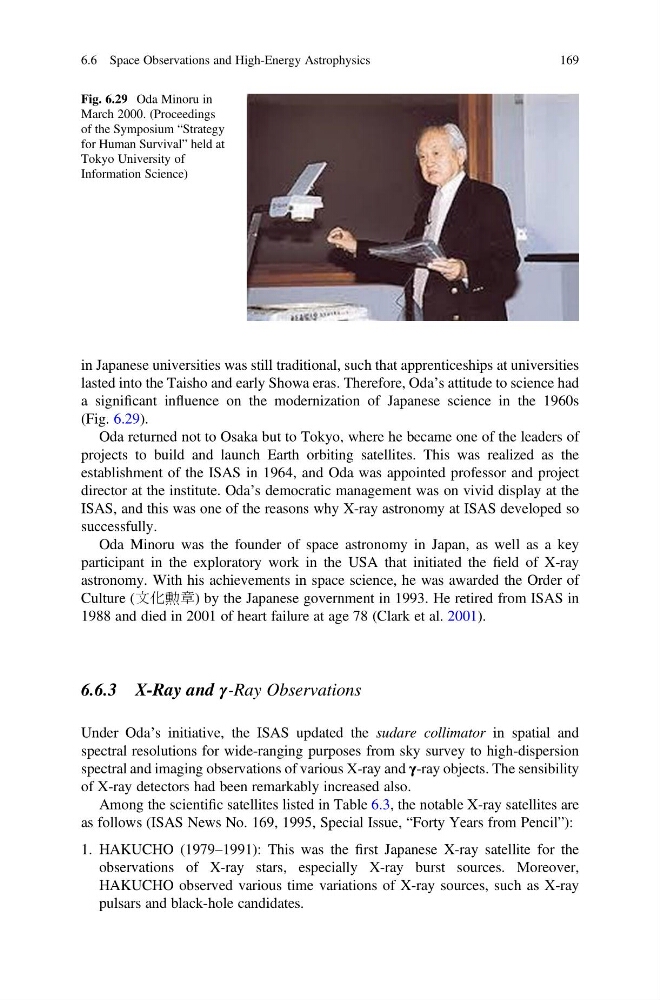
(Fig. 6.29).
Oda returned not to Osaka but to Tokyo, where he became one of the leaders of
projects to build and launch Earth orbiting satellites. This was realized as the
establishment of the ISAS in 1964, and Oda was appointed professor and project
director at the institute. Oda’s democratic management was on vivid display at the
ISAS, and this was one of the reasons why X-ray astronomy at ISAS developed so
successfully.
Oda Minoru was the founder of space astronomy in Japan, as well as a key
participant in the exploratory work in the USA that initiated the field of X-ray
astronomy. With his achievements in space science, he was awarded the Order of
Culture (文化勲章) by the Japanese government in 1993. He retired from ISAS in
1988 and died in 2001 of heart failure at age 78 (Clark et al. 2001).
6.6.3 X-Ray and γ-Ray Observations
Under Oda’s initiative, the ISAS updated the sudare collimator in spatial and
spectral resolutions for wide-ranging purposes from sky survey to high-dispersion
spectral and imaging observations of various X-ray and γ-ray objects. The sensibility
of X-ray detectors had been remarkably increased also.
Among the scientific satellites listed in Table 6.3, the notable X-ray satellites are
as follows (ISAS News No. 169, 1995, Special Issue, “Forty Years from Pencil”):
1. HAKUCHO (1979–1991): This was the first Japanese X-ray satellite for the
observations of X-ray stars, especially X-ray burst sources. Moreover,
HAKUCHO observed various time variations of X-ray sources, such as X-ray
pulsars and black-hole candidates.
Fig. 6.29 Oda Minoru in
March 2000. (Proceedings
of the Symposium “Strategy
for Human Survival” held at
Tokyo University of
Information Science)
6.6 Space Observations and High-Energy Astrophysics
169
lasted into the Taisho and early Showa eras. Therefore, Oda’s attitude to science had
a significant influence on the modernization of Japanese science in the 1960s
(Fig. 6.29).
Oda returned not to Osaka but to Tokyo, where he became one of the leaders of
projects to build and launch Earth orbiting satellites. This was realized as the
establishment of the ISAS in 1964, and Oda was appointed professor and project
director at the institute. Oda’s democratic management was on vivid display at the
ISAS, and this was one of the reasons why X-ray astronomy at ISAS developed so
successfully.
Oda Minoru was the founder of space astronomy in Japan, as well as a key
participant in the exploratory work in the USA that initiated the field of X-ray
astronomy. With his achievements in space science, he was awarded the Order of
Culture (文化勲章) by the Japanese government in 1993. He retired from ISAS in
1988 and died in 2001 of heart failure at age 78 (Clark et al. 2001).
6.6.3 X-Ray and γ-Ray Observations
Under Oda’s initiative, the ISAS updated the sudare collimator in spatial and
spectral resolutions for wide-ranging purposes from sky survey to high-dispersion
spectral and imaging observations of various X-ray and γ-ray objects. The sensibility
of X-ray detectors had been remarkably increased also.
Among the scientific satellites listed in Table 6.3, the notable X-ray satellites are
as follows (ISAS News No. 169, 1995, Special Issue, “Forty Years from Pencil”):
1. HAKUCHO (1979–1991): This was the first Japanese X-ray satellite for the
observations of X-ray stars, especially X-ray burst sources. Moreover,
HAKUCHO observed various time variations of X-ray sources, such as X-ray
pulsars and black-hole candidates.
Fig. 6.29 Oda Minoru in
March 2000. (Proceedings
of the Symposium “Strategy
for Human Survival” held at
Tokyo University of
Information Science)
6.6 Space Observations and High-Energy Astrophysics
169