

6.6.2 Oda Minoru and X-Ray Astronomy
1. Uhuru and X-ray observations
In 1970, the first X-ray satellite, UHURU, was launched from NASA’s San Marco
launch platform in Kenya. UHURU means freedom in Swahili. UHURU loaded the
sudare collimator (the modulation collimator, a device of two or more layers of
parallel wires), invented by Oda Minoru (Oda 1965). Since the sudare collimator had
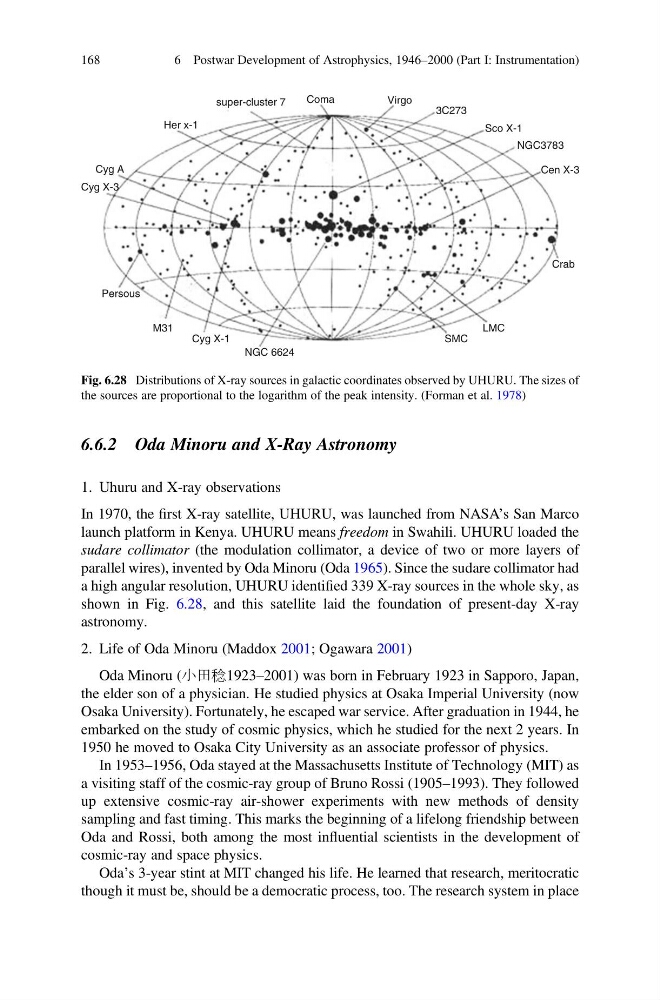
a high angular resolution, UHURU identified 339 X-ray sources in the whole sky, as
shown in Fig. 6.28, and this satellite laid the foundation of present-day X-ray
astronomy.
2. Life of Oda Minoru (Maddox 2001; Ogawara 2001)
Oda Minoru (小田稔1923–2001) was born in February 1923 in Sapporo, Japan,
the elder son of a physician. He studied physics at Osaka Imperial University (now
Osaka University). Fortunately, he escaped war service. After graduation in 1944, he
embarked on the study of cosmic physics, which he studied for the next 2 years. In
1950 he moved to Osaka City University as an associate professor of physics.
In 1953–1956, Oda stayed at the Massachusetts Institute of Technology (MIT) as
a visiting staff of the cosmic-ray group of Bruno Rossi (1905–1993). They followed
up extensive cosmic-ray air-shower experiments with new methods of density
sampling and fast timing. This marks the beginning of a lifelong friendship between
Oda and Rossi, both among the most influential scientists in the development of
cosmic-ray and space physics.
Oda’s 3-year stint at MIT changed his life. He learned that research, meritocratic
though it must be, should be a democratic process, too. The research system in place
super-cluster 7
Coma
Virgo
3C273
Sco X-1
NGC3783
Cen X-3
Crab
LMC
SMC
NGC 6624
Cyg X-1
M31
Persous
Cyg X-3
Cyg A
Her x-1
Fig. 6.28 Distributions of X-ray sources in galactic coordinates observed by UHURU. The sizes of
the sources are proportional to the logarithm of the peak intensity. (Forman et al. 1978)
168
6 Postwar Development of Astrophysics, 1946–2000 (Part I: Instrumentation)
1. Uhuru and X-ray observations
In 1970, the first X-ray satellite, UHURU, was launched from NASA’s San Marco
launch platform in Kenya. UHURU means freedom in Swahili. UHURU loaded the
sudare collimator (the modulation collimator, a device of two or more layers of
parallel wires), invented by Oda Minoru (Oda 1965). Since the sudare collimator had
a high angular resolution, UHURU identified 339 X-ray sources in the whole sky, as
shown in Fig. 6.28, and this satellite laid the foundation of present-day X-ray
astronomy.
2. Life of Oda Minoru (Maddox 2001; Ogawara 2001)
Oda Minoru (小田稔1923–2001) was born in February 1923 in Sapporo, Japan,
the elder son of a physician. He studied physics at Osaka Imperial University (now
Osaka University). Fortunately, he escaped war service. After graduation in 1944, he
embarked on the study of cosmic physics, which he studied for the next 2 years. In
1950 he moved to Osaka City University as an associate professor of physics.
In 1953–1956, Oda stayed at the Massachusetts Institute of Technology (MIT) as
a visiting staff of the cosmic-ray group of Bruno Rossi (1905–1993). They followed
up extensive cosmic-ray air-shower experiments with new methods of density
sampling and fast timing. This marks the beginning of a lifelong friendship between
Oda and Rossi, both among the most influential scientists in the development of
cosmic-ray and space physics.
Oda’s 3-year stint at MIT changed his life. He learned that research, meritocratic
though it must be, should be a democratic process, too. The research system in place
super-cluster 7
Coma
Virgo
3C273
Sco X-1
NGC3783
Cen X-3
Crab
LMC
SMC
NGC 6624
Cyg X-1
M31
Persous
Cyg X-3
Cyg A
Her x-1
Fig. 6.28 Distributions of X-ray sources in galactic coordinates observed by UHURU. The sizes of
the sources are proportional to the logarithm of the peak intensity. (Forman et al. 1978)
168
6 Postwar Development of Astrophysics, 1946–2000 (Part I: Instrumentation)