

follow the solar orbit in interplanetary space. It observed the solar-wind magnetic
field and plasma activities near Comet Halley at its near-perihelion stage.
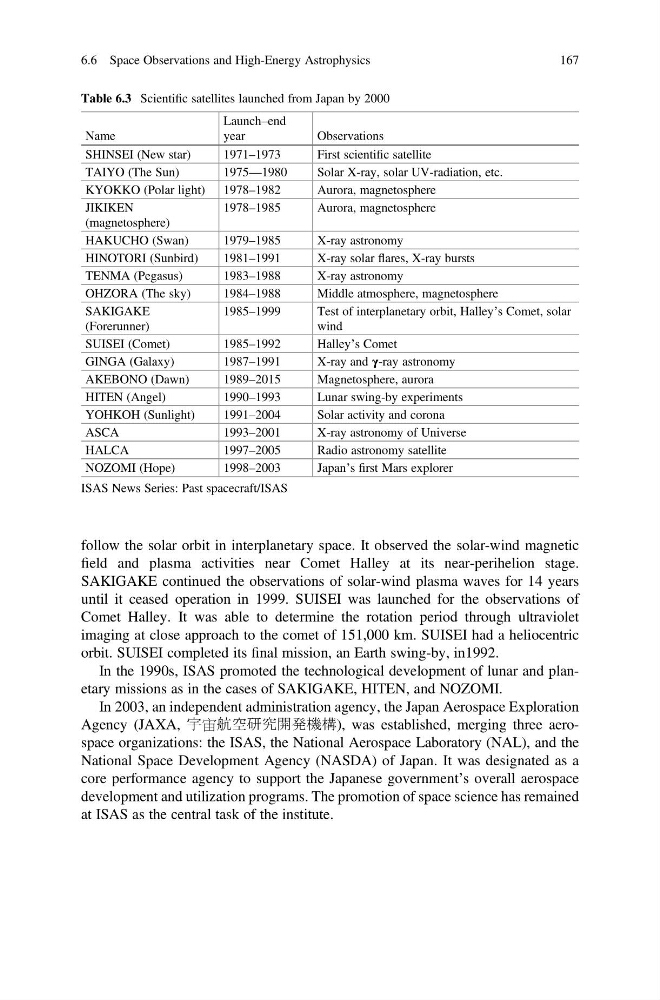
SAKIGAKE continued the observations of solar-wind plasma waves for 14 years
until it ceased operation in 1999. SUISEI was launched for the observations of
Comet Halley. It was able to determine the rotation period through ultraviolet
imaging at close approach to the comet of 151,000 km. SUISEI had a heliocentric
orbit. SUISEI completed its final mission, an Earth swing-by, in1992.
In the 1990s, ISAS promoted the technological development of lunar and planetary missions as in the cases of SAKIGAKE, HITEN, and NOZOMI.
In 2003, an independent administration agency, the Japan Aerospace Exploration
Agency (JAXA, 宇宙航空研究開発機構), was established, merging three aerospace organizations: the ISAS, the National Aerospace Laboratory (NAL), and the
National Space Development Agency (NASDA) of Japan. It was designated as a
core performance agency to support the Japanese government’s overall aerospace
development and utilization programs. The promotion of space science has remained
at ISAS as the central task of the institute.
Table 6.3 Scientific satellites launched from Japan by 2000
Name
Launch–end
year
Observations
SHINSEI (New star)
1971–1973
First scientific satellite
TAIYO (The Sun)
1975—1980
Solar X-ray, solar UV-radiation, etc.
KYOKKO (Polar light) 1978–1982
Aurora, magnetosphere
JIKIKEN
(magnetosphere)
1978–1985
Aurora, magnetosphere
HAKUCHO (Swan)
1979–1985
X-ray astronomy
HINOTORI (Sunbird)
1981–1991
X-ray solar flares, X-ray bursts
TENMA (Pegasus)
1983–1988
X-ray astronomy
OHZORA (The sky)
1984–1988
Middle atmosphere, magnetosphere
SAKIGAKE
(Forerunner)
1985–1999
Test of interplanetary orbit, Halley’s Comet, solar
wind
SUISEI (Comet)
1985–1992
Halley’s Comet
GINGA (Galaxy)
1987–1991
X-ray and γ-ray astronomy
AKEBONO (Dawn)
1989–2015
Magnetosphere, aurora
HITEN (Angel)
1990–1993
Lunar swing-by experiments
YOHKOH (Sunlight)
1991–2004
Solar activity and corona
ASCA
1993–2001
X-ray astronomy of Universe
HALCA
1997–2005
Radio astronomy satellite
NOZOMI (Hope)
1998–2003
Japan’s first Mars explorer
ISAS News Series: Past spacecraft/ISAS
6.6 Space Observations and High-Energy Astrophysics
167
field and plasma activities near Comet Halley at its near-perihelion stage.
SAKIGAKE continued the observations of solar-wind plasma waves for 14 years
until it ceased operation in 1999. SUISEI was launched for the observations of
Comet Halley. It was able to determine the rotation period through ultraviolet
imaging at close approach to the comet of 151,000 km. SUISEI had a heliocentric
orbit. SUISEI completed its final mission, an Earth swing-by, in1992.
In the 1990s, ISAS promoted the technological development of lunar and planetary missions as in the cases of SAKIGAKE, HITEN, and NOZOMI.
In 2003, an independent administration agency, the Japan Aerospace Exploration
Agency (JAXA, 宇宙航空研究開発機構), was established, merging three aerospace organizations: the ISAS, the National Aerospace Laboratory (NAL), and the
National Space Development Agency (NASDA) of Japan. It was designated as a
core performance agency to support the Japanese government’s overall aerospace
development and utilization programs. The promotion of space science has remained
at ISAS as the central task of the institute.
Table 6.3 Scientific satellites launched from Japan by 2000
Name
Launch–end
year
Observations
SHINSEI (New star)
1971–1973
First scientific satellite
TAIYO (The Sun)
1975—1980
Solar X-ray, solar UV-radiation, etc.
KYOKKO (Polar light) 1978–1982
Aurora, magnetosphere
JIKIKEN
(magnetosphere)
1978–1985
Aurora, magnetosphere
HAKUCHO (Swan)
1979–1985
X-ray astronomy
HINOTORI (Sunbird)
1981–1991
X-ray solar flares, X-ray bursts
TENMA (Pegasus)
1983–1988
X-ray astronomy
OHZORA (The sky)
1984–1988
Middle atmosphere, magnetosphere
SAKIGAKE
(Forerunner)
1985–1999
Test of interplanetary orbit, Halley’s Comet, solar
wind
SUISEI (Comet)
1985–1992
Halley’s Comet
GINGA (Galaxy)
1987–1991
X-ray and γ-ray astronomy
AKEBONO (Dawn)
1989–2015
Magnetosphere, aurora
HITEN (Angel)
1990–1993
Lunar swing-by experiments
YOHKOH (Sunlight)
1991–2004
Solar activity and corona
ASCA
1993–2001
X-ray astronomy of Universe
HALCA
1997–2005
Radio astronomy satellite
NOZOMI (Hope)
1998–2003
Japan’s first Mars explorer
ISAS News Series: Past spacecraft/ISAS
6.6 Space Observations and High-Energy Astrophysics
167