

6.7 Development of Computer
The age of computer science was initiated in 1946 by the first electronic computer,
the Electronic Numerical Integrator and Computer (ENIAC), made in the USA.
Afterwards, advances in computer technology were remarkable. Computer speed
was measured in floating-point number operations per second (FLOPS). In the early
days, computers processed one task at a time, called scalar processors, and computer
speed increased from several hundred FLOPS on ENIAC to around 1 megaflops
(MFLOPS) in the late 1960s. In 1976, a new type of “vector processor,” the CLAY1, which processes multiple tasks at a time, was introduced. Vector computers
operating at speeds exceeding 100 MFLOPS are generally called supercomputers.
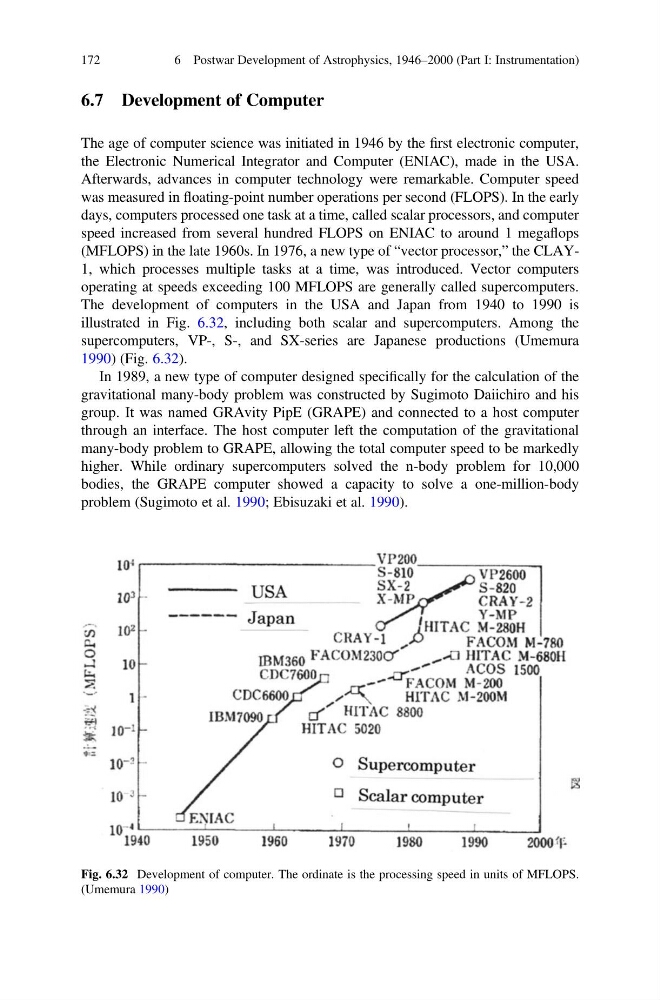
The development of computers in the USA and Japan from 1940 to 1990 is
illustrated in Fig. 6.32, including both scalar and supercomputers. Among the
supercomputers, VP-, S-, and SX-series are Japanese productions (Umemura
1990) (Fig. 6.32).
In 1989, a new type of computer designed specifically for the calculation of the
gravitational many-body problem was constructed by Sugimoto Daiichiro and his
group. It was named GRAvity PipE (GRAPE) and connected to a host computer
through an interface. The host computer left the computation of the gravitational
many-body problem to GRAPE, allowing the total computer speed to be markedly
higher. While ordinary supercomputers solved the n-body problem for 10,000
bodies, the GRAPE computer showed a capacity to solve a one-million-body
problem (Sugimoto et al. 1990; Ebisuzaki et al. 1990).
Fig. 6.32 Development of computer. The ordinate is the processing speed in units of MFLOPS.
(Umemura 1990)
172
6 Postwar Development of Astrophysics, 1946–2000 (Part I: Instrumentation)
The age of computer science was initiated in 1946 by the first electronic computer,
the Electronic Numerical Integrator and Computer (ENIAC), made in the USA.
Afterwards, advances in computer technology were remarkable. Computer speed
was measured in floating-point number operations per second (FLOPS). In the early
days, computers processed one task at a time, called scalar processors, and computer
speed increased from several hundred FLOPS on ENIAC to around 1 megaflops
(MFLOPS) in the late 1960s. In 1976, a new type of “vector processor,” the CLAY1, which processes multiple tasks at a time, was introduced. Vector computers
operating at speeds exceeding 100 MFLOPS are generally called supercomputers.
The development of computers in the USA and Japan from 1940 to 1990 is
illustrated in Fig. 6.32, including both scalar and supercomputers. Among the
supercomputers, VP-, S-, and SX-series are Japanese productions (Umemura
1990) (Fig. 6.32).
In 1989, a new type of computer designed specifically for the calculation of the
gravitational many-body problem was constructed by Sugimoto Daiichiro and his
group. It was named GRAvity PipE (GRAPE) and connected to a host computer
through an interface. The host computer left the computation of the gravitational
many-body problem to GRAPE, allowing the total computer speed to be markedly
higher. While ordinary supercomputers solved the n-body problem for 10,000
bodies, the GRAPE computer showed a capacity to solve a one-million-body
problem (Sugimoto et al. 1990; Ebisuzaki et al. 1990).
Fig. 6.32 Development of computer. The ordinate is the processing speed in units of MFLOPS.
(Umemura 1990)
172
6 Postwar Development of Astrophysics, 1946–2000 (Part I: Instrumentation)