

an 8-m aperture operating at 18- and 6-cm wavelengths. HALCA can make VLBI
observations with many radio telescopes around the Earth under international
collaborations. Due to the orbital motion of HALCA, the baseline can reach
30,000 km at maximum, when the space resolution becomes 0.0001-arcsec on
18-cm waves and 0.00003-arcsec on 3-cm waves. This high space resolution of
VSOP may be compared with the 0.05 arcsec of the Hubble Space Telescope in
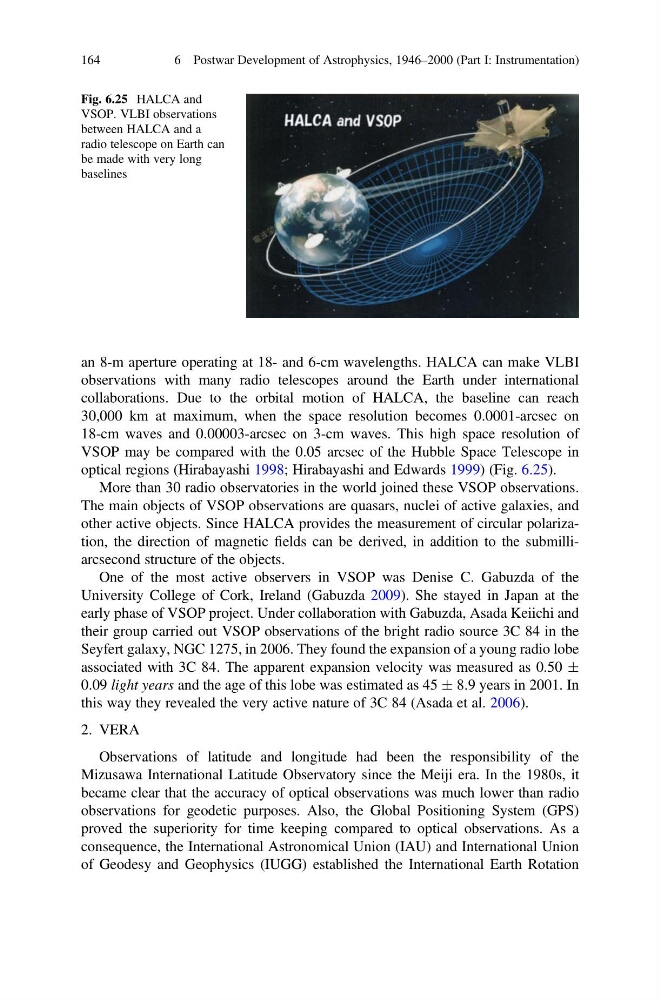
optical regions (Hirabayashi 1998; Hirabayashi and Edwards 1999) (Fig. 6.25).
More than 30 radio observatories in the world joined these VSOP observations.
The main objects of VSOP observations are quasars, nuclei of active galaxies, and
other active objects. Since HALCA provides the measurement of circular polarization, the direction of magnetic fields can be derived, in addition to the submilliarcsecond structure of the objects.
One of the most active observers in VSOP was Denise C. Gabuzda of the
University College of Cork, Ireland (Gabuzda 2009). She stayed in Japan at the
early phase of VSOP project. Under collaboration with Gabuzda, Asada Keiichi and
their group carried out VSOP observations of the bright radio source 3C 84 in the
Seyfert galaxy, NGC 1275, in 2006. They found the expansion of a young radio lobe
associated with 3C 84. The apparent expansion velocity was measured as 0.50 Æ
0.09 light years and the age of this lobe was estimated as 45 Æ 8.9 years in 2001. In
this way they revealed the very active nature of 3C 84 (Asada et al. 2006).
2. VERA
Observations of latitude and longitude had been the responsibility of the
Mizusawa International Latitude Observatory since the Meiji era. In the 1980s, it
became clear that the accuracy of optical observations was much lower than radio
observations for geodetic purposes. Also, the Global Positioning System (GPS)
proved the superiority for time keeping compared to optical observations. As a
consequence, the International Astronomical Union (IAU) and International Union
of Geodesy and Geophysics (IUGG) established the International Earth Rotation
Fig. 6.25 HALCA and
VSOP. VLBI observations
between HALCA and a
radio telescope on Earth can
be made with very long
baselines
164
6 Postwar Development of Astrophysics, 1946–2000 (Part I: Instrumentation)
observations with many radio telescopes around the Earth under international
collaborations. Due to the orbital motion of HALCA, the baseline can reach
30,000 km at maximum, when the space resolution becomes 0.0001-arcsec on
18-cm waves and 0.00003-arcsec on 3-cm waves. This high space resolution of
VSOP may be compared with the 0.05 arcsec of the Hubble Space Telescope in
optical regions (Hirabayashi 1998; Hirabayashi and Edwards 1999) (Fig. 6.25).
More than 30 radio observatories in the world joined these VSOP observations.
The main objects of VSOP observations are quasars, nuclei of active galaxies, and
other active objects. Since HALCA provides the measurement of circular polarization, the direction of magnetic fields can be derived, in addition to the submilliarcsecond structure of the objects.
One of the most active observers in VSOP was Denise C. Gabuzda of the
University College of Cork, Ireland (Gabuzda 2009). She stayed in Japan at the
early phase of VSOP project. Under collaboration with Gabuzda, Asada Keiichi and
their group carried out VSOP observations of the bright radio source 3C 84 in the
Seyfert galaxy, NGC 1275, in 2006. They found the expansion of a young radio lobe
associated with 3C 84. The apparent expansion velocity was measured as 0.50 Æ
0.09 light years and the age of this lobe was estimated as 45 Æ 8.9 years in 2001. In
this way they revealed the very active nature of 3C 84 (Asada et al. 2006).
2. VERA
Observations of latitude and longitude had been the responsibility of the
Mizusawa International Latitude Observatory since the Meiji era. In the 1980s, it
became clear that the accuracy of optical observations was much lower than radio
observations for geodetic purposes. Also, the Global Positioning System (GPS)
proved the superiority for time keeping compared to optical observations. As a
consequence, the International Astronomical Union (IAU) and International Union
of Geodesy and Geophysics (IUGG) established the International Earth Rotation
Fig. 6.25 HALCA and
VSOP. VLBI observations
between HALCA and a
radio telescope on Earth can
be made with very long
baselines
164
6 Postwar Development of Astrophysics, 1946–2000 (Part I: Instrumentation)