

6.5.5 VSOP and Vera Projects
The spatial resolution of telescope increases with the increase of telescope aperture
in any wave-length telescope. Large telescope gives high resolution, so that when
two parts of both ends of large telescope is cut-down to make some smaller ones, and
the cosmic image is focused just like at one large telescope, then the images of two
small telescopes yield the same spatial resolution, though light gathering power
significantly reduced. In order to get high spatial resolution, two or several telescopes are combined into one focus at some telescope center. In order to get the fine
image, the wave fronts sent from distant telescopes must be reserved. The method to
make this reservation possible belong to the technique of interferometer. So that such
telescope systems are called radio or optical interferometers, and when separation of
telescopes is very long (over 100 km or even several 1000 km), the system is called
very-long baseline interferometer (VLBI). Remarkable VLBI in Japan is presented
here in two cases.
1. VSOP
In the late 1990s, the Institute of Space and Aeronautical Sciences (ISAS) started
a VLBI project connected with a space radio telescope, that is, the VLBI Space
Observatory Program (VSOP). For this purpose, a satellite named HALCA was
launched in February 1997. HALCA has an apogee height of 21,000 km and a
perigee height of 580 km, with an orbital period of 6 h 20 min. It has an antenna with
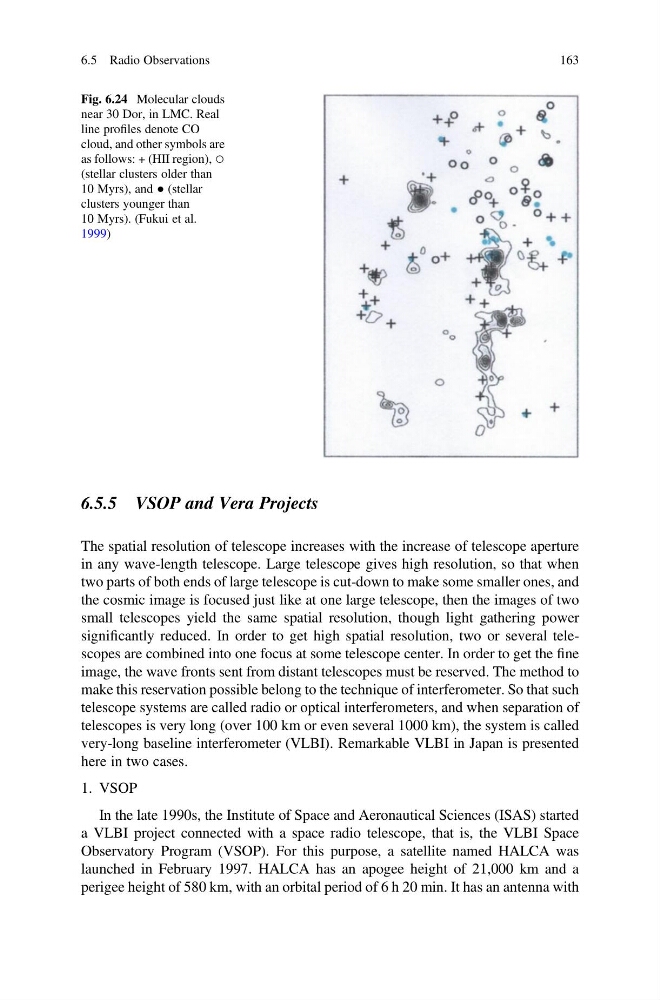
Fig. 6.24 Molecular clouds
near 30 Dor, in LMC. Real
line profiles denote CO
cloud, and other symbols are
as follows: + (HII region), ○
(stellar clusters older than
10 Myrs), and ● (stellar
clusters younger than
10 Myrs). (Fukui et al.
1999)
6.5 Radio Observations
163
The spatial resolution of telescope increases with the increase of telescope aperture
in any wave-length telescope. Large telescope gives high resolution, so that when
two parts of both ends of large telescope is cut-down to make some smaller ones, and
the cosmic image is focused just like at one large telescope, then the images of two
small telescopes yield the same spatial resolution, though light gathering power
significantly reduced. In order to get high spatial resolution, two or several telescopes are combined into one focus at some telescope center. In order to get the fine
image, the wave fronts sent from distant telescopes must be reserved. The method to
make this reservation possible belong to the technique of interferometer. So that such
telescope systems are called radio or optical interferometers, and when separation of
telescopes is very long (over 100 km or even several 1000 km), the system is called
very-long baseline interferometer (VLBI). Remarkable VLBI in Japan is presented
here in two cases.
1. VSOP
In the late 1990s, the Institute of Space and Aeronautical Sciences (ISAS) started
a VLBI project connected with a space radio telescope, that is, the VLBI Space
Observatory Program (VSOP). For this purpose, a satellite named HALCA was
launched in February 1997. HALCA has an apogee height of 21,000 km and a
perigee height of 580 km, with an orbital period of 6 h 20 min. It has an antenna with
Fig. 6.24 Molecular clouds
near 30 Dor, in LMC. Real
line profiles denote CO
cloud, and other symbols are
as follows: + (HII region), ○
(stellar clusters older than
10 Myrs), and ● (stellar
clusters younger than
10 Myrs). (Fukui et al.
1999)
6.5 Radio Observations
163