

6.5.4 Millimeter-Wave Telescopes of Nagoya University
While construction of the NRO was under way, Fukui Yasuo, Kawabata Kin’aki,
and Ogawa Hideo of Nagoya University built a 4-m millimeter-wave radio telescope
for molecular-line observations in 1982. This telescope allows for fast tracking of the
sky due to its lightweight antenna (~700 kg), with a beam width of 3 arcmin. It is
suitable for survey observations of a wide sky field, like a Schmidt telescope in
optical astronomy. Fukui’s group started survey observations of molecular clouds in
radio bands, 110 GHz (CO) and 90 GHz (HCO
+
, HCN), as a telescope to complement the Nobeyama 45-m telescope (Kawabata et al. 1984).
In 1996, Fukui Yasuo, Abe Rihei, and their group constructed a second 4-m radio
telescope at Las Campanas Observatory in Chile, and it was named Nanten Telescope (meaning Southern Sky). With the Nanten they carried out a CO-line survey of
the southern sky, particularly the Magellanic Clouds. At that time there were two
millimeter-wave telescopes in the southern hemisphere: a 1.2-m Smithsonian telescope and a 1.5-m EWO telescope. Fukui’s 4-m telescope was the most powerful
one in the southern sky at the time (Fukui et al. 1999).
Fig. 6.24 shows a CO map of the Large Magellanic Cloud (LMC) in the area
around 30 Doradus. Fukui’s group found 55 CO clouds coexisting with HII regions
and stellar clusters. They showed that about 47% of CO clouds are associated with
stellar clusters and large HII regions, suggesting active, ongoing formation of stellar
clusters. The remaining CO clouds show almost no sign of star formation, that is,
they have no HII regions and stellar clusters. Some parts of CO clouds are associated
with small HII regions but have no stellar clusters. From these distributions Fukui’s
group found that young clusters coexist with CO clouds, whereas in old clusters their
surrounding CO clouds have already dissipated (Fukui et al. 1999).
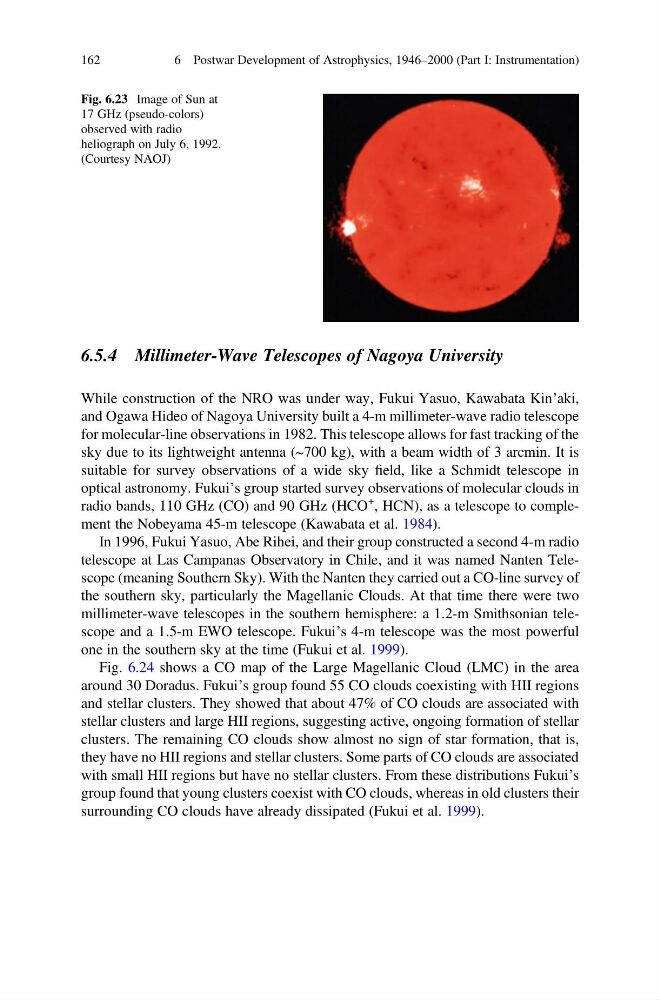
Fig. 6.23 Image of Sun at
17 GHz (pseudo-colors)
observed with radio
heliograph on July 6, 1992.
(Courtesy NAOJ)
162
6 Postwar Development of Astrophysics, 1946–2000 (Part I: Instrumentation)
While construction of the NRO was under way, Fukui Yasuo, Kawabata Kin’aki,
and Ogawa Hideo of Nagoya University built a 4-m millimeter-wave radio telescope
for molecular-line observations in 1982. This telescope allows for fast tracking of the
sky due to its lightweight antenna (~700 kg), with a beam width of 3 arcmin. It is
suitable for survey observations of a wide sky field, like a Schmidt telescope in
optical astronomy. Fukui’s group started survey observations of molecular clouds in
radio bands, 110 GHz (CO) and 90 GHz (HCO
+
, HCN), as a telescope to complement the Nobeyama 45-m telescope (Kawabata et al. 1984).
In 1996, Fukui Yasuo, Abe Rihei, and their group constructed a second 4-m radio
telescope at Las Campanas Observatory in Chile, and it was named Nanten Telescope (meaning Southern Sky). With the Nanten they carried out a CO-line survey of
the southern sky, particularly the Magellanic Clouds. At that time there were two
millimeter-wave telescopes in the southern hemisphere: a 1.2-m Smithsonian telescope and a 1.5-m EWO telescope. Fukui’s 4-m telescope was the most powerful
one in the southern sky at the time (Fukui et al. 1999).
Fig. 6.24 shows a CO map of the Large Magellanic Cloud (LMC) in the area
around 30 Doradus. Fukui’s group found 55 CO clouds coexisting with HII regions
and stellar clusters. They showed that about 47% of CO clouds are associated with
stellar clusters and large HII regions, suggesting active, ongoing formation of stellar
clusters. The remaining CO clouds show almost no sign of star formation, that is,
they have no HII regions and stellar clusters. Some parts of CO clouds are associated
with small HII regions but have no stellar clusters. From these distributions Fukui’s
group found that young clusters coexist with CO clouds, whereas in old clusters their
surrounding CO clouds have already dissipated (Fukui et al. 1999).
Fig. 6.23 Image of Sun at
17 GHz (pseudo-colors)
observed with radio
heliograph on July 6, 1992.
(Courtesy NAOJ)
162
6 Postwar Development of Astrophysics, 1946–2000 (Part I: Instrumentation)