

Some results will be given in Chap. 7.
The Nobeyama Millimeter Array (NMA) is a telescope array initially consisting
of five 10-m parabolas and another similar parabola added later. The observable
frequency ranges from 80 to 230 GHz. Its ability to produce high spatial resolution is
equivalent to a 600-m diameter parabola, and the maximum angular resolution
reaches 0.0003 arcsec, which corresponds to a visual acuity of around 60.
6.5.3 Nobeyama Solar Radio Observatory
In 1975,the Nobeyama Solar Radio Observatory was established, equipped with
a radio heliograph. It is composed of eight-four 80-cm-aperture parabolic antennas
arranged in a clove. This heliograph started regular observations in June 1992.
It observes the Sun at 17 GHz in a field of view that covers the entire solar disk,
with spatial and temporal resolutions of 12 arcsec and 1 sec, respectively. In the
1990s, simultaneous observations in radio waves (Nobeyama Radio Heliograph),
soft X-rays (Yohkoh satellite), and Hα lines (Hida DST) were carried out for the
analysis of flares, eruptive prominences, coronal arcades, and other solar activities.
Figure 6.23 illustrates an example of a solar image at 17 GHz observed with the
Radio Heliograph on July 6, 1992.
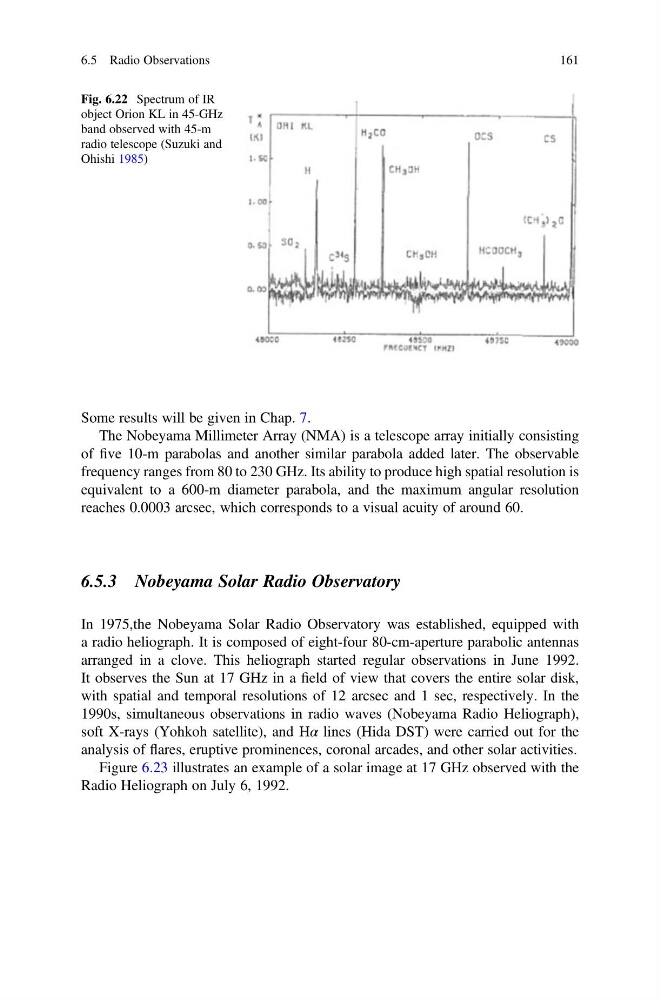
Fig. 6.22 Spectrum of IR
object Orion KL in 45-GHz
band observed with 45-m
radio telescope (Suzuki and
Ohishi 1985)
6.5 Radio Observations
161
The Nobeyama Millimeter Array (NMA) is a telescope array initially consisting
of five 10-m parabolas and another similar parabola added later. The observable
frequency ranges from 80 to 230 GHz. Its ability to produce high spatial resolution is
equivalent to a 600-m diameter parabola, and the maximum angular resolution
reaches 0.0003 arcsec, which corresponds to a visual acuity of around 60.
6.5.3 Nobeyama Solar Radio Observatory
In 1975,the Nobeyama Solar Radio Observatory was established, equipped with
a radio heliograph. It is composed of eight-four 80-cm-aperture parabolic antennas
arranged in a clove. This heliograph started regular observations in June 1992.
It observes the Sun at 17 GHz in a field of view that covers the entire solar disk,
with spatial and temporal resolutions of 12 arcsec and 1 sec, respectively. In the
1990s, simultaneous observations in radio waves (Nobeyama Radio Heliograph),
soft X-rays (Yohkoh satellite), and Hα lines (Hida DST) were carried out for the
analysis of flares, eruptive prominences, coronal arcades, and other solar activities.
Figure 6.23 illustrates an example of a solar image at 17 GHz observed with the
Radio Heliograph on July 6, 1992.
Fig. 6.22 Spectrum of IR
object Orion KL in 45-GHz
band observed with 45-m
radio telescope (Suzuki and
Ohishi 1985)
6.5 Radio Observations
161