

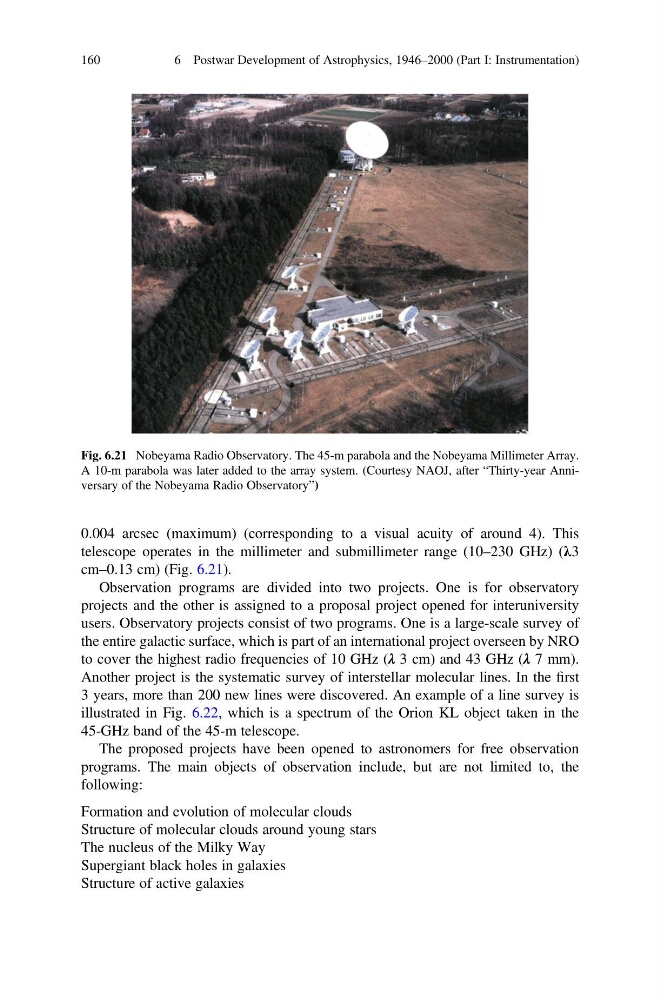
0.004 arcsec (maximum) (corresponding to a visual acuity of around 4). This
telescope operates in the millimeter and submillimeter range (10–230 GHz) (λ3
cm–0.13 cm) (Fig. 6.21).
Observation programs are divided into two projects. One is for observatory
projects and the other is assigned to a proposal project opened for interuniversity
users. Observatory projects consist of two programs. One is a large-scale survey of
the entire galactic surface, which is part of an international project overseen by NRO
to cover the highest radio frequencies of 10 GHz (λ 3 cm) and 43 GHz (λ 7 mm).
Another project is the systematic survey of interstellar molecular lines. In the first
3 years, more than 200 new lines were discovered. An example of a line survey is
illustrated in Fig. 6.22, which is a spectrum of the Orion KL object taken in the
45-GHz band of the 45-m telescope.
The proposed projects have been opened to astronomers for free observation
programs. The main objects of observation include, but are not limited to, the
following:
Formation and evolution of molecular clouds
Structure of molecular clouds around young stars
The nucleus of the Milky Way
Supergiant black holes in galaxies
Structure of active galaxies
Fig. 6.21 Nobeyama Radio Observatory. The 45-m parabola and the Nobeyama Millimeter Array.
A 10-m parabola was later added to the array system. (Courtesy NAOJ, after “Thirty-year Anniversary of the Nobeyama Radio Observatory”)
160
6 Postwar Development of Astrophysics, 1946–2000 (Part I: Instrumentation)
telescope operates in the millimeter and submillimeter range (10–230 GHz) (λ3
cm–0.13 cm) (Fig. 6.21).
Observation programs are divided into two projects. One is for observatory
projects and the other is assigned to a proposal project opened for interuniversity
users. Observatory projects consist of two programs. One is a large-scale survey of
the entire galactic surface, which is part of an international project overseen by NRO
to cover the highest radio frequencies of 10 GHz (λ 3 cm) and 43 GHz (λ 7 mm).
Another project is the systematic survey of interstellar molecular lines. In the first
3 years, more than 200 new lines were discovered. An example of a line survey is
illustrated in Fig. 6.22, which is a spectrum of the Orion KL object taken in the
45-GHz band of the 45-m telescope.
The proposed projects have been opened to astronomers for free observation
programs. The main objects of observation include, but are not limited to, the
following:
Formation and evolution of molecular clouds
Structure of molecular clouds around young stars
The nucleus of the Milky Way
Supergiant black holes in galaxies
Structure of active galaxies
Fig. 6.21 Nobeyama Radio Observatory. The 45-m parabola and the Nobeyama Millimeter Array.
A 10-m parabola was later added to the array system. (Courtesy NAOJ, after “Thirty-year Anniversary of the Nobeyama Radio Observatory”)
160
6 Postwar Development of Astrophysics, 1946–2000 (Part I: Instrumentation)