

Service for global geodetic observations. The Mizusawa was reorganized as the
Mizusawa VLBI Observatory and became a branch of the NAOJ in 1988
(Yokoyama 2008).
As the new establishment, the Mizusawa VLBI Observatory launched the VLBI
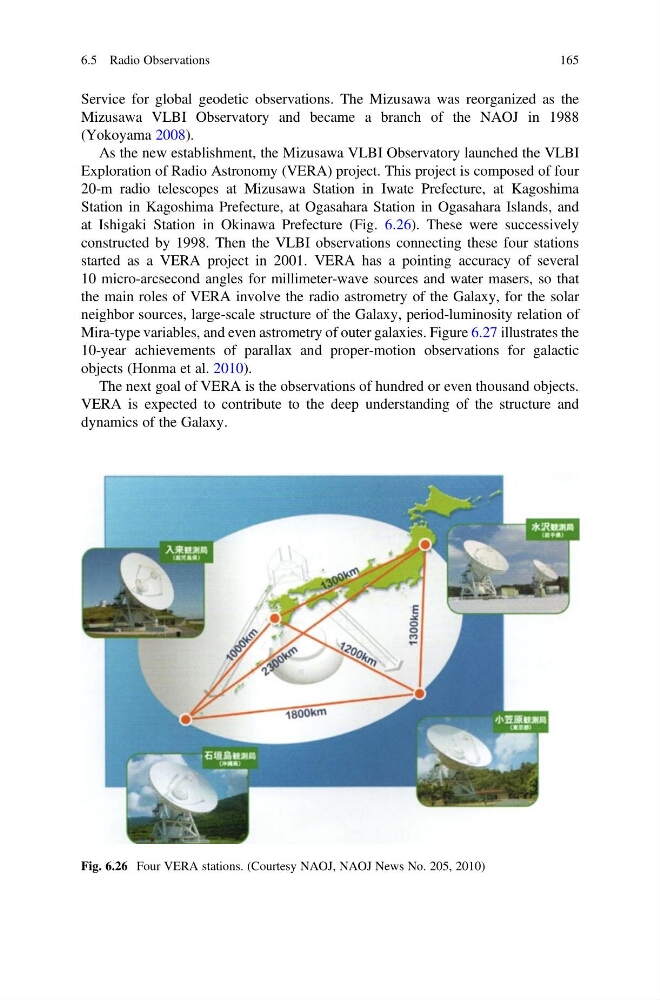
Exploration of Radio Astronomy (VERA) project. This project is composed of four
20-m radio telescopes at Mizusawa Station in Iwate Prefecture, at Kagoshima
Station in Kagoshima Prefecture, at Ogasahara Station in Ogasahara Islands, and
at Ishigaki Station in Okinawa Prefecture (Fig. 6.26). These were successively
constructed by 1998. Then the VLBI observations connecting these four stations
started as a VERA project in 2001. VERA has a pointing accuracy of several
10 micro-arcsecond angles for millimeter-wave sources and water masers, so that
the main roles of VERA involve the radio astrometry of the Galaxy, for the solar
neighbor sources, large-scale structure of the Galaxy, period-luminosity relation of
Mira-type variables, and even astrometry of outer galaxies. Figure 6.27 illustrates the
10-year achievements of parallax and proper-motion observations for galactic
objects (Honma et al. 2010).
The next goal of VERA is the observations of hundred or even thousand objects.
VERA is expected to contribute to the deep understanding of the structure and
dynamics of the Galaxy.
Fig. 6.26 Four VERA stations. (Courtesy NAOJ, NAOJ News No. 205, 2010)
6.5 Radio Observations
165
Mizusawa VLBI Observatory and became a branch of the NAOJ in 1988
(Yokoyama 2008).
As the new establishment, the Mizusawa VLBI Observatory launched the VLBI
Exploration of Radio Astronomy (VERA) project. This project is composed of four
20-m radio telescopes at Mizusawa Station in Iwate Prefecture, at Kagoshima
Station in Kagoshima Prefecture, at Ogasahara Station in Ogasahara Islands, and
at Ishigaki Station in Okinawa Prefecture (Fig. 6.26). These were successively
constructed by 1998. Then the VLBI observations connecting these four stations
started as a VERA project in 2001. VERA has a pointing accuracy of several
10 micro-arcsecond angles for millimeter-wave sources and water masers, so that
the main roles of VERA involve the radio astrometry of the Galaxy, for the solar
neighbor sources, large-scale structure of the Galaxy, period-luminosity relation of
Mira-type variables, and even astrometry of outer galaxies. Figure 6.27 illustrates the
10-year achievements of parallax and proper-motion observations for galactic
objects (Honma et al. 2010).
The next goal of VERA is the observations of hundred or even thousand objects.
VERA is expected to contribute to the deep understanding of the structure and
dynamics of the Galaxy.
Fig. 6.26 Four VERA stations. (Courtesy NAOJ, NAOJ News No. 205, 2010)
6.5 Radio Observations
165