

1974: 3.8-m reflector at Siding Spring Observatory (Australia)
1977: 3.57-m reflector at the La Cilla Observatory (ESO)
The other trend was the development of the new-technology telescope (NTT), which
consisted of a lightweight main mirror and computer-controlled mirror to maintain a
correct surface.
The first NTT was the 3.58-m telescope constructed at ESO in 1989. The Keck
10-m telescope I at Mt. Mauna Kea followed in 1993, and four 8.2-m very-large
telescopes (VLTs) at ESO in Chile were built in 1998–2000.
2. Large telescope plans in Japan
Discussions on the next telescope after the OAO started in the 1970s and various
plans were proposed. A study group with a membership of around 150, Group of
Optical and Infrared Astronomers (GOPIRA), was established at the end of 1980.
After long discussions, the NTT plan with an aperture larger than 5 m was accepted
by the National Committee for Astronomy (NCA) of the Science Council of Japan
(学術会議). Afterward GOPIRA undertook a feasibility study of the so-called
Japanese National Large Telescope (JNLT), and, finally, a plan for a NTT with an
aperture of 8.2 m with a single mirror was accepted (Kogure and Tokunaga 1989).
In 1988, the TAO was reorganized as the NAOJ, and the project of the JNLT was
endorsed in 1991. Construction began in 1992 on the summit of Mauna Kea, Hawaii,
under cooperation with Hawaii University, and later that year a public contest was
held to officially name the telescope, and it became known as Subaru Telescope
(Subaru ¼ Pleiades in Japanese). Construction was completed in 1998 as one of the
telescopes grouped on the summit of Mauna Kea (Figs. 6.8).
3. Subaru Telescope
The Subaru telescope is one of the NTTs and uses various updating technologies
to achieve outstanding performance.
The primary mirror has an effective diameter of 8.2 m, against its small thickness
20 cm. This mirror is made of ultralow thermal expansion (ULE) glass with a weight
of 22.8 metric tons and a focal length of 15 m. To support this thin mirror during
observations, 261 robotic fingers were inserted into holes drilled into the back of the
mirror to keep it in perfect condition regardless of where the telescope is pointing in
the sky.
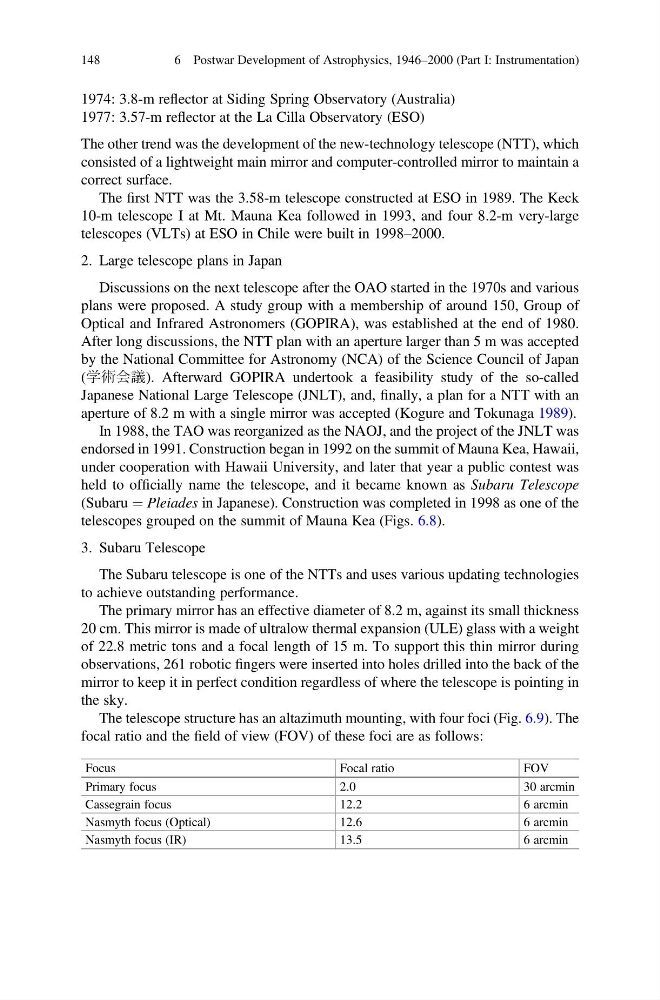
The telescope structure has an altazimuth mounting, with four foci (Fig. 6.9). The
focal ratio and the field of view (FOV) of these foci are as follows:
Focus
Focal ratio
FOV
Primary focus
2.0
30 arcmin
Cassegrain focus
12.2
6 arcmin
Nasmyth focus (Optical)
12.6
6 arcmin
Nasmyth focus (IR)
13.5
6 arcmin
148
6 Postwar Development of Astrophysics, 1946–2000 (Part I: Instrumentation)
1977: 3.57-m reflector at the La Cilla Observatory (ESO)
The other trend was the development of the new-technology telescope (NTT), which
consisted of a lightweight main mirror and computer-controlled mirror to maintain a
correct surface.
The first NTT was the 3.58-m telescope constructed at ESO in 1989. The Keck
10-m telescope I at Mt. Mauna Kea followed in 1993, and four 8.2-m very-large
telescopes (VLTs) at ESO in Chile were built in 1998–2000.
2. Large telescope plans in Japan
Discussions on the next telescope after the OAO started in the 1970s and various
plans were proposed. A study group with a membership of around 150, Group of
Optical and Infrared Astronomers (GOPIRA), was established at the end of 1980.
After long discussions, the NTT plan with an aperture larger than 5 m was accepted
by the National Committee for Astronomy (NCA) of the Science Council of Japan
(学術会議). Afterward GOPIRA undertook a feasibility study of the so-called
Japanese National Large Telescope (JNLT), and, finally, a plan for a NTT with an
aperture of 8.2 m with a single mirror was accepted (Kogure and Tokunaga 1989).
In 1988, the TAO was reorganized as the NAOJ, and the project of the JNLT was
endorsed in 1991. Construction began in 1992 on the summit of Mauna Kea, Hawaii,
under cooperation with Hawaii University, and later that year a public contest was
held to officially name the telescope, and it became known as Subaru Telescope
(Subaru ¼ Pleiades in Japanese). Construction was completed in 1998 as one of the
telescopes grouped on the summit of Mauna Kea (Figs. 6.8).
3. Subaru Telescope
The Subaru telescope is one of the NTTs and uses various updating technologies
to achieve outstanding performance.
The primary mirror has an effective diameter of 8.2 m, against its small thickness
20 cm. This mirror is made of ultralow thermal expansion (ULE) glass with a weight
of 22.8 metric tons and a focal length of 15 m. To support this thin mirror during
observations, 261 robotic fingers were inserted into holes drilled into the back of the
mirror to keep it in perfect condition regardless of where the telescope is pointing in
the sky.
The telescope structure has an altazimuth mounting, with four foci (Fig. 6.9). The
focal ratio and the field of view (FOV) of these foci are as follows:
Focus
Focal ratio
FOV
Primary focus
2.0
30 arcmin
Cassegrain focus
12.2
6 arcmin
Nasmyth focus (Optical)
12.6
6 arcmin
Nasmyth focus (IR)
13.5
6 arcmin
148
6 Postwar Development of Astrophysics, 1946–2000 (Part I: Instrumentation)