

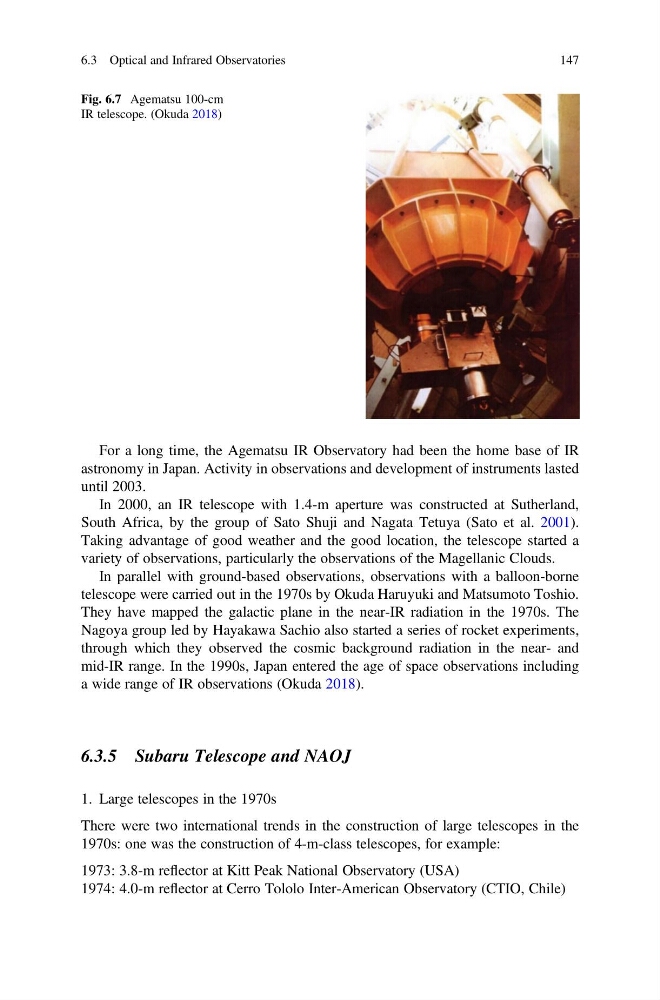
For a long time, the Agematsu IR Observatory had been the home base of IR
astronomy in Japan. Activity in observations and development of instruments lasted
until 2003.
In 2000, an IR telescope with 1.4-m aperture was constructed at Sutherland,
South Africa, by the group of Sato Shuji and Nagata Tetuya (Sato et al. 2001).
Taking advantage of good weather and the good location, the telescope started a
variety of observations, particularly the observations of the Magellanic Clouds.
In parallel with ground-based observations, observations with a balloon-borne
telescope were carried out in the 1970s by Okuda Haruyuki and Matsumoto Toshio.
They have mapped the galactic plane in the near-IR radiation in the 1970s. The
Nagoya group led by Hayakawa Sachio also started a series of rocket experiments,
through which they observed the cosmic background radiation in the near- and
mid-IR range. In the 1990s, Japan entered the age of space observations including
a wide range of IR observations (Okuda 2018).
6.3.5 Subaru Telescope and NAOJ
1. Large telescopes in the 1970s
There were two international trends in the construction of large telescopes in the
1970s: one was the construction of 4-m-class telescopes, for example:
1973: 3.8-m reflector at Kitt Peak National Observatory (USA)
1974: 4.0-m reflector at Cerro Tololo Inter-American Observatory (CTIO, Chile)
Fig. 6.7 Agematsu 100-cm
IR telescope. (Okuda 2018)
6.3 Optical and Infrared Observatories
147
astronomy in Japan. Activity in observations and development of instruments lasted
until 2003.
In 2000, an IR telescope with 1.4-m aperture was constructed at Sutherland,
South Africa, by the group of Sato Shuji and Nagata Tetuya (Sato et al. 2001).
Taking advantage of good weather and the good location, the telescope started a
variety of observations, particularly the observations of the Magellanic Clouds.
In parallel with ground-based observations, observations with a balloon-borne
telescope were carried out in the 1970s by Okuda Haruyuki and Matsumoto Toshio.
They have mapped the galactic plane in the near-IR radiation in the 1970s. The
Nagoya group led by Hayakawa Sachio also started a series of rocket experiments,
through which they observed the cosmic background radiation in the near- and
mid-IR range. In the 1990s, Japan entered the age of space observations including
a wide range of IR observations (Okuda 2018).
6.3.5 Subaru Telescope and NAOJ
1. Large telescopes in the 1970s
There were two international trends in the construction of large telescopes in the
1970s: one was the construction of 4-m-class telescopes, for example:
1973: 3.8-m reflector at Kitt Peak National Observatory (USA)
1974: 4.0-m reflector at Cerro Tololo Inter-American Observatory (CTIO, Chile)
Fig. 6.7 Agematsu 100-cm
IR telescope. (Okuda 2018)
6.3 Optical and Infrared Observatories
147