

These foci are equipped with various types of observational instruments that are
constantly updated to increase their observational capacity. What follows are examples of instruments:
Primary focus
Fiber multiobject spectrograph (FMOS)
Subaru prime focus camera (Supreme Cam)
Nasmyth (Op)
High-dispersion spectrograph (HDS)
Nasmyth (IR)
IR camera and spectrograph (IRCS)
Cassegrain
Multiobject IR camera and spectrograph (MOIRCS)
Faint object camera and spectrograph (FOCAS)
Cooled Mid-IR camera and spectrograph (COMICS)
The telescope enclosure is also shaped to improve the quality of astronomical
images by minimizing the effects of atmospheric turbulence.
The Subaru telescope was completed in the end of 1998 and first-light images
were released in January 1999. Open-use observations began in December 1999.
Since then, Subaru has begun to operate as the basic telescope in Japan and in the
astronomical community of the world.
A number of projects and programs had been proposed and successfully carried
out in many fields and subjects including the following:
1. Solar System: small objects such as cometary nuclei, small asteroids, small object
orbiting the Edgeworth-Kuiper Belt.
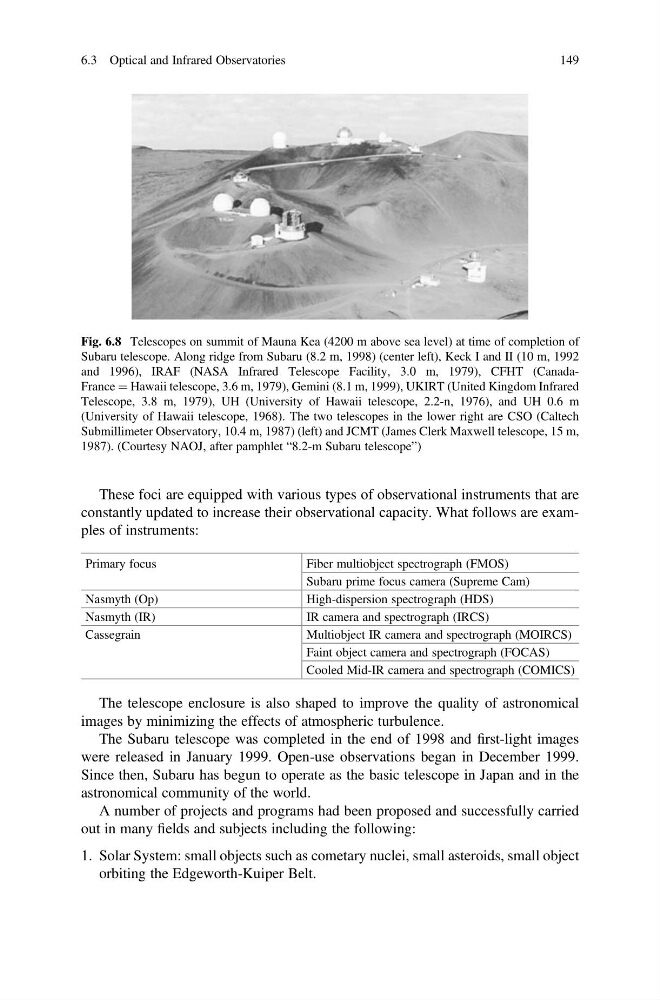
Fig. 6.8 Telescopes on summit of Mauna Kea (4200 m above sea level) at time of completion of
Subaru telescope. Along ridge from Subaru (8.2 m, 1998) (center left), Keck I and II (10 m, 1992
and 1996), IRAF (NASA Infrared Telescope Facility, 3.0 m, 1979), CFHT (CanadaFrance ¼ Hawaii telescope, 3.6 m, 1979), Gemini (8.1 m, 1999), UKIRT (United Kingdom Infrared
Telescope, 3.8 m, 1979), UH (University of Hawaii telescope, 2.2-n, 1976), and UH 0.6 m
(University of Hawaii telescope, 1968). The two telescopes in the lower right are CSO (Caltech
Submillimeter Observatory, 10.4 m, 1987) (left) and JCMT (James Clerk Maxwell telescope, 15 m,
1987). (Courtesy NAOJ, after pamphlet “8.2-m Subaru telescope”)
6.3 Optical and Infrared Observatories
149
constantly updated to increase their observational capacity. What follows are examples of instruments:
Primary focus
Fiber multiobject spectrograph (FMOS)
Subaru prime focus camera (Supreme Cam)
Nasmyth (Op)
High-dispersion spectrograph (HDS)
Nasmyth (IR)
IR camera and spectrograph (IRCS)
Cassegrain
Multiobject IR camera and spectrograph (MOIRCS)
Faint object camera and spectrograph (FOCAS)
Cooled Mid-IR camera and spectrograph (COMICS)
The telescope enclosure is also shaped to improve the quality of astronomical
images by minimizing the effects of atmospheric turbulence.
The Subaru telescope was completed in the end of 1998 and first-light images
were released in January 1999. Open-use observations began in December 1999.
Since then, Subaru has begun to operate as the basic telescope in Japan and in the
astronomical community of the world.
A number of projects and programs had been proposed and successfully carried
out in many fields and subjects including the following:
1. Solar System: small objects such as cometary nuclei, small asteroids, small object
orbiting the Edgeworth-Kuiper Belt.
Fig. 6.8 Telescopes on summit of Mauna Kea (4200 m above sea level) at time of completion of
Subaru telescope. Along ridge from Subaru (8.2 m, 1998) (center left), Keck I and II (10 m, 1992
and 1996), IRAF (NASA Infrared Telescope Facility, 3.0 m, 1979), CFHT (CanadaFrance ¼ Hawaii telescope, 3.6 m, 1979), Gemini (8.1 m, 1999), UKIRT (United Kingdom Infrared
Telescope, 3.8 m, 1979), UH (University of Hawaii telescope, 2.2-n, 1976), and UH 0.6 m
(University of Hawaii telescope, 1968). The two telescopes in the lower right are CSO (Caltech
Submillimeter Observatory, 10.4 m, 1987) (left) and JCMT (James Clerk Maxwell telescope, 15 m,
1987). (Courtesy NAOJ, after pamphlet “8.2-m Subaru telescope”)
6.3 Optical and Infrared Observatories
149