

range of fields, including humanistic and natural sciences, high-energy physics, and
information sciences. The Inter-University Research Institute is a research institute
operated by the research community, that is, a type of world-class organization
unique in Japan.
The astronomical facilities of the NAOJ at the end of the 1990s were as follows:
NAOJ Headquarters, Mitaka City, Tokyo
Dodaira Station, Tokigawa, Saitama Prefecture
Mizusawa VERA Observatory, Ōshu, Iwate Prefecture
Nobeyama Radio Observatory (NRO) and Nobeyama Solar Radio Observatory,
Minamimaki, Nagano Prefecture
Okayama Astrophysical Observatory, Asaguchi, Okayama Prefecture
Hawaii Observatory, Hilo and Mauna Kea, Hawaii
6.3 Optical and Infrared Observatories
6.3.1 Okayama Astrophysical Observatory
Astrophysical observations in Japan passed a milestone in 1961 with the construction of the Okayama Astrophysical Observatory (OAO) for the physical observations of celestial objects. The OAO is the first facility built for the astronomical
community in Japan.
The OAO has three major telescopes: 188-cm reflector, 91-cm reflector, and
65-cm solar Coudé telescope, the last having been constructed in 1968. Of these,
the 188-cm reflector was made by Grubb-Parson of England, whereas the 91-cm and
65-cm telescopes were made by Nihon-Kogaku of Japan. The 188-cm reflector
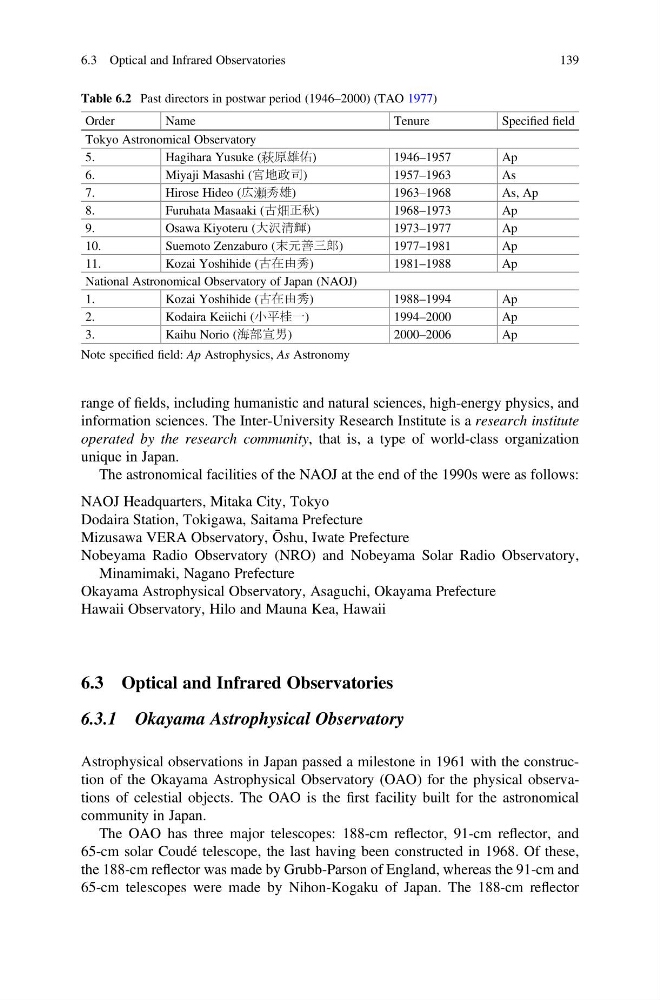
Table 6.2 Past directors in postwar period (1946–2000) (TAO 1977)
Order
Name
Tenure
Specified field
Tokyo Astronomical Observatory
5.
Hagihara Yusuke (萩原雄佑)
1946–1957
Ap
6.
Miyaji Masashi (宮地政司)
1957–1963
As
7.
Hirose Hideo (広瀬秀雄)
1963–1968
As, Ap
8.
Furuhata Masaaki (古畑正秋)
1968–1973
Ap
9.
Osawa Kiyoteru (大沢清輝)
1973–1977
Ap
10.
Suemoto Zenzaburo (末元善三郎)
1977–1981
Ap
11.
Kozai Yoshihide (古在由秀)
1981–1988
Ap
National Astronomical Observatory of Japan (NAOJ)
1.
Kozai Yoshihide (古在由秀)
1988–1994
Ap
2.
Kodaira Keiichi (小平桂一)
1994–2000
Ap
3.
Kaihu Norio (海部宣男)
2000–2006
Ap
Note specified field: Ap Astrophysics, As Astronomy
6.3 Optical and Infrared Observatories
139
information sciences. The Inter-University Research Institute is a research institute
operated by the research community, that is, a type of world-class organization
unique in Japan.
The astronomical facilities of the NAOJ at the end of the 1990s were as follows:
NAOJ Headquarters, Mitaka City, Tokyo
Dodaira Station, Tokigawa, Saitama Prefecture
Mizusawa VERA Observatory, Ōshu, Iwate Prefecture
Nobeyama Radio Observatory (NRO) and Nobeyama Solar Radio Observatory,
Minamimaki, Nagano Prefecture
Okayama Astrophysical Observatory, Asaguchi, Okayama Prefecture
Hawaii Observatory, Hilo and Mauna Kea, Hawaii
6.3 Optical and Infrared Observatories
6.3.1 Okayama Astrophysical Observatory
Astrophysical observations in Japan passed a milestone in 1961 with the construction of the Okayama Astrophysical Observatory (OAO) for the physical observations of celestial objects. The OAO is the first facility built for the astronomical
community in Japan.
The OAO has three major telescopes: 188-cm reflector, 91-cm reflector, and
65-cm solar Coudé telescope, the last having been constructed in 1968. Of these,
the 188-cm reflector was made by Grubb-Parson of England, whereas the 91-cm and
65-cm telescopes were made by Nihon-Kogaku of Japan. The 188-cm reflector
Table 6.2 Past directors in postwar period (1946–2000) (TAO 1977)
Order
Name
Tenure
Specified field
Tokyo Astronomical Observatory
5.
Hagihara Yusuke (萩原雄佑)
1946–1957
Ap
6.
Miyaji Masashi (宮地政司)
1957–1963
As
7.
Hirose Hideo (広瀬秀雄)
1963–1968
As, Ap
8.
Furuhata Masaaki (古畑正秋)
1968–1973
Ap
9.
Osawa Kiyoteru (大沢清輝)
1973–1977
Ap
10.
Suemoto Zenzaburo (末元善三郎)
1977–1981
Ap
11.
Kozai Yoshihide (古在由秀)
1981–1988
Ap
National Astronomical Observatory of Japan (NAOJ)
1.
Kozai Yoshihide (古在由秀)
1988–1994
Ap
2.
Kodaira Keiichi (小平桂一)
1994–2000
Ap
3.
Kaihu Norio (海部宣男)
2000–2006
Ap
Note specified field: Ap Astrophysics, As Astronomy
6.3 Optical and Infrared Observatories
139