

by the electronic computer, and computer centers were established in 1965 at Tokyo
and Kyoto Universities. The nation as a whole entered the computer age in the
1970s.
These social, economic, and technological developments enabled the accomplishment of national projects for constructing large scientific facilities, including observatories and orbiting satellites. Astronomy and space science grew up together into
the Big Sciences.
6.2 Tokyo Astronomical Observatory
In 1949, the Tokyo Astronomical Observatory (TAO) changed from being a classical engineer-technician system to a department-section system. In the same year, the
National University system was reformed; the Tokyo Imperial University changed to
the University of Tokyo, and the TAO became an integral part of the university.
The TAO was composed of 6 departments and 19 sections, with each department
and section composed of research staff of professors, associate professors, lecturers,
and assistants. The number of staff increased to 123, and thus the TAO became a
research institute. The names of the directors in the postwar era are given in
Table 6.2. Since 1950, the status of the TAO increased gradually into a core institute
of the interuniversity astronomical community (TAO 1977).
As shown in Table 6.2, the TAO was reorganized in 1988 as the National
Astronomical Observatory of Japan (NAOJ), together with the Latitude Observatory
in Mizusawa and Research Institute of Atmospherics of Nagoya University. For a
time, the NAOJ came under the jurisdiction of the Ministry of Education and
Science, and it was operated by a wide astronomical community across universities.
In 2004, the NAOJ was incorporated as the Inter-University Research Institute
Corporation, the National Institutes of Natural Sciences (NINS), and the National
Astronomical Observatory of Japan. The NINS (自然科学研究機構) includes five
institutes: NAOJ (国立天文台), National Institute for Fusion Science (核融合科学
研究所), the National Institute of Physiological Science (生理学研究所), National
Institute of Basic Biology (基礎生物学研究所), and the National Institute of
Molecular Science (分子科学研究所). NINS are a member of the Inter-University
Research Institute Corporation (大学共同利用機関法人), which covers a broad
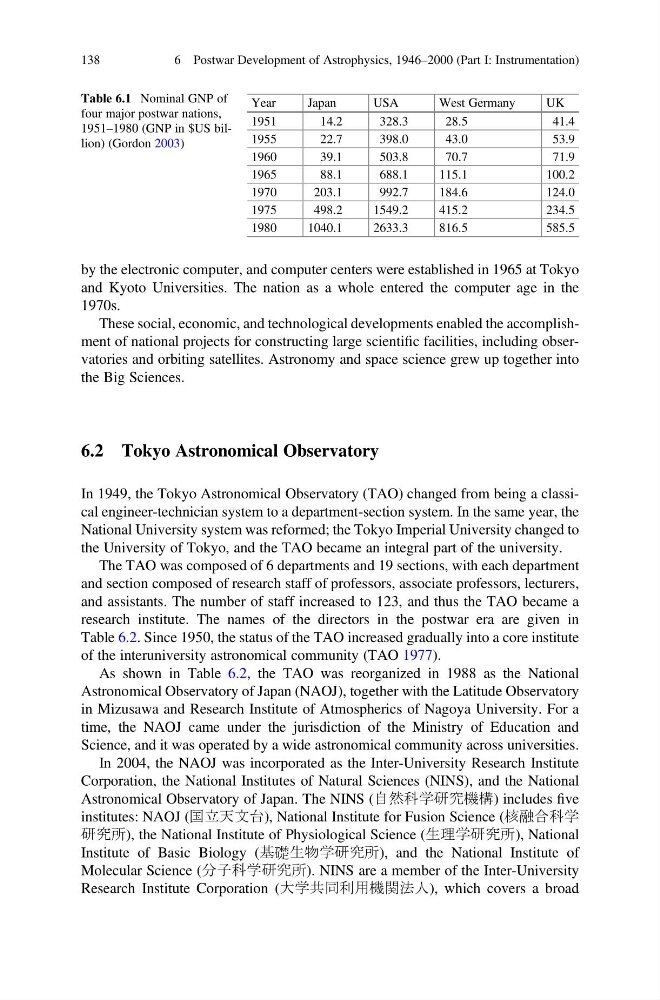
Table 6.1 Nominal GNP of
four major postwar nations,
1951–1980 (GNP in $US billion) (Gordon 2003)
Year
Japan
USA
West Germany
UK
1951
14.2
328.3
28.5
41.4
1955
22.7
398.0
43.0
53.9
1960
39.1
503.8
70.7
71.9
1965
88.1
688.1
115.1
100.2
1970
203.1
992.7
184.6
124.0
1975
498.2
1549.2
415.2
234.5
1980
1040.1
2633.3
816.5
585.5
138
6 Postwar Development of Astrophysics, 1946–2000 (Part I: Instrumentation)
and Kyoto Universities. The nation as a whole entered the computer age in the
1970s.
These social, economic, and technological developments enabled the accomplishment of national projects for constructing large scientific facilities, including observatories and orbiting satellites. Astronomy and space science grew up together into
the Big Sciences.
6.2 Tokyo Astronomical Observatory
In 1949, the Tokyo Astronomical Observatory (TAO) changed from being a classical engineer-technician system to a department-section system. In the same year, the
National University system was reformed; the Tokyo Imperial University changed to
the University of Tokyo, and the TAO became an integral part of the university.
The TAO was composed of 6 departments and 19 sections, with each department
and section composed of research staff of professors, associate professors, lecturers,
and assistants. The number of staff increased to 123, and thus the TAO became a
research institute. The names of the directors in the postwar era are given in
Table 6.2. Since 1950, the status of the TAO increased gradually into a core institute
of the interuniversity astronomical community (TAO 1977).
As shown in Table 6.2, the TAO was reorganized in 1988 as the National
Astronomical Observatory of Japan (NAOJ), together with the Latitude Observatory
in Mizusawa and Research Institute of Atmospherics of Nagoya University. For a
time, the NAOJ came under the jurisdiction of the Ministry of Education and
Science, and it was operated by a wide astronomical community across universities.
In 2004, the NAOJ was incorporated as the Inter-University Research Institute
Corporation, the National Institutes of Natural Sciences (NINS), and the National
Astronomical Observatory of Japan. The NINS (自然科学研究機構) includes five
institutes: NAOJ (国立天文台), National Institute for Fusion Science (核融合科学
研究所), the National Institute of Physiological Science (生理学研究所), National
Institute of Basic Biology (基礎生物学研究所), and the National Institute of
Molecular Science (分子科学研究所). NINS are a member of the Inter-University
Research Institute Corporation (大学共同利用機関法人), which covers a broad
Table 6.1 Nominal GNP of
four major postwar nations,
1951–1980 (GNP in $US billion) (Gordon 2003)
Year
Japan
USA
West Germany
UK
1951
14.2
328.3
28.5
41.4
1955
22.7
398.0
43.0
53.9
1960
39.1
503.8
70.7
71.9
1965
88.1
688.1
115.1
100.2
1970
203.1
992.7
184.6
124.0
1975
498.2
1549.2
415.2
234.5
1980
1040.1
2633.3
816.5
585.5
138
6 Postwar Development of Astrophysics, 1946–2000 (Part I: Instrumentation)