

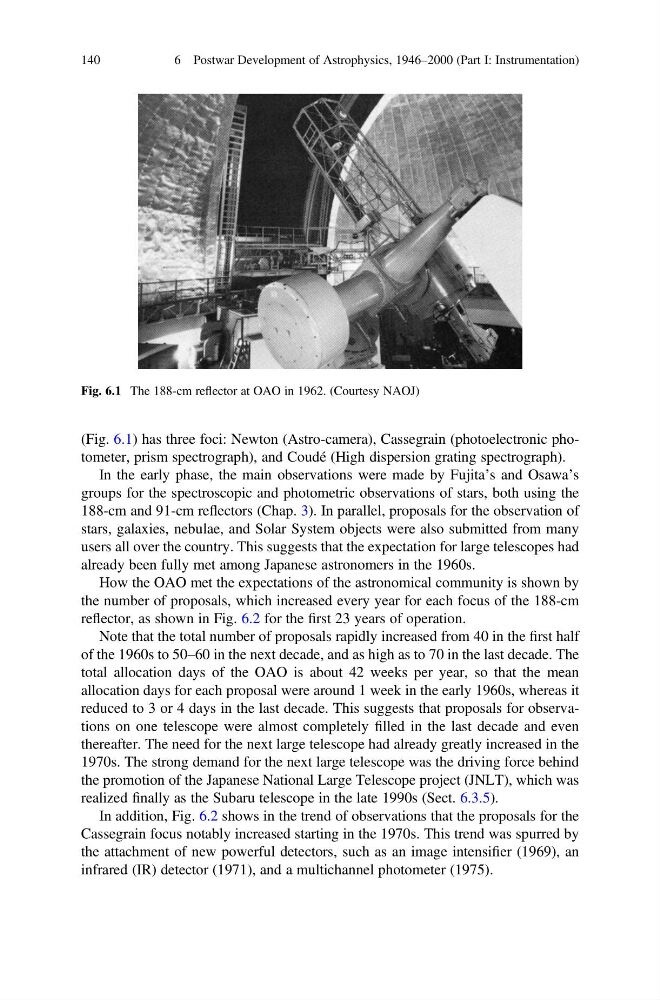
(Fig. 6.1) has three foci: Newton (Astro-camera), Cassegrain (photoelectronic photometer, prism spectrograph), and Coudé (High dispersion grating spectrograph).
In the early phase, the main observations were made by Fujita’s and Osawa’s
groups for the spectroscopic and photometric observations of stars, both using the
188-cm and 91-cm reflectors (Chap. 3). In parallel, proposals for the observation of
stars, galaxies, nebulae, and Solar System objects were also submitted from many
users all over the country. This suggests that the expectation for large telescopes had
already been fully met among Japanese astronomers in the 1960s.
How the OAO met the expectations of the astronomical community is shown by
the number of proposals, which increased every year for each focus of the 188-cm
reflector, as shown in Fig. 6.2 for the first 23 years of operation.
Note that the total number of proposals rapidly increased from 40 in the first half
of the 1960s to 50–60 in the next decade, and as high as to 70 in the last decade. The
total allocation days of the OAO is about 42 weeks per year, so that the mean
allocation days for each proposal were around 1 week in the early 1960s, whereas it
reduced to 3 or 4 days in the last decade. This suggests that proposals for observations on one telescope were almost completely filled in the last decade and even
thereafter. The need for the next large telescope had already greatly increased in the
1970s. The strong demand for the next large telescope was the driving force behind
the promotion of the Japanese National Large Telescope project (JNLT), which was
realized finally as the Subaru telescope in the late 1990s (Sect. 6.3.5).
In addition, Fig. 6.2 shows in the trend of observations that the proposals for the
Cassegrain focus notably increased starting in the 1970s. This trend was spurred by
the attachment of new powerful detectors, such as an image intensifier (1969), an
infrared (IR) detector (1971), and a multichannel photometer (1975).
Fig. 6.1 The 188-cm reflector at OAO in 1962. (Courtesy NAOJ)
140
6 Postwar Development of Astrophysics, 1946–2000 (Part I: Instrumentation)
In the early phase, the main observations were made by Fujita’s and Osawa’s
groups for the spectroscopic and photometric observations of stars, both using the
188-cm and 91-cm reflectors (Chap. 3). In parallel, proposals for the observation of
stars, galaxies, nebulae, and Solar System objects were also submitted from many
users all over the country. This suggests that the expectation for large telescopes had
already been fully met among Japanese astronomers in the 1960s.
How the OAO met the expectations of the astronomical community is shown by
the number of proposals, which increased every year for each focus of the 188-cm
reflector, as shown in Fig. 6.2 for the first 23 years of operation.
Note that the total number of proposals rapidly increased from 40 in the first half
of the 1960s to 50–60 in the next decade, and as high as to 70 in the last decade. The
total allocation days of the OAO is about 42 weeks per year, so that the mean
allocation days for each proposal were around 1 week in the early 1960s, whereas it
reduced to 3 or 4 days in the last decade. This suggests that proposals for observations on one telescope were almost completely filled in the last decade and even
thereafter. The need for the next large telescope had already greatly increased in the
1970s. The strong demand for the next large telescope was the driving force behind
the promotion of the Japanese National Large Telescope project (JNLT), which was
realized finally as the Subaru telescope in the late 1990s (Sect. 6.3.5).
In addition, Fig. 6.2 shows in the trend of observations that the proposals for the
Cassegrain focus notably increased starting in the 1970s. This trend was spurred by
the attachment of new powerful detectors, such as an image intensifier (1969), an
infrared (IR) detector (1971), and a multichannel photometer (1975).
Fig. 6.1 The 188-cm reflector at OAO in 1962. (Courtesy NAOJ)
140
6 Postwar Development of Astrophysics, 1946–2000 (Part I: Instrumentation)