

Matukuma’s aim on the study of globular clusters was to derive the threedimensional distribution of stars in the clusters. Jeans (1915) considered this problem under the assumptions of spherical symmetry and steady state, whereas Eddington (1930) added the assumptions of polytropic distribution of stars and velocity
ellipsoid of Karl Schwarzschild. Referring to these previous works, Matukuma
adopted the three assumptions of steady state, spherical distribution, and velocity
ellipsoid of stellar motions.
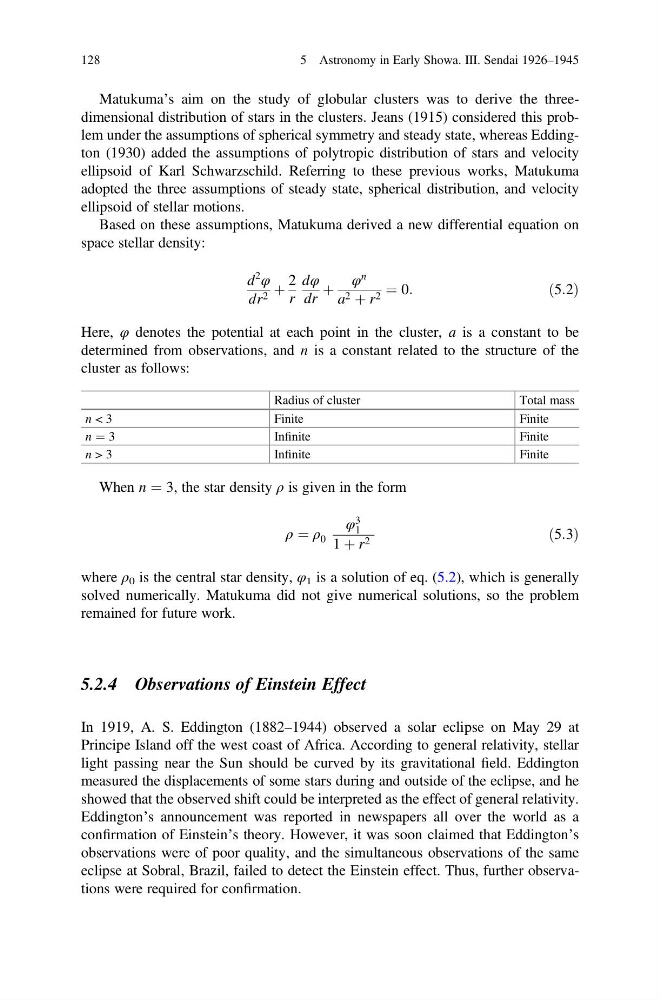
Based on these assumptions, Matukuma derived a new differential equation on
space stellar density:
d
2
φ
dr 2 þ
2
r
dφ
dr
þ
φ
n
a 2 þ r 2 ¼ 0:
ð5:2Þ
Here, φ denotes the potential at each point in the cluster, a is a constant to be
determined from observations, and n is a constant related to the structure of the
cluster as follows:
Radius of cluster
Total mass
n < 3
Finite
Finite
n ¼ 3
I n finite
Finite
n > 3
Infinite
Finite
When n ¼ 3, the star density ρ is given in the form
ρ ¼ ρ 0
φ
3
1
1 þ r 2
ð5:3Þ
where ρ 0 is the central star density, φ 1 is a solution of eq. (5.2), which is generally
solved numerically. Matukuma did not give numerical solutions, so the problem
remained for future work.
5.2.4 Observations of Einstein Effect
In 1919, A. S. Eddington (1882–1944) observed a solar eclipse on May 29 at
Principe Island off the west coast of Africa. According to general relativity, stellar
light passing near the Sun should be curved by its gravitational field. Eddington
measured the displacements of some stars during and outside of the eclipse, and he
showed that the observed shift could be interpreted as the effect of general relativity.
Eddington’s announcement was reported in newspapers all over the world as a
confirmation of Einstein’s theory. However, it was soon claimed that Eddington’s
observations were of poor quality, and the simultaneous observations of the same
eclipse at Sobral, Brazil, failed to detect the Einstein effect. Thus, further observations were required for confirmation.
128
5 Astronomy in Early Showa. III. Sendai 1926–1945
ellipsoid of Karl Schwarzschild. Referring to these previous works, Matukuma
adopted the three assumptions of steady state, spherical distribution, and velocity
ellipsoid of stellar motions.
Based on these assumptions, Matukuma derived a new differential equation on
space stellar density:
d
2
φ
dr 2 þ
2
r
dφ
dr
þ
φ
n
a 2 þ r 2 ¼ 0:
ð5:2Þ
Here, φ denotes the potential at each point in the cluster, a is a constant to be
determined from observations, and n is a constant related to the structure of the
cluster as follows:
Radius of cluster
Total mass
n < 3
Finite
Finite
n ¼ 3
I n finite
Finite
n > 3
Infinite
Finite
When n ¼ 3, the star density ρ is given in the form
ρ ¼ ρ 0
φ
3
1
1 þ r 2
ð5:3Þ
where ρ 0 is the central star density, φ 1 is a solution of eq. (5.2), which is generally
solved numerically. Matukuma did not give numerical solutions, so the problem
remained for future work.
5.2.4 Observations of Einstein Effect
In 1919, A. S. Eddington (1882–1944) observed a solar eclipse on May 29 at
Principe Island off the west coast of Africa. According to general relativity, stellar
light passing near the Sun should be curved by its gravitational field. Eddington
measured the displacements of some stars during and outside of the eclipse, and he
showed that the observed shift could be interpreted as the effect of general relativity.
Eddington’s announcement was reported in newspapers all over the world as a
confirmation of Einstein’s theory. However, it was soon claimed that Eddington’s
observations were of poor quality, and the simultaneous observations of the same
eclipse at Sobral, Brazil, failed to detect the Einstein effect. Thus, further observations were required for confirmation.
128
5 Astronomy in Early Showa. III. Sendai 1926–1945