

Matukuma organized a solar eclipse expedition, observed on the northeastern
coast of Hokkaido Island on June 19, 1936, for the confirmation of the Einstein
effect (Matukuma et al. 1940).
During the solar eclipse Matukuma’s group obtained some photographic plates
with different exposures. After half a year, they observed the same sky area and
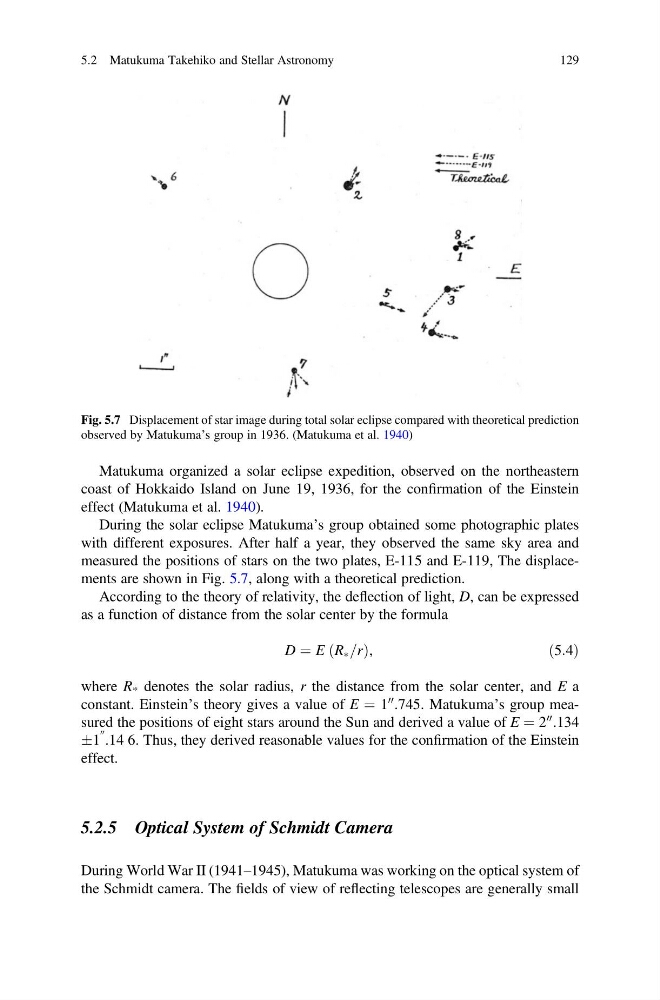
measured the positions of stars on the two plates, E-115 and E-119, The displacements are shown in Fig. 5.7, along with a theoretical prediction.
According to the theory of relativity, the deflection of light, D, can be expressed
as a function of distance from the solar center by the formula
D ¼ E R Ã =r
ð
Þ,
ð5:4Þ
where R * denotes the solar radius, r the distance from the solar center, and E a
constant. Einstein’s theory gives a value of E ¼ 1
00 .745. Matukuma’s group measured the positions of eight stars around the Sun and derived a value of E ¼ 2
00 .134
Æ1
00 .14 6. Thus, they derived reasonable values for the confirmation of the Einstein
effect.
5.2.5 Optical System of Schmidt Camera
During World War II (1941–1945), Matukuma was working on the optical system of
the Schmidt camera. The fields of view of reflecting telescopes are generally small
Fig. 5.7 Displacement of star image during total solar eclipse compared with theoretical prediction
observed by Matukuma’s group in 1936. (Matukuma et al. 1940)
5.2 Matukuma Takehiko and Stellar Astronomy
129
coast of Hokkaido Island on June 19, 1936, for the confirmation of the Einstein
effect (Matukuma et al. 1940).
During the solar eclipse Matukuma’s group obtained some photographic plates
with different exposures. After half a year, they observed the same sky area and
measured the positions of stars on the two plates, E-115 and E-119, The displacements are shown in Fig. 5.7, along with a theoretical prediction.
According to the theory of relativity, the deflection of light, D, can be expressed
as a function of distance from the solar center by the formula
D ¼ E R Ã =r
ð
Þ,
ð5:4Þ
where R * denotes the solar radius, r the distance from the solar center, and E a
constant. Einstein’s theory gives a value of E ¼ 1
00 .745. Matukuma’s group measured the positions of eight stars around the Sun and derived a value of E ¼ 2
00 .134
Æ1
00 .14 6. Thus, they derived reasonable values for the confirmation of the Einstein
effect.
5.2.5 Optical System of Schmidt Camera
During World War II (1941–1945), Matukuma was working on the optical system of
the Schmidt camera. The fields of view of reflecting telescopes are generally small
Fig. 5.7 Displacement of star image during total solar eclipse compared with theoretical prediction
observed by Matukuma’s group in 1936. (Matukuma et al. 1940)
5.2 Matukuma Takehiko and Stellar Astronomy
129