

calculations were performed. The orbits of these cases remained as future problems
(Matukuma 1933).
In the early 1940s, Matukuma was also working on the theoretical study of the
motion of perihelion and node of the planet Venus, Earth, and Mars, with lengthy
numerical calculations (Matukuma 1949).
5.2.3 Structure of Globular Clusters
When Matukuma began working on the structure of globular clusters (Matukuma
1930), he adopted the Kapteyn model of the Milky Way galaxy. In this model, the
Galaxy was a rotating ellipsoidal stellar system; the radius of the galactic plane was
9000 pc, the vertical height at the center was 1800 pc, and the Sun was located near
the center. In contrast, the distance to the nearby globular cluster, the Hercules
cluster (M13), was 11,000 pc and that of the most distant cluster, NGC 7006, was
67,500 pc. Matukuma accordingly argued that globular clusters were almost extragalactic objects, like spiral nebulae. On the concentration of globular clusters in the
direction of the constellation Sagittarius, he supposed that it might be related to the
structure of the whole Universe.
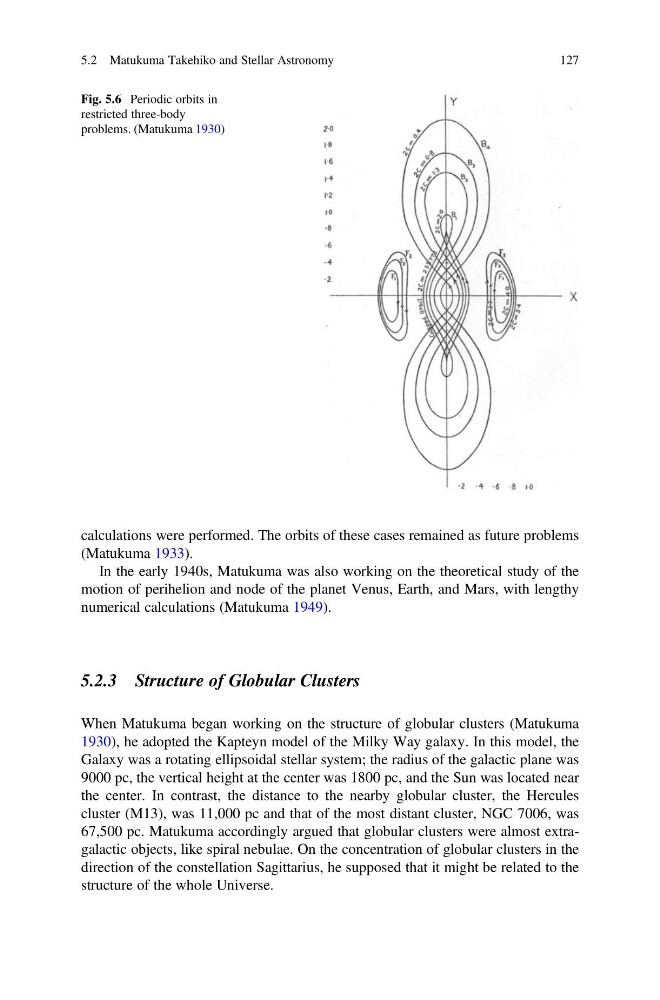
Fig. 5.6 Periodic orbits in
restricted three-body
problems. (Matukuma 1930)
5.2 Matukuma Takehiko and Stellar Astronomy
127
(Matukuma 1933).
In the early 1940s, Matukuma was also working on the theoretical study of the
motion of perihelion and node of the planet Venus, Earth, and Mars, with lengthy
numerical calculations (Matukuma 1949).
5.2.3 Structure of Globular Clusters
When Matukuma began working on the structure of globular clusters (Matukuma
1930), he adopted the Kapteyn model of the Milky Way galaxy. In this model, the
Galaxy was a rotating ellipsoidal stellar system; the radius of the galactic plane was
9000 pc, the vertical height at the center was 1800 pc, and the Sun was located near
the center. In contrast, the distance to the nearby globular cluster, the Hercules
cluster (M13), was 11,000 pc and that of the most distant cluster, NGC 7006, was
67,500 pc. Matukuma accordingly argued that globular clusters were almost extragalactic objects, like spiral nebulae. On the concentration of globular clusters in the
direction of the constellation Sagittarius, he supposed that it might be related to the
structure of the whole Universe.
Fig. 5.6 Periodic orbits in
restricted three-body
problems. (Matukuma 1930)
5.2 Matukuma Takehiko and Stellar Astronomy
127