

5.2.2 Celestial Mechanics
In celestial mechanics, Matukuma was interested in the numerical solutions of the
restricted three-body problem for the orbit of a third body (Matukuma 1930, 1932).
G. W. Hill considered the numerical solution of periodic orbits in some cases (Hill
1902a, b). Matukuma extended Hill’s work and derived the periodic orbits as shown
in Fig. 5.6, where X and Y are nondimensional axes, and the Y axis is on the line
connecting the two main bodies. He calculated two-dimensional orbits of a small
body moving on the (X-Y) plane. The orbits are characterized by the so-called Jacobi
constant 2C, which appears as an integration constant of the equations of motion for
the square of velocity V, as given by
V
2
¼ 3x
2
þ
2
r
À 2C
ð5:1Þ
where x denotes the distance on the X axis and r the distance from the center. The
integration constant 2C can take any numerical value. The orbits in Fig. 5.6 present
some different groups of 2C taken as a parameter.
Matukuma classified orbits into several families: Family B (looped orbit), given
as B1 (2C ¼ 2.0), B2 (1.3), B3 (0.8), and B4 (0.4), and Family F (liberation orbit),
given as F1 (2C ¼ 4.0), F2 (3.7), and F3 (3.4). Family F represents the oscillating
motion around the equilibrium points (Lagrange’s equilateral triangles). Family B is
contained between a cusped orbit (2C ¼ 2.55778) and the ejection orbit (2C <0.4).
No ejection orbit is given in Fig. 5.6.
In addition, Matukuma proposed the existence of periodic orbits in the case of
2C < 0. He examined several cases from 2C ¼ À3, À10 and À100,000 and proved
the possible existence of periodic and nonperiodic orbits, but no detailed numerical
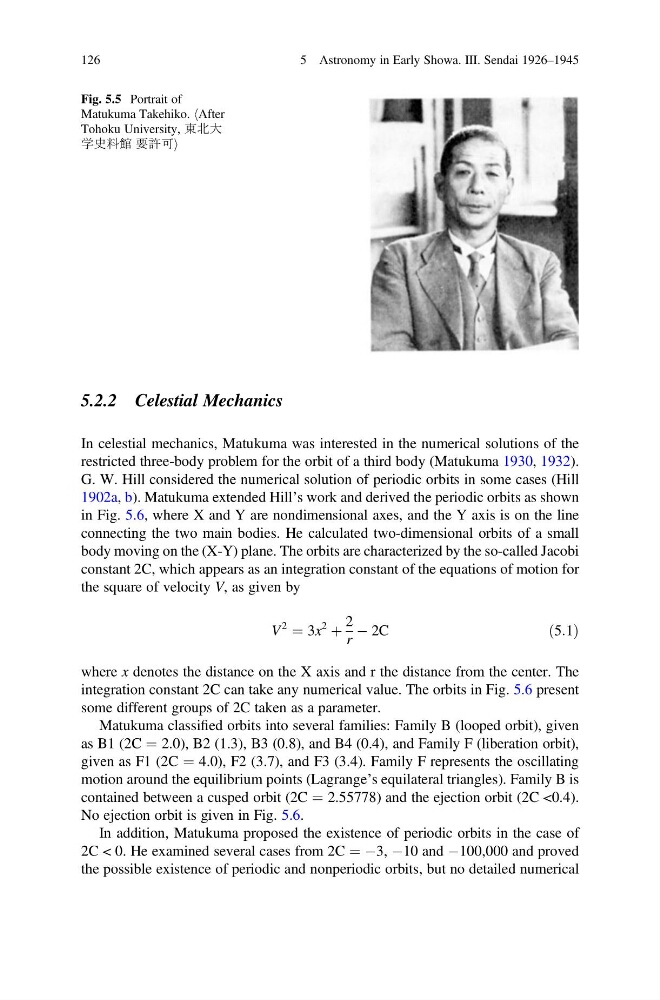
Fig. 5.5 Portrait of
Matukuma Takehiko. hAfter
Tohoku University, 東北大
学史料館 要許可i
126
5 Astronomy in Early Showa. III. Sendai 1926–1945
In celestial mechanics, Matukuma was interested in the numerical solutions of the
restricted three-body problem for the orbit of a third body (Matukuma 1930, 1932).
G. W. Hill considered the numerical solution of periodic orbits in some cases (Hill
1902a, b). Matukuma extended Hill’s work and derived the periodic orbits as shown
in Fig. 5.6, where X and Y are nondimensional axes, and the Y axis is on the line
connecting the two main bodies. He calculated two-dimensional orbits of a small
body moving on the (X-Y) plane. The orbits are characterized by the so-called Jacobi
constant 2C, which appears as an integration constant of the equations of motion for
the square of velocity V, as given by
V
2
¼ 3x
2
þ
2
r
À 2C
ð5:1Þ
where x denotes the distance on the X axis and r the distance from the center. The
integration constant 2C can take any numerical value. The orbits in Fig. 5.6 present
some different groups of 2C taken as a parameter.
Matukuma classified orbits into several families: Family B (looped orbit), given
as B1 (2C ¼ 2.0), B2 (1.3), B3 (0.8), and B4 (0.4), and Family F (liberation orbit),
given as F1 (2C ¼ 4.0), F2 (3.7), and F3 (3.4). Family F represents the oscillating
motion around the equilibrium points (Lagrange’s equilateral triangles). Family B is
contained between a cusped orbit (2C ¼ 2.55778) and the ejection orbit (2C <0.4).
No ejection orbit is given in Fig. 5.6.
In addition, Matukuma proposed the existence of periodic orbits in the case of
2C < 0. He examined several cases from 2C ¼ À3, À10 and À100,000 and proved
the possible existence of periodic and nonperiodic orbits, but no detailed numerical
Fig. 5.5 Portrait of
Matukuma Takehiko. hAfter
Tohoku University, 東北大
学史料館 要許可i
126
5 Astronomy in Early Showa. III. Sendai 1926–1945