

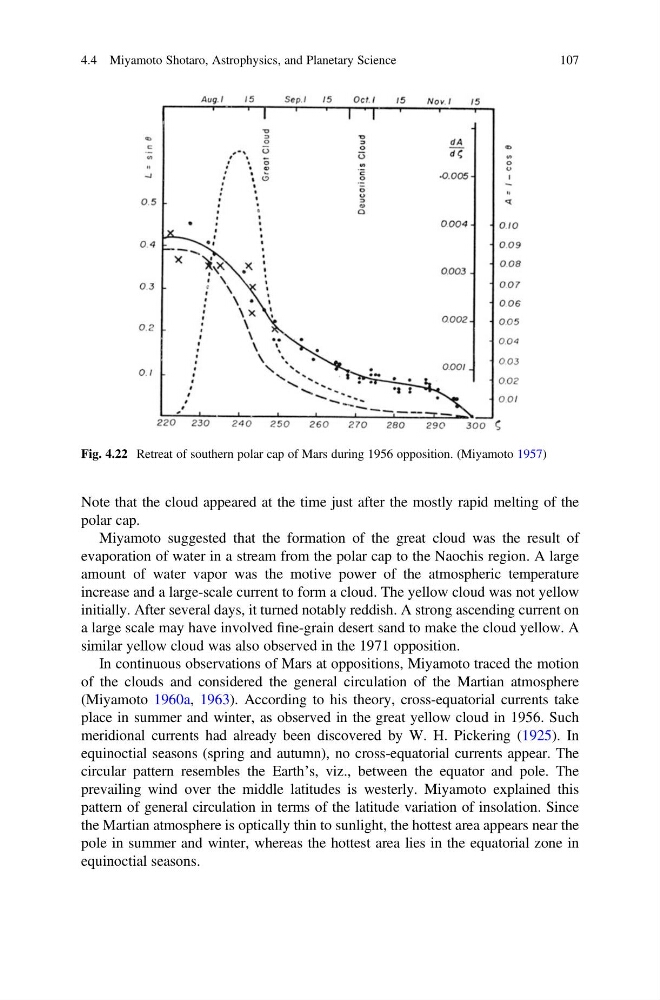
Note that the cloud appeared at the time just after the mostly rapid melting of the
polar cap.
Miyamoto suggested that the formation of the great cloud was the result of
evaporation of water in a stream from the polar cap to the Naochis region. A large
amount of water vapor was the motive power of the atmospheric temperature
increase and a large-scale current to form a cloud. The yellow cloud was not yellow
initially. After several days, it turned notably reddish. A strong ascending current on
a large scale may have involved fine-grain desert sand to make the cloud yellow. A
similar yellow cloud was also observed in the 1971 opposition.
In continuous observations of Mars at oppositions, Miyamoto traced the motion
of the clouds and considered the general circulation of the Martian atmosphere
(Miyamoto 1960a, 1963). According to his theory, cross-equatorial currents take
place in summer and winter, as observed in the great yellow cloud in 1956. Such
meridional currents had already been discovered by W. H. Pickering (1925). In
equinoctial seasons (spring and autumn), no cross-equatorial currents appear. The
circular pattern resembles the Earth’s, viz., between the equator and pole. The
prevailing wind over the middle latitudes is westerly. Miyamoto explained this
pattern of general circulation in terms of the latitude variation of insolation. Since
the Martian atmosphere is optically thin to sunlight, the hottest area appears near the
pole in summer and winter, whereas the hottest area lies in the equatorial zone in
equinoctial seasons.
Fig. 4.22 Retreat of southern polar cap of Mars during 1956 opposition. (Miyamoto 1957)
4.4 Miyamoto Shotaro, Astrophysics, and Planetary Science
107
polar cap.
Miyamoto suggested that the formation of the great cloud was the result of
evaporation of water in a stream from the polar cap to the Naochis region. A large
amount of water vapor was the motive power of the atmospheric temperature
increase and a large-scale current to form a cloud. The yellow cloud was not yellow
initially. After several days, it turned notably reddish. A strong ascending current on
a large scale may have involved fine-grain desert sand to make the cloud yellow. A
similar yellow cloud was also observed in the 1971 opposition.
In continuous observations of Mars at oppositions, Miyamoto traced the motion
of the clouds and considered the general circulation of the Martian atmosphere
(Miyamoto 1960a, 1963). According to his theory, cross-equatorial currents take
place in summer and winter, as observed in the great yellow cloud in 1956. Such
meridional currents had already been discovered by W. H. Pickering (1925). In
equinoctial seasons (spring and autumn), no cross-equatorial currents appear. The
circular pattern resembles the Earth’s, viz., between the equator and pole. The
prevailing wind over the middle latitudes is westerly. Miyamoto explained this
pattern of general circulation in terms of the latitude variation of insolation. Since
the Martian atmosphere is optically thin to sunlight, the hottest area appears near the
pole in summer and winter, whereas the hottest area lies in the equatorial zone in
equinoctial seasons.
Fig. 4.22 Retreat of southern polar cap of Mars during 1956 opposition. (Miyamoto 1957)
4.4 Miyamoto Shotaro, Astrophysics, and Planetary Science
107