

2. Lunar geology
The lunar surface is characterized by bright highlands and dark maria. The craters
are particularly concentrated in the mountainous regions. With the publication of the
Photographic Atlas of the Moon (Miyamoto and Matsui 1960; Miyamoto and
Hattori 1963), Miyamoto advanced the study of lunar geology.
On the origin of the characteristic structure of selenography, Miyamoto proposed
a hypothesis according to which the differentiation of bright silicic mass from dark
basaltic mass occurred during the formation of the lunar crust (Miyamoto 1960b, c).
Due to the low surface gravity, the lunar crust was thin in its depth and rapidly
solidified compared to the Earth, so that there had been no real orogeny on the Moon.
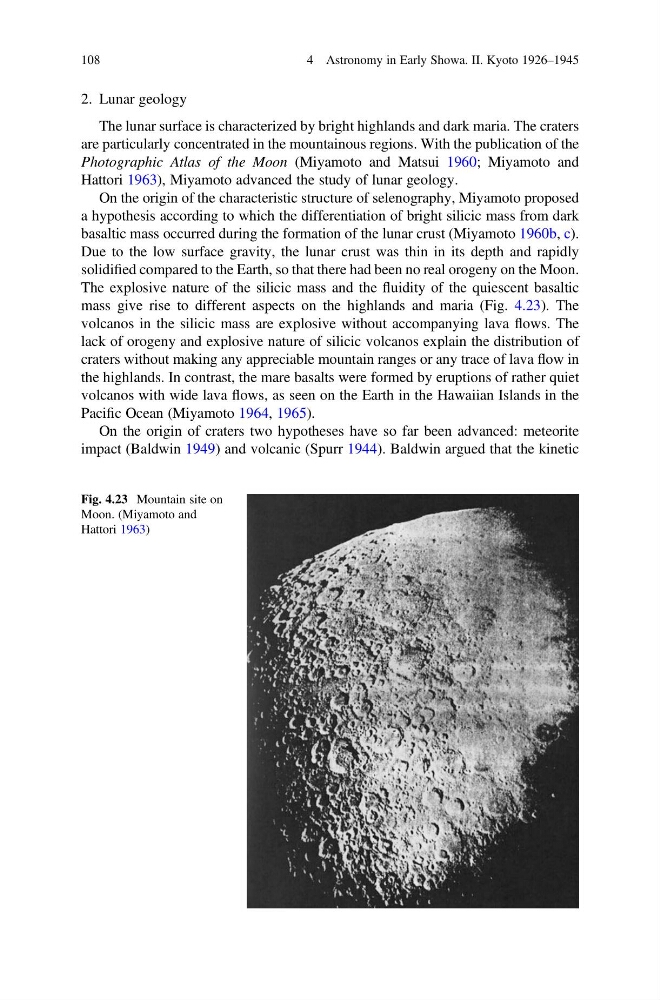
The explosive nature of the silicic mass and the fluidity of the quiescent basaltic
mass give rise to different aspects on the highlands and maria (Fig. 4.23). The
volcanos in the silicic mass are explosive without accompanying lava flows. The
lack of orogeny and explosive nature of silicic volcanos explain the distribution of
craters without making any appreciable mountain ranges or any trace of lava flow in
the highlands. In contrast, the mare basalts were formed by eruptions of rather quiet
volcanos with wide lava flows, as seen on the Earth in the Hawaiian Islands in the
Pacific Ocean (Miyamoto 1964, 1965).
On the origin of craters two hypotheses have so far been advanced: meteorite
impact (Baldwin 1949) and volcanic (Spurr 1944). Baldwin argued that the kinetic
Fig. 4.23 Mountain site on
Moon. (Miyamoto and
Hattori 1963)
108
4 Astronomy in Early Showa. II. Kyoto 1926–1945
The lunar surface is characterized by bright highlands and dark maria. The craters
are particularly concentrated in the mountainous regions. With the publication of the
Photographic Atlas of the Moon (Miyamoto and Matsui 1960; Miyamoto and
Hattori 1963), Miyamoto advanced the study of lunar geology.
On the origin of the characteristic structure of selenography, Miyamoto proposed
a hypothesis according to which the differentiation of bright silicic mass from dark
basaltic mass occurred during the formation of the lunar crust (Miyamoto 1960b, c).
Due to the low surface gravity, the lunar crust was thin in its depth and rapidly
solidified compared to the Earth, so that there had been no real orogeny on the Moon.
The explosive nature of the silicic mass and the fluidity of the quiescent basaltic
mass give rise to different aspects on the highlands and maria (Fig. 4.23). The
volcanos in the silicic mass are explosive without accompanying lava flows. The
lack of orogeny and explosive nature of silicic volcanos explain the distribution of
craters without making any appreciable mountain ranges or any trace of lava flow in
the highlands. In contrast, the mare basalts were formed by eruptions of rather quiet
volcanos with wide lava flows, as seen on the Earth in the Hawaiian Islands in the
Pacific Ocean (Miyamoto 1964, 1965).
On the origin of craters two hypotheses have so far been advanced: meteorite
impact (Baldwin 1949) and volcanic (Spurr 1944). Baldwin argued that the kinetic
Fig. 4.23 Mountain site on
Moon. (Miyamoto and
Hattori 1963)
108
4 Astronomy in Early Showa. II. Kyoto 1926–1945