

A high electron temperature of the corona was also supported by large widths of
emission lines observed by B. Lyot during the solar eclipse in 1935 (Lyot 1937). If
the large widths were attributed to the thermal motion, the electron temperature
should be as high as one million degrees.
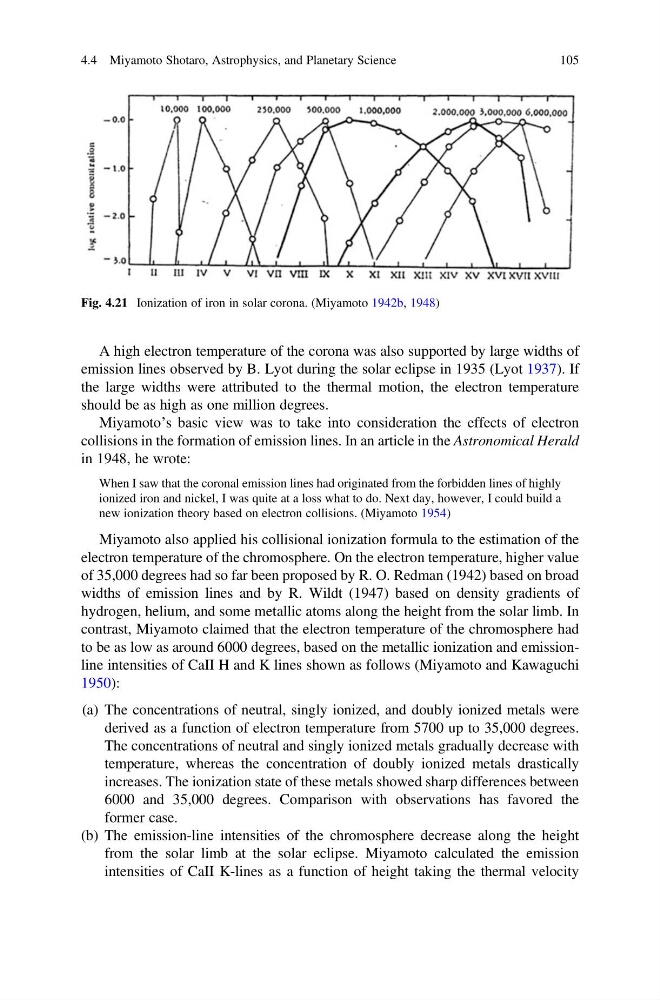
Miyamoto’s basic view was to take into consideration the effects of electron
collisions in the formation of emission lines. In an article in the Astronomical Herald
in 1948, he wrote:
When I saw that the coronal emission lines had originated from the forbidden lines of highly
ionized iron and nickel, I was quite at a loss what to do. Next day, however, I could build a
new ionization theory based on electron collisions. (Miyamoto 1954)
Miyamoto also applied his collisional ionization formula to the estimation of the
electron temperature of the chromosphere. On the electron temperature, higher value
of 35,000 degrees had so far been proposed by R. O. Redman (1942) based on broad
widths of emission lines and by R. Wildt (1947) based on density gradients of
hydrogen, helium, and some metallic atoms along the height from the solar limb. In
contrast, Miyamoto claimed that the electron temperature of the chromosphere had
to be as low as around 6000 degrees, based on the metallic ionization and emissionline intensities of CaII H and K lines shown as follows (Miyamoto and Kawaguchi
1950):
(a) The concentrations of neutral, singly ionized, and doubly ionized metals were
derived as a function of electron temperature from 5700 up to 35,000 degrees.
The concentrations of neutral and singly ionized metals gradually decrease with
temperature, whereas the concentration of doubly ionized metals drastically
increases. The ionization state of these metals showed sharp differences between
6000 and 35,000 degrees. Comparison with observations has favored the
former case.
(b) The emission-line intensities of the chromosphere decrease along the height
from the solar limb at the solar eclipse. Miyamoto calculated the emission
intensities of CaII K-lines as a function of height taking the thermal velocity
Fig. 4.21 Ionization of iron in solar corona. (Miyamoto 1942b, 1948)
4.4 Miyamoto Shotaro, Astrophysics, and Planetary Science
105
emission lines observed by B. Lyot during the solar eclipse in 1935 (Lyot 1937). If
the large widths were attributed to the thermal motion, the electron temperature
should be as high as one million degrees.
Miyamoto’s basic view was to take into consideration the effects of electron
collisions in the formation of emission lines. In an article in the Astronomical Herald
in 1948, he wrote:
When I saw that the coronal emission lines had originated from the forbidden lines of highly
ionized iron and nickel, I was quite at a loss what to do. Next day, however, I could build a
new ionization theory based on electron collisions. (Miyamoto 1954)
Miyamoto also applied his collisional ionization formula to the estimation of the
electron temperature of the chromosphere. On the electron temperature, higher value
of 35,000 degrees had so far been proposed by R. O. Redman (1942) based on broad
widths of emission lines and by R. Wildt (1947) based on density gradients of
hydrogen, helium, and some metallic atoms along the height from the solar limb. In
contrast, Miyamoto claimed that the electron temperature of the chromosphere had
to be as low as around 6000 degrees, based on the metallic ionization and emissionline intensities of CaII H and K lines shown as follows (Miyamoto and Kawaguchi
1950):
(a) The concentrations of neutral, singly ionized, and doubly ionized metals were
derived as a function of electron temperature from 5700 up to 35,000 degrees.
The concentrations of neutral and singly ionized metals gradually decrease with
temperature, whereas the concentration of doubly ionized metals drastically
increases. The ionization state of these metals showed sharp differences between
6000 and 35,000 degrees. Comparison with observations has favored the
former case.
(b) The emission-line intensities of the chromosphere decrease along the height
from the solar limb at the solar eclipse. Miyamoto calculated the emission
intensities of CaII K-lines as a function of height taking the thermal velocity
Fig. 4.21 Ionization of iron in solar corona. (Miyamoto 1942b, 1948)
4.4 Miyamoto Shotaro, Astrophysics, and Planetary Science
105