

4.4.5 Solar Physics
Miyamoto contributed to solar physics, particularly on the physical state of the
corona and chromosphere. The corona exhibits many emission lines and weak
continuum. The origin of coronal emission lines had long been an enigma, and the
lines were attributed to an unidentified chemical element Coronium. In 1941, Bengt
Edlèn (1906–1993) attributed these lines to the multiply ionized iron, from the ninth
order (Fe X at λ6374Å) to the thirteenth order (Fe XIV at λ5303Å) (Edlèn 1941), so
the enigma of Coronium was clearly solved.
To explain the relative intensities of these ions, Miyamoto considered the effects
of collisional ionization and formulated a new ionization formula, which was an
extension of Saha’s equation to the inclusion of collisional terms (Miyamoto 1942b,
1948). Miyamoto applied this formula and derived the electron temperature of the
corona as high as one to two million degrees. The result of his calculation is shown in
Fig. 4.21. The ordinate represents the logarithms of the relative abundance in units of
the concentration of the ion of maximum abundance, and the abscissa denotes the
series of Fe ions in its order. The electron temperature corresponding to each curve is
shown in the upper part. Since the observed iron emission lines ranged from Fe X to
Fe XIV, Miyamoto concluded that the coronal electron temperature should be one to
two million degrees.
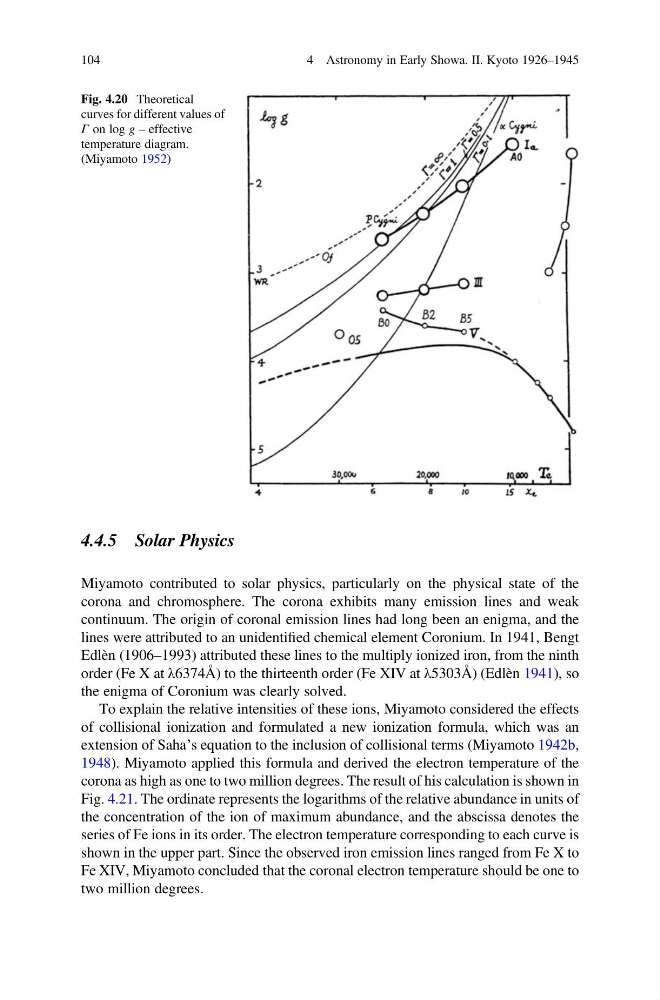
Fig. 4.20 Theoretical
curves for different values of
Γ on log g – effective
temperature diagram.
(Miyamoto 1952)
104
4 Astronomy in Early Showa. II. Kyoto 1926–1945
Miyamoto contributed to solar physics, particularly on the physical state of the
corona and chromosphere. The corona exhibits many emission lines and weak
continuum. The origin of coronal emission lines had long been an enigma, and the
lines were attributed to an unidentified chemical element Coronium. In 1941, Bengt
Edlèn (1906–1993) attributed these lines to the multiply ionized iron, from the ninth
order (Fe X at λ6374Å) to the thirteenth order (Fe XIV at λ5303Å) (Edlèn 1941), so
the enigma of Coronium was clearly solved.
To explain the relative intensities of these ions, Miyamoto considered the effects
of collisional ionization and formulated a new ionization formula, which was an
extension of Saha’s equation to the inclusion of collisional terms (Miyamoto 1942b,
1948). Miyamoto applied this formula and derived the electron temperature of the
corona as high as one to two million degrees. The result of his calculation is shown in
Fig. 4.21. The ordinate represents the logarithms of the relative abundance in units of
the concentration of the ion of maximum abundance, and the abscissa denotes the
series of Fe ions in its order. The electron temperature corresponding to each curve is
shown in the upper part. Since the observed iron emission lines ranged from Fe X to
Fe XIV, Miyamoto concluded that the coronal electron temperature should be one to
two million degrees.
Fig. 4.20 Theoretical
curves for different values of
Γ on log g – effective
temperature diagram.
(Miyamoto 1952)
104
4 Astronomy in Early Showa. II. Kyoto 1926–1945