

In contrast, in the Be type, photoionization takes place mainly from the first
excited energy level and the emission lines are formed through a modified recombination process accompanying some self-absorption of emission lines.
Miyamoto showed that the envelopes of WR, Be, and P Cyg type stars are of the
Be type. He applied this theory to the Balmer decrements of Be stars and found that
the large variety of the observed decrement Hα/Hβ ranging from around 1 to
10 could be explained according to the variety of the envelope size and stellar
temperatures.
2. Stability of stellar envelopes
In 1934, Boris P. Gerasimovič (1889–1937), a Soviet astrophysicist, first
discussed the effect of radiation pressure for the stability of outer envelopes of
stars. He showed that the radiation pressure from ultraviolet radiation could surpass
the gravitational acceleration for supergiants such as P Cygni (Gerasimovič 1934).
He thus developed the theory of a stellar envelope streaming out due to ultraviolet
radiation pressure. His theory was based on the PN type of envelope.
In contrast, Miyamoto considered a similar problem for Be-type envelopes
(Miyamoto 1952). He solved the equation of dynamical equilibrium in a simplified
stellar envelope that is composed of pure ionized hydrogen and in an isothermal
state. The main factors acting for their dynamical stability are gravitational acceleration, g, radiation pressure from ultraviolet radiation, P rad, and gas pressure due to
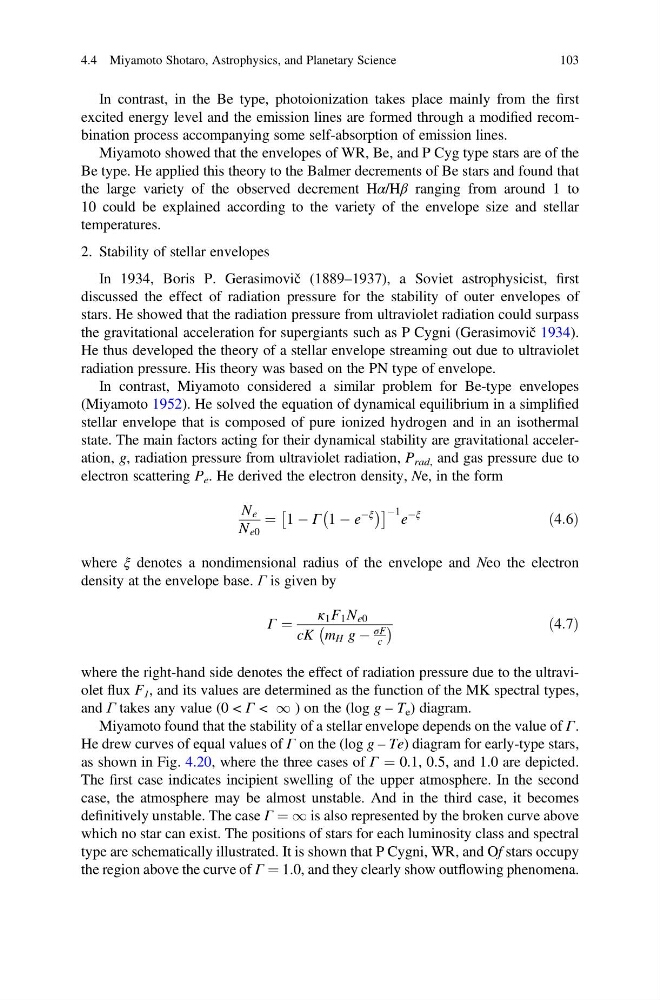
electron scattering P e . He derived the electron density, Ne, in the form
N e
N e0
¼ 1 À Γ 1 À e
Àξ
À
Á
Â
à À1 e
Àξ
ð4:6Þ
where ξ denotes a nondimensional radius of the envelope and Neo the electron
density at the envelope base. Г is given by
Γ ¼
κ 1 F 1 N e0
cK m H g À
σF
c
À
Á
ð4:7Þ
where the right-hand side denotes the effect of radiation pressure due to the ultraviolet flux F 1 , and its values are determined as the function of the MK spectral types,
and Г takes any value (0 < Γ < 1 ) on the (log g – T e ) diagram.
Miyamoto found that the stability of a stellar envelope depends on the value of Γ.
He drew curves of equal values of Γ on the (log g – Te) diagram for early-type stars,
as shown in Fig. 4.20, where the three cases of Γ ¼ 0.1, 0.5, and 1.0 are depicted.
The first case indicates incipient swelling of the upper atmosphere. In the second
case, the atmosphere may be almost unstable. And in the third case, it becomes
definitively unstable. The case Γ ¼ 1 is also represented by the broken curve above
which no star can exist. The positions of stars for each luminosity class and spectral
type are schematically illustrated. It is shown that P Cygni, WR, and Of stars occupy
the region above the curve of Γ ¼ 1.0, and they clearly show outflowing phenomena.
4.4 Miyamoto Shotaro, Astrophysics, and Planetary Science
103
excited energy level and the emission lines are formed through a modified recombination process accompanying some self-absorption of emission lines.
Miyamoto showed that the envelopes of WR, Be, and P Cyg type stars are of the
Be type. He applied this theory to the Balmer decrements of Be stars and found that
the large variety of the observed decrement Hα/Hβ ranging from around 1 to
10 could be explained according to the variety of the envelope size and stellar
temperatures.
2. Stability of stellar envelopes
In 1934, Boris P. Gerasimovič (1889–1937), a Soviet astrophysicist, first
discussed the effect of radiation pressure for the stability of outer envelopes of
stars. He showed that the radiation pressure from ultraviolet radiation could surpass
the gravitational acceleration for supergiants such as P Cygni (Gerasimovič 1934).
He thus developed the theory of a stellar envelope streaming out due to ultraviolet
radiation pressure. His theory was based on the PN type of envelope.
In contrast, Miyamoto considered a similar problem for Be-type envelopes
(Miyamoto 1952). He solved the equation of dynamical equilibrium in a simplified
stellar envelope that is composed of pure ionized hydrogen and in an isothermal
state. The main factors acting for their dynamical stability are gravitational acceleration, g, radiation pressure from ultraviolet radiation, P rad, and gas pressure due to
electron scattering P e . He derived the electron density, Ne, in the form
N e
N e0
¼ 1 À Γ 1 À e
Àξ
À
Á
Â
à À1 e
Àξ
ð4:6Þ
where ξ denotes a nondimensional radius of the envelope and Neo the electron
density at the envelope base. Г is given by
Γ ¼
κ 1 F 1 N e0
cK m H g À
σF
c
À
Á
ð4:7Þ
where the right-hand side denotes the effect of radiation pressure due to the ultraviolet flux F 1 , and its values are determined as the function of the MK spectral types,
and Г takes any value (0 < Γ < 1 ) on the (log g – T e ) diagram.
Miyamoto found that the stability of a stellar envelope depends on the value of Γ.
He drew curves of equal values of Γ on the (log g – Te) diagram for early-type stars,
as shown in Fig. 4.20, where the three cases of Γ ¼ 0.1, 0.5, and 1.0 are depicted.
The first case indicates incipient swelling of the upper atmosphere. In the second
case, the atmosphere may be almost unstable. And in the third case, it becomes
definitively unstable. The case Γ ¼ 1 is also represented by the broken curve above
which no star can exist. The positions of stars for each luminosity class and spectral
type are schematically illustrated. It is shown that P Cygni, WR, and Of stars occupy
the region above the curve of Γ ¼ 1.0, and they clearly show outflowing phenomena.
4.4 Miyamoto Shotaro, Astrophysics, and Planetary Science
103