

In 1949, Miyamoto also considered the atmospheric structure of white dwarfs
based on the theory of model atmosphere, particularly for the atmosphere of Sirius B
(Miyamoto 1949). He supposed that the dominant source of opacity is the boundfree transitions of hydrogen, and he derived their atmospheric structure. He showed
that due to pressure effects, the effective temperature of Sirius B is around 12,500 K,
which is considerably higher than ordinary scales.
4.4.4 Early-Type Emission-Line Stars
1. Envelopes of Early-type stars
The physical parameters of the envelopes of early-type stars greatly differ from those
of planetary nebulae, as shown in Table 4.2. The physical process of emission-line
formation is also different for these objects. Under the assumption that the envelopes
consist of pure hydrogen, Miyamoto distinguished two types of the radiation process:
planetary nebula type (PN type) and Be star type (Be type) (Miyamoto 1942a, 1951).
In the PN type, the photoionization of hydrogen atoms occurs from the ground
energy level and a recombination process takes place, forming emission lines by
cascade transitions. The nebulae are generally transparent for the emission lines.
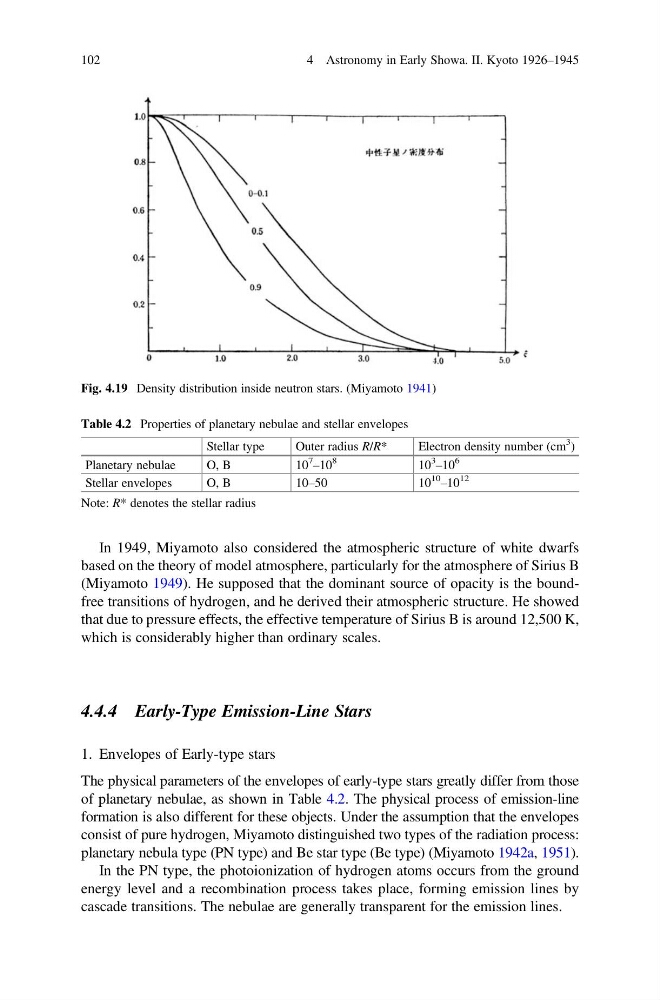
Fig. 4.19 Density distribution inside neutron stars. (Miyamoto 1941)
Table 4.2 Properties of planetary nebulae and stellar envelopes
Stellar type
Outer radius R/R*
Electron density number (cm
3
)
Planetary nebulae
O, B
10
7
–10
8
10
3
–10
6
Stellar envelopes
O, B
10–50
10
10
–10
12
Note: R* denotes the stellar radius
102
4 Astronomy in Early Showa. II. Kyoto 1926–1945
based on the theory of model atmosphere, particularly for the atmosphere of Sirius B
(Miyamoto 1949). He supposed that the dominant source of opacity is the boundfree transitions of hydrogen, and he derived their atmospheric structure. He showed
that due to pressure effects, the effective temperature of Sirius B is around 12,500 K,
which is considerably higher than ordinary scales.
4.4.4 Early-Type Emission-Line Stars
1. Envelopes of Early-type stars
The physical parameters of the envelopes of early-type stars greatly differ from those
of planetary nebulae, as shown in Table 4.2. The physical process of emission-line
formation is also different for these objects. Under the assumption that the envelopes
consist of pure hydrogen, Miyamoto distinguished two types of the radiation process:
planetary nebula type (PN type) and Be star type (Be type) (Miyamoto 1942a, 1951).
In the PN type, the photoionization of hydrogen atoms occurs from the ground
energy level and a recombination process takes place, forming emission lines by
cascade transitions. The nebulae are generally transparent for the emission lines.
Fig. 4.19 Density distribution inside neutron stars. (Miyamoto 1941)
Table 4.2 Properties of planetary nebulae and stellar envelopes
Stellar type
Outer radius R/R*
Electron density number (cm
3
)
Planetary nebulae
O, B
10
7
–10
8
10
3
–10
6
Stellar envelopes
O, B
10–50
10
10
–10
12
Note: R* denotes the stellar radius
102
4 Astronomy in Early Showa. II. Kyoto 1926–1945