

2. Doubly ionized oxygen [O III]
Emission lines at wavelengths λ4958Å, λ5006Å, had long been attributed to an
unknown chemical element Nebulium. It was in 1926 that Ira Bowen identified these
lines as the forbidden lines of doubly ionized oxygen [O III] (Bowen 1927).
Miyamoto (1939) calculated the collisional transition probabilities, one year prior
to the work of Hebb and Menzel (1940), and he applied to the estimation of electron
temperature of planetary nebulae. Miyamoto’s result showed that the electron
temperature lies in a range of 10,000 to 25,000 degrees for most of the nebulae
observed, in good agreement with the results of Menzel’s group (Miyamoto 1939).
4.4.3 Neutron Stars and White Dwarfs
When a star is exhausted, its energy source collapses to some highly condensed state,
as with white dwarfs or neutron stars. The existence of neutron stars was proposed
by Lev D. Landau (Landau 1932), and the stellar structure was studied by Landau
(Landau 1938) and J. R. Oppenheimer and G. M. Volkoff (Oppenheimer and
Volkoff 1939).
In 1941, Miyamoto considered the structure of neutron stars, based on his own
calculation of nuclear exchange force (Miyamoto 1941). He temporarily classified
two types of neutron star: cold neutron stars (N stars), which are composed of pure
neutrons with an absolute zero temperature, and proton-neutron stars (P stars), which
are composed of the same abundance of protons and neutrons. According to his
calculation, the radius and mass of N stars are 40–100 km and 0.001–0.010 solar
mass, respectively, whereas P stars show 200–400 km and 1.1–1.2 solar mass,
respectively.
For N stars, Miyamoto derived the internal density distribution for some case of
parameter α, which represents the relative importance of the pressure due to the
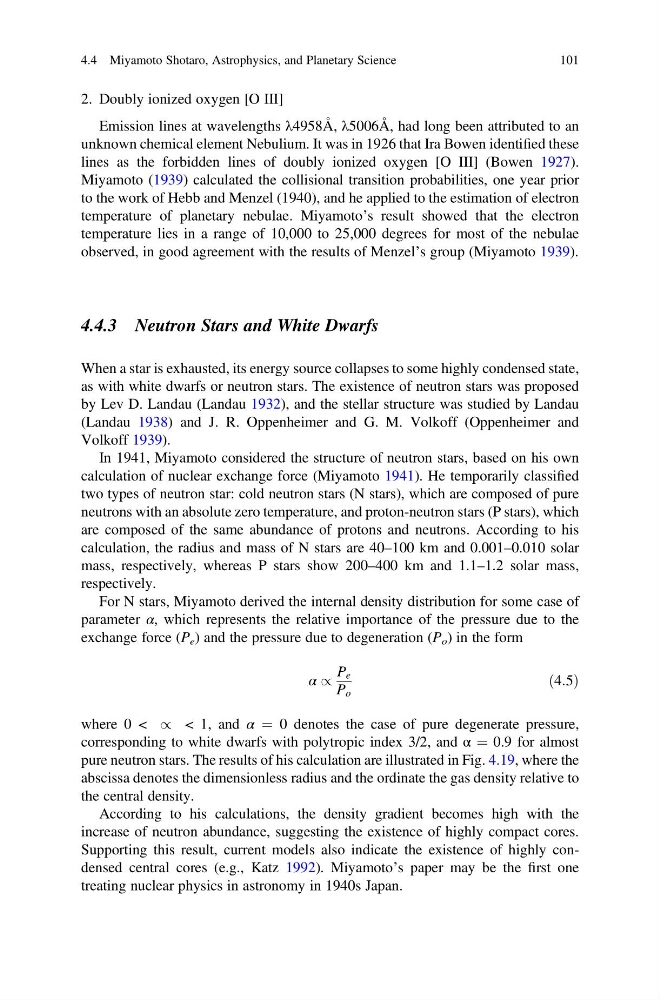
exchange force (P e ) and the pressure due to degeneration (P o ) in the form
α /
P e
P o
ð4:5Þ
where 0 < / < 1, and α ¼ 0 denotes the case of pure degenerate pressure,
corresponding to white dwarfs with polytropic index 3/2, and α ¼ 0.9 for almost
pure neutron stars. The results of his calculation are illustrated in Fig. 4.19, where the
abscissa denotes the dimensionless radius and the ordinate the gas density relative to
the central density.
According to his calculations, the density gradient becomes high with the
increase of neutron abundance, suggesting the existence of highly compact cores.
Supporting this result, current models also indicate the existence of highly condensed central cores (e.g., Katz 1992). Miyamoto’s paper may be the first one
treating nuclear physics in astronomy in 1940s Japan.
4.4 Miyamoto Shotaro, Astrophysics, and Planetary Science
101
Emission lines at wavelengths λ4958Å, λ5006Å, had long been attributed to an
unknown chemical element Nebulium. It was in 1926 that Ira Bowen identified these
lines as the forbidden lines of doubly ionized oxygen [O III] (Bowen 1927).
Miyamoto (1939) calculated the collisional transition probabilities, one year prior
to the work of Hebb and Menzel (1940), and he applied to the estimation of electron
temperature of planetary nebulae. Miyamoto’s result showed that the electron
temperature lies in a range of 10,000 to 25,000 degrees for most of the nebulae
observed, in good agreement with the results of Menzel’s group (Miyamoto 1939).
4.4.3 Neutron Stars and White Dwarfs
When a star is exhausted, its energy source collapses to some highly condensed state,
as with white dwarfs or neutron stars. The existence of neutron stars was proposed
by Lev D. Landau (Landau 1932), and the stellar structure was studied by Landau
(Landau 1938) and J. R. Oppenheimer and G. M. Volkoff (Oppenheimer and
Volkoff 1939).
In 1941, Miyamoto considered the structure of neutron stars, based on his own
calculation of nuclear exchange force (Miyamoto 1941). He temporarily classified
two types of neutron star: cold neutron stars (N stars), which are composed of pure
neutrons with an absolute zero temperature, and proton-neutron stars (P stars), which
are composed of the same abundance of protons and neutrons. According to his
calculation, the radius and mass of N stars are 40–100 km and 0.001–0.010 solar
mass, respectively, whereas P stars show 200–400 km and 1.1–1.2 solar mass,
respectively.
For N stars, Miyamoto derived the internal density distribution for some case of
parameter α, which represents the relative importance of the pressure due to the
exchange force (P e ) and the pressure due to degeneration (P o ) in the form
α /
P e
P o
ð4:5Þ
where 0 < / < 1, and α ¼ 0 denotes the case of pure degenerate pressure,
corresponding to white dwarfs with polytropic index 3/2, and α ¼ 0.9 for almost
pure neutron stars. The results of his calculation are illustrated in Fig. 4.19, where the
abscissa denotes the dimensionless radius and the ordinate the gas density relative to
the central density.
According to his calculations, the density gradient becomes high with the
increase of neutron abundance, suggesting the existence of highly compact cores.
Supporting this result, current models also indicate the existence of highly condensed central cores (e.g., Katz 1992). Miyamoto’s paper may be the first one
treating nuclear physics in astronomy in 1940s Japan.
4.4 Miyamoto Shotaro, Astrophysics, and Planetary Science
101